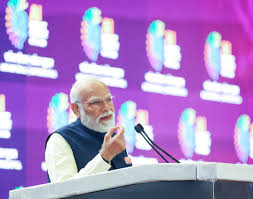
The Indian Institute of Technology (IIT) Delhi is set to host its 57th Annual Convocation on August 8, 2026, in a ceremony that will celebrate academic excellence while highlighting India’s growing leadership in artificial intelligence and advanced research. Prime Minister Narendra Modi will attend the event as the Chief Guest, where he will address graduating students, present the institute’s highest academic honours, and inaugurate ‘Param Pragya’, an AI-powered high-performance supercomputing facility established at IIT Delhi’s Sonipat campus.
The convocation is expected to be one of the institute’s most significant academic events, bringing together graduates, researchers, faculty members, policymakers and industry leaders to celebrate achievements while reinforcing India’s commitment to becoming a global innovation hub.
————————————————–
More Than 3,000 Students to Receive Degrees
This year’s convocation will witness more than 3,000 students receiving degrees across undergraduate, postgraduate and doctoral programmes.
Among the graduating cohort are:
- More than 3,000 graduates
- 587 PhD scholars
- Students from diverse engineering, science, management, design and interdisciplinary programmes
The ceremony represents years of academic dedication and research, while also showcasing IIT Delhi’s contribution to producing highly skilled professionals and innovators.
————————————————–
Prime Minister to Present IIT Delhi’s Highest Academic Honours
A major highlight of the convocation will be the presentation of IIT Delhi’s most prestigious academic awards to meritorious students.
The honours include:
- President’s Gold Medal
- Director’s Gold Medal
- Shankar Dayal Sharma Gold Medal
- Perfect Ten Gold Medals
These awards recognise exceptional academic performance, leadership and all-round excellence demonstrated by graduating students throughout their academic journey.
————————————————–
‘Param Pragya’ Supercomputer: A New Era for AI Research
The centrepiece of this year’s convocation will be the inauguration of ‘Param Pragya’, an AI-powered High-Performance Computing (HPC) facility at IIT Delhi’s Sonipat campus.
The advanced supercomputing system is expected to significantly strengthen the institute’s capabilities in:
- Artificial Intelligence (AI)
- Machine Learning
- Data Science
- High-Performance Computing
- Scientific Simulations
- Computational Engineering
- Climate and Environmental Modelling
- Healthcare Research
- Interdisciplinary Innovation
The new facility will enable researchers to process massive datasets, develop complex AI models and solve computationally intensive scientific problems that require enormous computing power.
————————————————–
Why ‘Param Pragya’ is Important for India
High-performance computing has become the backbone of modern scientific research.
With the launch of Param Pragya, IIT Delhi aims to accelerate research in several emerging fields, including:
- Generative Artificial Intelligence
- Advanced Robotics
- Semiconductor Research
- Cybersecurity
- Quantum Computing Applications
- Space Technology
- Smart Manufacturing
- Biomedical Engineering
Experts believe that enhanced computing infrastructure will enable Indian researchers to compete globally in AI-driven innovation while supporting national initiatives such as Digital India, semiconductor development and advanced scientific research.
————————————————–
Boosting India’s Research Ecosystem
The new supercomputing facility is expected to benefit not only IIT Delhi but also the broader research ecosystem.
Researchers and students will gain access to powerful computational resources for:
- Large-scale AI model training
- Data-intensive scientific projects
- Engineering simulations
- Multidisciplinary research
- Collaborative innovation with industry
- National research missions
The facility is expected to strengthen collaborations between academia, industry and government research organisations.
————————————————–
IIT Delhi’s Growing Global Reputation
Over the years, IIT Delhi has established itself as one of India’s leading institutions for engineering, science and technology.
The institute has consistently expanded its global footprint through:
- International academic collaborations
- Cutting-edge research centres
- Industry partnerships
- Start-up incubation programmes
- Innovation and entrepreneurship initiatives
- Global faculty and student exchanges
Investments in advanced research infrastructure such as Param Pragya further reinforce IIT Delhi’s position among the world’s leading technology institutions.
————————————————–
Artificial Intelligence Becomes Central to Higher Education
The inauguration of an AI-focused supercomputing facility reflects the increasing importance of artificial intelligence in higher education.
Universities across India are expanding investments in:
- AI laboratories
- Supercomputing infrastructure
- Data science programmes
- Robotics research
- Digital engineering
- Advanced analytics
- Computational research
These investments align with India’s broader objective of becoming a global leader in emerging technologies and innovation-driven economic growth.
————————————————–
A Convocation Beyond Degrees
This year’s convocation represents more than an academic graduation ceremony.
It symbolises:
- Recognition of academic excellence.
- India’s investment in research infrastructure.
- Expansion of AI and advanced computing.
- Stronger university-industry collaboration.
- Greater emphasis on innovation-led development.
- Preparing students for technology-driven careers.
The simultaneous celebration of student achievement and inauguration of world-class research infrastructure reflects the evolving role of higher education institutions in driving national development.