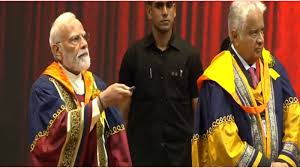
The Indian Institute of Technology (IIT) Delhi marked its 57th Convocation on Saturday, August 8, 2026, with Prime Minister Narendra Modi attending as the Chief Guest and addressing more than 3,000 graduating students.
The ceremony brought together undergraduate, postgraduate and doctoral scholars at a time when India’s premier technical institutions are increasingly being positioned at the centre of the country’s ambitions in artificial intelligence, advanced computing, research and technological innovation.
As part of the ceremony, 587 PhD scholars were among those receiving their degrees. The Prime Minister also presented some of IIT Delhi’s most prestigious academic honours to students who demonstrated exceptional academic performance.
PM Modi’s Message to IIT Delhi Graduates: Keep Learning Beyond the Classroom
In his address, Prime Minister Modi encouraged graduates to remain curious and continue learning even after leaving the institute.
His message centred on a rapidly changing technological environment in which knowledge acquired during a degree may not remain sufficient throughout a professional career.
The Prime Minister urged students to develop the ability to adapt, question, innovate and solve unfamiliar problems rather than limiting themselves to challenges already covered in their academic curriculum.
The message carries particular significance for IIT Delhi graduates entering sectors being transformed by technologies such as artificial intelligence, automation and advanced computing.
The key lessons for graduates
- Learning should continue after graduation
- Curiosity should remain central to professional growth
- Technology requires constant adaptation
- Innovation should focus on real-world challenges
- Graduates should contribute to India’s technological development
587 PhD Scholars Among IIT Delhi’s Graduating Class
A major feature of the IIT Delhi 57th Convocation was the large number of doctoral scholars receiving degrees.
A total of 587 PhD scholars were among the more than 3,000 graduating students.
The figure highlights IIT Delhi’s role not only as an engineering education institution but also as a major centre for advanced research.
Doctoral research has become increasingly important as India seeks to strengthen domestic capabilities in areas such as:
- Artificial intelligence
- Semiconductors
- Advanced materials
- Quantum technologies
- Energy
- Biotechnology
- Data science
- Climate and sustainability
- Advanced manufacturing
The growing emphasis on research also reflects the broader national objective of moving from technology adoption towards technology development.
IIT Delhi Academic Honours Presented to Meritorious Students
The convocation also recognised outstanding academic achievement.
Prime Minister Modi presented IIT Delhi’s prestigious academic honours, including the:
- President’s Gold Medal
- Director’s Gold Medal
- Shankar Dayal Sharma Gold Medal
- Perfect Ten Gold Medals
These honours recognise students who have demonstrated exceptional performance during their academic journey at the institute.
For the graduating batch, the awards added another significant dimension to a ceremony marking the transition from university education to professional and research careers.
‘Param Pragya’: IIT Delhi’s New AI Supercomputing Facility
One of the biggest highlights of the IIT Delhi Convocation 2026 was outside the traditional degree ceremony.
Prime Minister Modi inaugurated Param Pragya, an AI-powered high-performance supercomputing facility established at IIT Delhi’s Sonipat campus.
The facility is expected to strengthen IIT Delhi’s capabilities in artificial intelligence, data science, advanced computing and interdisciplinary research.
The inauguration is significant because access to high-performance computing is increasingly essential for modern research.
Large-scale AI models, complex simulations, scientific computing and data-intensive research can require substantial computational resources. Facilities such as Param Pragya can therefore support researchers working on problems that would be difficult to address using conventional computing infrastructure.
Why Param Pragya Matters for India’s AI Ambitions
Artificial intelligence has rapidly become a strategic area of technology development.
India’s higher education and research institutions are consequently expanding their focus on AI infrastructure, talent development and computational research.
For IIT Delhi, the new facility can potentially strengthen research across several disciplines rather than restricting AI applications to computer science alone.
Potential research areas include:
Artificial Intelligence: Development and testing of advanced AI systems.
Data Science: Processing and analysing large datasets for research and applications.
Scientific Computing: Supporting computationally intensive scientific studies.
Interdisciplinary Research: Bringing engineering, science and other disciplines together around complex problems.
The facility thus represents a broader shift towards building research infrastructure capable of supporting next-generation technologies.
IIT Delhi and India’s Next Generation of Technology Leaders
The significance of the ceremony extends beyond the graduating batch.
IIT Delhi is one of India’s premier institutions for engineering, science, management and research. Its alumni network includes scientists, engineers, entrepreneurs, researchers and professionals working across multiple sectors.
According to IIT Delhi’s 2026-27 prospectus, nearly 66,000 students have graduated from the institute since its inception, including more than 8,000 PhD graduates and more than 22,000 B.Tech graduates.
This long-term institutional footprint makes each convocation part of a much larger story: the creation of professionals and researchers who go on to contribute to India’s technological and economic development.
From IIT Classroom to Real-World Problems
One of the strongest themes emerging from the Prime Minister’s interaction with graduates was the need to move beyond conventional academic achievement.
An IIT education provides students with technical knowledge, but professional life frequently presents problems that do not have straightforward textbook solutions.
The ability to work across disciplines, identify new problems and develop practical solutions is becoming increasingly important as technology changes industries at unprecedented speed.
For young engineers and researchers, this means that graduation is not the end of learning—it is the beginning of a different kind of learning.
Why IIT Delhi Convocation 2026 Matters for Students Across India
The event also carries a broader message for students preparing for higher education.
IITs remain among the most sought-after destinations for engineering and technology education in India. Their emphasis on research, innovation and advanced infrastructure makes them important institutions in the country’s higher education ecosystem.
The IIT Delhi convocation demonstrates three trends that prospective students should watch closely:
1. AI is becoming central to higher education
Artificial intelligence is increasingly influencing academic programmes, research and institutional infrastructure.
2. Research infrastructure is gaining importance
High-performance computing and advanced laboratories are becoming essential for frontier research.
3. Employability increasingly depends on adaptability
A degree provides a foundation, but graduates will increasingly need to update their skills as technologies and industries evolve.
IIT Delhi 57th Convocation 2026: Key Highlights
| Highlight | Details |
|---|---|
| Event | 57th Convocation of IIT Delhi |
| Date | August 8, 2026 |
| Chief Guest | Prime Minister Narendra Modi |
| Graduating students | More than 3,000 |
| PhD scholars | 587 |
| Academic honours | President’s Gold Medal, Director’s Gold Medal, Shankar Dayal Sharma Gold Medal and Perfect Ten Gold Medals |
| Major inauguration | Param Pragya AI-powered high-performance supercomputing facility |
| Location of new facility | IIT Delhi Sonipat campus |
| Key themes | AI, advanced computing, research, innovation and lifelong learning |
The Bigger Picture: Building India’s Technology Talent
The IIT Delhi convocation comes at a time when India is seeking to strengthen its position in emerging technologies.
Artificial intelligence, semiconductor technology, quantum computing, robotics and advanced manufacturing are expected to play an increasingly important role in the country’s economic and strategic future.
That makes the role of institutions such as IIT Delhi particularly important.
Universities are no longer expected merely to produce degree holders. They are increasingly being called upon to develop researchers, innovators, entrepreneurs and problem-solvers capable of addressing complex national and global challenges.
The inauguration of Param Pragya alongside the convocation symbolically connects these two priorities: developing talented graduates and providing researchers with the infrastructure needed to push technological boundaries.
What IIT Delhi Graduates Take Forward
For the graduating students, the ceremony marks the conclusion of one chapter and the beginning of another.
Some will enter industry. Others will pursue higher studies, research, entrepreneurship, public service or careers in emerging technologies.
But the central message from the ceremony remains relevant across all these paths: technical education must be accompanied by curiosity, adaptability and a willingness to keep learning.
As technology continues to evolve, the most valuable skill may not be knowing every answer—but having the ability to find new answers when the questions themselves change.