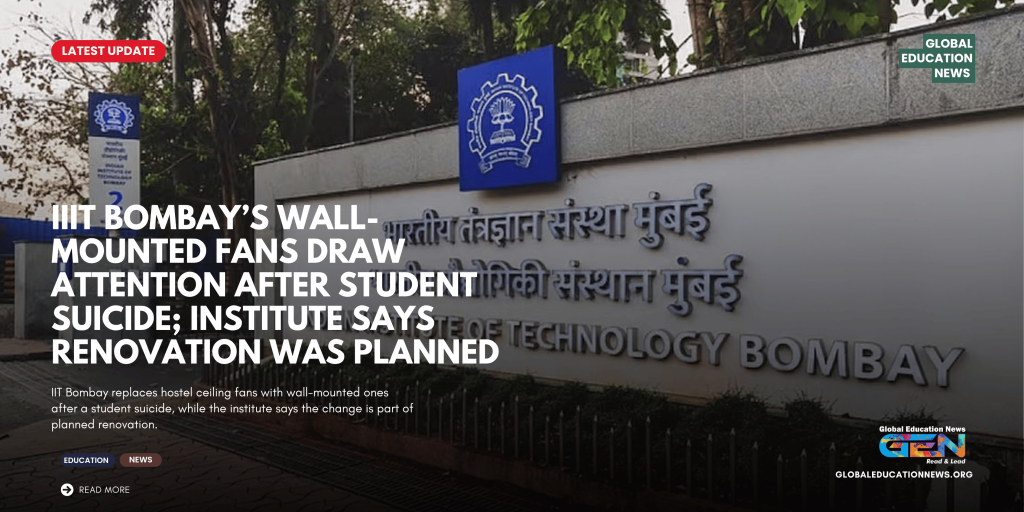
MUMBAI, MAHARASHTRA — IIT Bombay has started replacing ceiling fans with wall-mounted fans in some student hostel rooms, a move that has drawn renewed attention following the suicide of a student at IIT Bombay earlier this month.
The development comes at a sensitive moment for the Powai campus, where the student’s death has prompted protests, questions about student welfare and renewed scrutiny of the institute’s support systems.
IIT Bombay, however, has said the fan replacement should not be viewed as a measure introduced specifically because of the student’s death. According to the institute, the work is part of a planned hostel renovation programme that includes broader infrastructure improvements.
IIT Bombay replaces hostel ceiling fans after student suicide
The replacement of ceiling fans with wall-mounted units has become one of the most visible changes inside IIT Bombay’s residential facilities following the student suicide at IIT Bombay.
The first batch of wall-mounted fans has arrived on campus as part of the ongoing hostel work. The institute has maintained that the renovation was planned independently of the recent student death.
The timing has nevertheless brought the hostel infrastructure into sharper focus.
For students living on campus, hostels are more than accommodation. They are the spaces where academic pressure, personal challenges and everyday university life intersect. That has made the condition and design of residential facilities part of the wider conversation about student wellbeing at IIT Bombay.
Student suicide at IIT Bombay puts student welfare in focus
The recent IIT Bombay student suicide has intensified discussion around the pressures faced by students at one of India’s most competitive higher-education institutions.
The death has also led to protests and demands from students concerning institutional processes and student welfare. Authorities are examining the circumstances surrounding the death, while the institute has faced questions about its response and communication.
It is important to distinguish those developments from the hostel renovation itself.
There is no indication that the wall-mounted fan replacement was announced as a direct response to the student’s death. IIT Bombay has said the renovation was already planned, with the fan replacement forming part of wider hostel infrastructure work.
Why IIT Bombay says the fan replacement is part of renovation
IIT Bombay’s explanation centres on its broader programme of hostel repairs, renovation and retrofitting.
Official tender records show that the institute has been undertaking work involving structural repairs, renovation, retrofitting, additions and alterations in hostel facilities. That provides context for the administration’s statement that the fan replacement is part of planned infrastructure work.
The wall-mounted fans should therefore be viewed within that larger renovation programme, even as their installation has attracted additional attention because of the recent student suicide.
A planned renovation amid heightened scrutiny
The timing is what makes the development notable.
Had the same infrastructure work taken place without the recent student death, it might have received little attention beyond routine campus maintenance. Instead, the IIT Bombay hostel fan replacement has become part of a much broader discussion about residential safety and student welfare.
That distinction matters when assessing what the institute has actually said.
The administration has linked the replacement to renovation. The student death, meanwhile, has triggered a separate and continuing conversation about the pressures and support systems affecting students.
IIT Bombay student suicide raises wider questions about campus support
The death has shifted attention beyond physical infrastructure.
Student welfare at a residential institute involves several layers: access to counselling, grievance mechanisms, academic support, communication during crises and the quality of residential facilities.
Changing a ceiling fan to a wall-mounted model addresses an element of hostel infrastructure. It does not, by itself, answer the wider questions being raised by students following the suicide.
Those questions concern how institutions identify students in difficulty, how quickly students can access support and how administrations respond when serious concerns emerge.
What the IIT Bombay hostel renovation means
The immediate infrastructure change is straightforward: ceiling fans are being replaced with wall-mounted fans in hostel rooms as part of renovation work.
The context is more complicated.
The replacement comes after a student suicide at IIT Bombay, at a time when student welfare and campus support systems are receiving increased attention. But the institute has explicitly maintained that the renovation was planned and that the fan replacement is part of that broader work.
For IIT Bombay, the coming period will therefore involve two parallel conversations—one about hostel renovation and campus infrastructure, and another about student welfare following the recent suicide.
Keeping those two issues distinct is essential to understanding what has changed on campus and why the fan replacement has attracted so much attention.