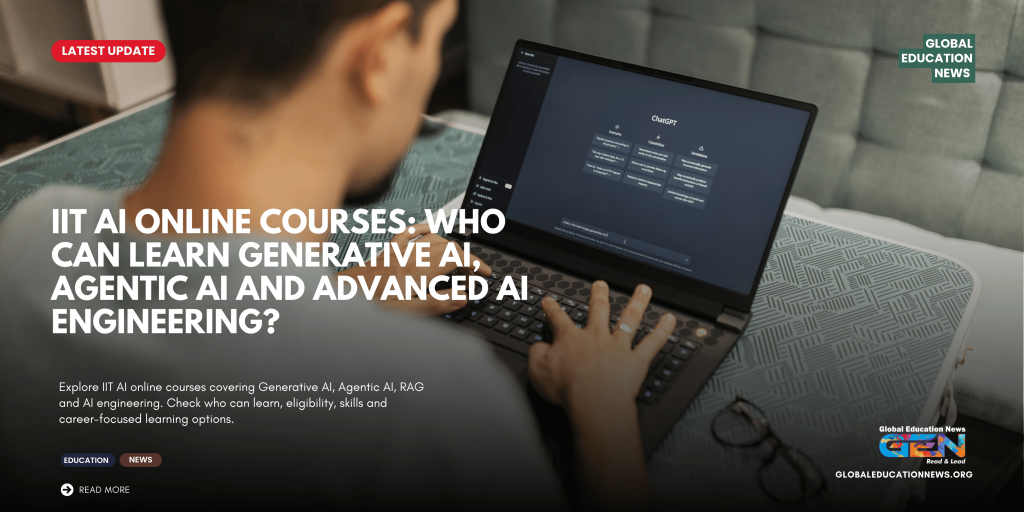
From engineering graduates and software developers to data professionals and technology-focused working professionals, IIT-linked online AI courses are opening new pathways into Generative AI, RAG and Agentic AI.
New Delhi, India — Artificial intelligence is moving quickly from an experimental technology to a practical engineering skill. That shift is also changing what learners expect from an AI course. Instead of learning only how to write better prompts, students and working professionals are increasingly looking for IIT AI online courses that teach them how to build, test and deploy real AI applications.
Several IIT-linked online programmes now cover areas such as machine learning, large language models, Generative AI, Retrieval-Augmented Generation (RAG), AI agents, multi-agent systems, APIs and deployment. The programmes differ significantly in their entry requirements and depth, making it important for learners to understand which type of course matches their background.
IIT AI Online Courses: What Can You Actually Learn?
The new generation of IIT AI programmes goes considerably further than basic chatbot usage.
Depending on the programme, learners can study:
- Machine learning and deep learning
- Python and data structures
- Large language models (LLMs)
- Generative AI
- Prompt engineering
- Retrieval-Augmented Generation (RAG)
- Vector databases
- LLM fine-tuning
- AI agent architecture
- Tool calling and APIs
- Multi-agent systems
- Agent orchestration
- Model Context Protocol (MCP)
- AI evaluation and testing
- Deployment and MLOps
- AI security and monitoring
For example, IIT Kharagpur’s current Executive Post Graduate Certificate in Generative AI & Agentic AI progresses from AI and LLM foundations through RAG and fine-tuning to multimodal and Agentic AI, followed by deployment and AI safety.
That makes these programmes substantially different from short courses focused primarily on prompt writing.
Who Can Learn Through IIT AI Online Courses?
There is no single learner profile.
The right programme depends on a person’s existing education, programming knowledge and career objective.
1. Engineering Graduates
B.Tech, B.E. and related engineering graduates can use online IIT AI programmes to move from conventional software or engineering roles toward AI and machine learning.
For candidates with computer science, information technology, artificial intelligence or electronics backgrounds, advanced programmes may provide a relatively direct route into LLM engineering and Agentic AI.
IIT Kharagpur’s Generative AI and Agentic AI programme, for example, lists B.Tech/M.Tech and B.E./M.E. qualifications in areas including CS, IT, AI and ECE among its eligible backgrounds.
2. Software Developers and Programmers
Developers are another natural audience for IIT Agentic AI courses.
A developer who already understands Python, APIs and software development can concentrate on the next layer: connecting AI models with external tools, databases and applications.
Agentic systems require more than an LLM. They need software components that allow an AI system to retrieve information, call tools, maintain context and execute multi-step workflows.
IIT Kharagpur’s programme specifically lists Python functions, basic data structures and API experience among its prerequisites.
3. Data Scientists and Data Analysts
Professionals already working with data can also build toward advanced AI.
Their existing understanding of data preparation, statistics, SQL and analytical workflows can provide a useful foundation for RAG systems, machine learning and AI applications.
For these learners, the key transition is from analysing data to building systems that can use data intelligently.
4. AI and Machine Learning Professionals
Those already working in AI or ML may not need an introductory course.
Instead, an advanced Generative AI or Agentic AI online course can help them expand into LLM engineering, fine-tuning, RAG, agent architecture and production deployment.
IIT Kharagpur describes its programme as a production-focused pathway covering foundation models, system design and deployment.
5. Working Professionals Looking to Move Into AI
Online delivery makes these programmes particularly relevant to professionals who cannot leave their jobs for a full-time campus programme.
The IIT Kharagpur Generative AI and Agentic AI programme, for instance, is delivered 100% live online over eight months.
For working professionals, however, the weekly workload and technical prerequisites need to be checked before applying.
6. Science and Mathematics Graduates
AI is not restricted to computer science graduates.
Some IIT online AI programmes accept candidates from mathematics, statistics and related science backgrounds. IIT Kharagpur’s programme lists B.Sc./M.Sc. qualifications in CS, Mathematics and Statistics among eligible backgrounds.
However, advanced Agentic AI courses can still require programming and API knowledge. A learner coming from a non-computing background may therefore need to strengthen Python and basic data structures first.
7. Business and Product Professionals
There is also a growing audience of managers, product professionals and business leaders who want to understand how AI can be incorporated into products and organisational workflows.
For this group, the objective does not necessarily have to be becoming an AI engineer.
Understanding how LLMs, RAG, AI agents, automation, evaluation and deployment work can help professionals participate more effectively in AI-related product and business decisions.
Can Beginners Learn AI Through an IIT Online Course?
Yes—but the answer depends on the course.
This distinction is crucial.
A beginner with no programming or AI background may find an advanced Agentic AI programme difficult because these courses can assume familiarity with Python, APIs, mathematics, statistics or machine-learning concepts.
IIT Kharagpur’s current Agentic AI programme, for example, specifies Python, basic data structures, API experience and familiarity with fundamental ML mathematics and statistics as prerequisites.
A complete beginner should therefore consider a staged learning path:
Python → Data & Mathematics → Machine Learning → Deep Learning → Generative AI → RAG → Agentic AI
That route can provide the foundation needed to understand why an AI system behaves the way it does, rather than simply teaching users which buttons or prompts to use.
IIT AI Courses for Different Learner Profiles
| Learner | Useful learning direction |
|---|---|
| School student interested in AI | Python and foundational AI first |
| College engineering student | ML, deep learning and GenAI |
| CS/IT graduate | LLMs, RAG and AI engineering |
| Software developer | Agentic AI, APIs and deployment |
| Data scientist | GenAI, RAG and AI applications |
| AI/ML professional | LLM engineering and multi-agent systems |
| Working professional | Flexible executive AI programme |
| Business/product professional | AI strategy and practical AI applications |
| Non-CS graduate | Python and AI foundations before advanced Agentic AI |
The table should be treated as a learning-path guide rather than a statement that every programme accepts every category of learner. Admission requirements vary by institution and programme.
What Makes an Advanced IIT AI Course Different?
The important question is not simply whether a course contains the word “AI”.
Learners should look at what they actually build.
A stronger technical programme may require participants to create a RAG application, connect an AI model to APIs, build an agent workflow, evaluate model performance or deploy an AI service.
IIT Kharagpur’s current programme, for example, includes projects involving multi-agent systems, deployed Generative AI APIs and an industry capstone.
That practical component matters because AI engineering involves more than generating an impressive response from a chatbot.
A production system must deal with data quality, reliability, security, cost, monitoring and human oversight.
Before Choosing an IIT AI Online Course, Check These 6 Things
Check the eligibility
Look at the required degree, percentage, work experience and technical prerequisites before applying.
Check the programming requirement
If the programme teaches RAG or Agentic AI, find out whether Python and API knowledge are expected.
Check the curriculum
Look beyond “Generative AI”. Check whether the syllabus actually includes RAG, agents, deployment, evaluation and related engineering concepts.
Check the learning format
Some programmes are fully online, while others may include campus components, examinations or optional in-person activities.
Check the credential
A postgraduate diploma, executive postgraduate certificate and certificate are different credentials. Learners should read exactly what the institution awards.
Check the project component
A programme involving substantial projects can provide a different learning experience from one based mainly on lectures.
IIT AI Online Courses Are Expanding the Definition of AI Learning
The biggest change is happening in the skills being taught.
AI education is moving from “How do I prompt an AI model?” toward “How do I build an AI system that can work with information, tools and other software?”
That is where RAG, AI agents, orchestration, APIs, evaluation and deployment enter the picture.
For students, graduates and working professionals, the right starting point will depend on their existing technical foundation. Beginners may need to build programming and AI fundamentals first, while developers and AI professionals can move more directly into advanced Agentic AI engineering.
The result is a broader AI learning ecosystem in which an IIT online programme can serve very different purposes—from building foundational machine-learning knowledge to developing production-oriented Generative AI and autonomous-agent systems.