Date: October 21, 2026
Place: Mumbai, Maharashtra
Education News: Student Mental Health, Academic Pressure and Higher Education
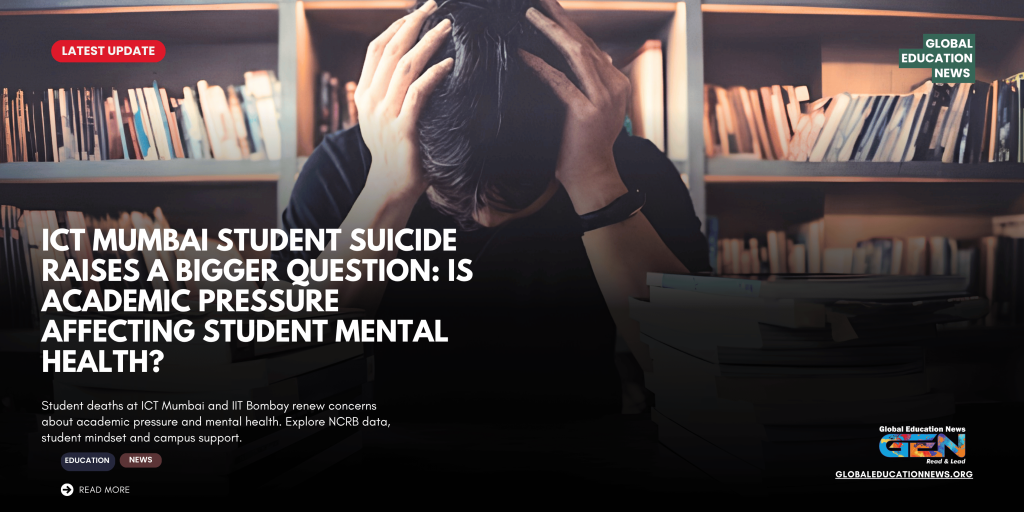
Mumbai, Education news: Recent student deaths at prominent institutions have renewed concerns about academic pressure, emotional well-being and the support systems available to students in Indian colleges. The death of a student at Mumbai’s Institute of Chemical Technology (ICT) on October 20, followed by the September death of IIT Bombay student Sahil Wakode, has brought student welfare back into focus.
Behind examination schedules, grades, rankings and placement statistics are young people managing expectations from families, teachers, peers and themselves. For some students, academic difficulties can become entangled with anxiety, loneliness, financial worries or fear about the future. These challenges do not affect every student in the same way, and no single explanation should be assumed for an individual death.
The broader question for India’s education system is whether institutions are doing enough to ensure that students can seek support early, discuss difficulties without fear of humiliation and understand that one examination or academic setback does not define their future.
Recent Student Deaths Put Campus Mental Health Under the Spotlight
The latest incidents have intensified discussions about how universities respond when students experience distress and how their welfare systems operate beyond academic performance.
What happened at Mumbai’s Institute of Chemical Technology?
A second-year chemical engineering student at ICT in Mumbai died on October 20, 2026, according to reports published the following day. The incident prompted renewed concern about student well-being and the availability of timely mental health support.
The circumstances surrounding an individual death should be established through the appropriate investigation. It would be irresponsible to attribute the incident to academic pressure alone without verified evidence.
Why is the IIT Bombay case still being discussed?
In September 2026, IIT Bombay student Sahil Wakode died following an examination-related incident. The death prompted campus protests and questions about student welfare, institutional communication and how sensitive academic matters are handled.
IIT Bombay stated that the student had been counselled and that disciplinary action had not been initiated. His family raised allegations concerning the circumstances preceding his death, including alleged harassment and caste-based discrimination. These allegations and the circumstances of the death have been subject to investigation.
The case highlights an important issue for colleges: students need clear, fair and proportionate academic procedures, as well as accessible support when they are struggling. The investigation must establish the facts rather than allowing speculation to become the explanation.
These incidents are not proof that academic pressure alone causes suicide. They are reminders that student welfare, early support and transparent institutional processes deserve serious attention.
How Does Academic Pressure Affect a Student’s Mindset?
Academic pressure is not simply about having too much homework. It can also arise from what students believe poor performance might mean for their identity, family relationships, financial future or career prospects.
1. Fear of failure can feel bigger than the result itself
When students believe that only top marks, a prestigious college or a high-paying job will make them successful, an academic setback can feel like a judgment on their entire future.
A low score, failed subject or rejected application may then be interpreted as proof that they are not capable, even though one result cannot measure a person’s complete ability or potential.
What students need to understand: A disappointing result is information about a particular performance, not a final verdict on their worth or future.
2. Comparing themselves with classmates can increase stress
Students constantly see the visible achievements of others: high grades, internships, scholarships, awards and placement offers. They may not see the uncertainty, setbacks or personal difficulties behind those achievements.
Comparison can become particularly difficult in highly competitive courses, where students who previously performed well may suddenly find themselves among many equally talented peers.
Colleges can help by recognising different strengths and pathways instead of communicating that there is only one acceptable version of success.
3. Family expectations may become difficult to communicate
Parents often encourage academic achievement because they want their children to have secure futures. However, when expectations are communicated mainly through marks, ranks or comparisons, students may become reluctant to admit that they are struggling.
Some may fear disappointing their families or being seen as ungrateful for the sacrifices made for their education.
Families can make a difference by asking what support a student needs, listening without immediately judging and separating the child’s well-being from the latest academic result.
4. Moving away from home can create emotional challenges
For students living in hostels or moving to another city for college, the transition may involve homesickness, unfamiliar routines, new friendships and greater independence.
A student can be surrounded by classmates and still feel isolated. Having people nearby does not automatically mean someone feels comfortable discussing personal worries.
Accessible mentors, supportive hostel communities, peer groups and confidential counselling can help students build connections before difficulties become overwhelming.
5. Uncertainty about careers can add another layer of stress
Students may worry about employment, internships, competitive examinations, education loans or whether their degree will lead to a stable career.
When a student believes there is only one route to success, uncertainty can become harder to manage.
Career counselling should therefore explain alternative pathways, further-study options and realistic employment prospects—not merely celebrate a small number of high-profile placements.
Why Student Mental Health Is a National Education Issue
The concern extends beyond individual colleges. National data show that student deaths by suicide remain a serious public-health issue.
According to the National Crime Records Bureau’s Accidental Deaths & Suicides in India 2024 report, India recorded 14,488 student deaths by suicide in 2024. That was higher than the 13,892 recorded in 2023. These figures represent recorded deaths and do not, by themselves, explain the circumstances or causes behind each case.
| Indicator | Reported figure |
|---|---|
| Student deaths by suicide in 2024 | 14,488 |
| Student deaths by suicide in 2023 | 13,892 |
| Difference between the two years | 596 |
| Increase from 2023 to 2024 | Approximately 4.3% |
The figures should be understood as a warning about the scale of the problem, not as evidence that every case has the same cause. The NCRB categorises recorded incidents, while individual experiences may involve multiple personal, social, educational or economic factors.
The data strengthen the case for better prevention, timely mental health support and institutional systems that respond to students’ needs.
Are Indian Colleges Doing Enough to Support Students?
Universities have a responsibility to provide more than classrooms, examinations and career services. Student well-being should be part of everyday campus life rather than a service students discover only when they reach a crisis.
The University Grants Commission’s 2026 policy framework on mental health and well-being for higher education institutions outlines measures such as mental health and well-being centres, monitoring committees, crisis-management arrangements and greater awareness among faculty and students.
The framework is a significant policy step. Its practical value will depend on how effectively institutions implement the measures, make services accessible and ensure that students trust the support available.
What colleges can improve
- Confidential counselling: Students should know how to access trained professionals and what confidentiality protections apply.
- Early support: Faculty and mentors should be able to recognise signs of distress and refer students to appropriate help without trying to diagnose them.
- Fair academic procedures: Examination and disciplinary rules should be clear, proportionate and communicated respectfully.
- Reasonable access to support: Counselling should be available at times and through channels students can realistically use.
- Better grievance redressal: Students should have safe ways to raise concerns about harassment, discrimination, bullying or unfair treatment.
- Support after a campus crisis: Institutions should provide appropriate help to classmates, friends, faculty and others affected by a student’s death.
- Regular review: Colleges should assess whether students know about support services and whether those services are meeting their needs.
A counselling office alone cannot solve every problem. A supportive campus also depends on how teachers speak to students, how institutions respond to complaints and whether asking for help is treated as normal rather than shameful.
What Can Parents and Teachers Do When a Student Is Struggling?
Support does not require having every answer. Often, the first step is to listen and take a student’s concerns seriously.
For parents
Ask open questions about how the student is coping, not only whether they are meeting academic targets. Avoid comparing them with relatives, friends or classmates. If a student is struggling, work together to identify practical and professional support.
For teachers and faculty
Correct academic mistakes without humiliating students. Explain consequences clearly, make referral options known and avoid assuming that a high-performing student is always coping well.
For college administrators
Make counselling, mentoring and grievance channels visible. Ensure that students can raise concerns without fear of retaliation, and establish clear procedures for urgent situations.
For classmates and friends
Listen without dismissing a friend’s concerns or promising to keep serious safety concerns secret. If someone seems overwhelmed or says they may not be safe, involve a trusted adult, campus counsellor or qualified professional promptly.
What Can Students Do When Academic Pressure Feels Overwhelming?
Students do not have to wait until a problem becomes severe before asking for help.
- Talk to someone trustworthy. A parent, friend, teacher, mentor or counsellor can help you work through a difficult situation.
- Break large tasks into smaller steps. Focus on what can reasonably be done today rather than trying to solve every future problem at once.
- Ask for academic support early. Discuss difficult subjects, deadlines or examination concerns with the relevant faculty member.
- Make room for basic well-being. Sleep, regular meals, movement and time away from studying can support concentration and emotional health.
- Seek professional help when needed. Persistent distress, anxiety or difficulty functioning deserves attention from a qualified mental health professional.
A student does not need to prove that their situation is the worst in the class to deserve support. Seeking help is a sensible response to difficulty, not a sign of failure.
Frequently Asked Questions (FAQs)
1. Why is student mental health receiving renewed attention in India?
Recent deaths at institutions including ICT Mumbai and IIT Bombay, together with national student-suicide data, have renewed questions about academic pressure, campus support, institutional accountability and access to mental health care.
2. Does academic pressure alone cause student suicide?
No single cause should be assumed. Individual cases can involve a range of personal, social, health, family, financial or academic circumstances. The circumstances of each death must be established through evidence and appropriate investigation.
3. How many student deaths by suicide were recorded in India in 2024?
The NCRB’s Accidental Deaths & Suicides in India 2024 report recorded 14,488 student deaths by suicide in 2024, compared with 13,892 in 2023.
4. What happened in the recent IIT Bombay case?
IIT Bombay student Sahil Wakode died in September 2026 following an examination-related incident. The death prompted student protests and scrutiny of campus welfare. His family raised allegations about the circumstances preceding his death, and the matter has been subject to investigation.
5. What support should colleges provide?
Colleges should make professional counselling accessible, establish clear grievance procedures, train faculty to respond appropriately to student distress and ensure that students know how to obtain help.
6. How can parents help students facing academic pressure?
Parents can listen without judgement, avoid comparisons, recognise effort and progress, and help students access academic or professional support when needed.
7. Where can students in India seek mental health support?
Students can contact a trusted adult, a campus counsellor or a qualified mental health professional. India’s Tele-MANAS mental health support service can be reached at 14416. If someone is in immediate danger, seek urgent help from local emergency services and a trusted adult.
Conclusion: A Student Is More Than Their Marks
The recent deaths at ICT Mumbai and IIT Bombay have brought difficult questions about student welfare into public discussion. These cases should be treated with dignity, and their circumstances should be established through proper investigation rather than speculation.
India’s education system must continue to pursue academic excellence, but excellence should not come at the expense of students’ emotional well-being. Colleges need accessible counselling, fair academic procedures, trusted grievance mechanisms and a culture in which students can admit they are struggling without fear of humiliation.
Families and teachers also have a role to play by making it clear that setbacks can be addressed and that a student’s future is not determined by one examination, one disciplinary matter or one difficult semester.
Global Education News calls for continued attention to student mental health, responsible campus policies and practical support systems that help every student learn, grow and seek help when needed.