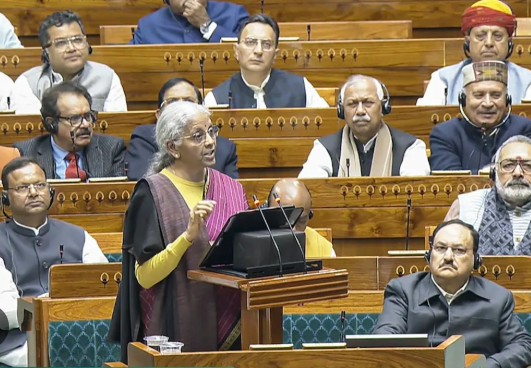
The Union Budget 2026-27, presented by Finance Minister Nirmala Sitharaman, places education, healthcare education and skilling at the centre of India’s long-term growth agenda. With a projected allocation of ₹1.39 lakh crore — an increase of over 8% from the previous year — the government aims to build an ecosystem that enhances employability, fosters innovation and bridges the gap between academia and industry needs.
1. Significant Increase in Education Allocation
- Total outlay: ₹1.39 lakh crore — highest ever for the education ministry.
- Reflects a targeted shift toward quality education, digital learning and skill-oriented programmes.
- Funds distributed across school education, higher education and specialised skilling initiatives.
Key Allocations:
- School Education: ₹83,562 crore
- Higher Education: ₹55,727 crore
- Increase focused on infrastructure, teacher training, research support and short-cycle skilling programmes.
2. Transformative Vision for Healthcare and Medical Education
Budget 2026-27 introduces deep reforms to strengthen medical training, research, biopharma and allied health skills:
a. Allied Health & Care Ecosystem
- Expansion across 10 disciplines including optometry, radiology, anesthesia and behavioural health.
- Target to train 100,000 Allied Health Professionals (AHPs) in five years.
b. Clinical and Research Infrastructure
- Creation of 1,000 accredited clinical trial sites to bolster practical exposure in medical research.
- Increased funding for Indian Council of Medical Research (ICMR).
c. Biopharma Shakti Initiative
- ₹10,000 crore over five years to build an end-to-end biopharmaceutical ecosystem.
- Focus on innovation, research capacity and global standards for biologics and biosimilars.
d. NIMHANS, AIIMS & Ayurveda Expansion
- A second NIMHANS-style mental health institute proposed in north India.
- New All India Institutes of Ayurveda to boost traditional medicine education.
3. Creative & Digital Skills: AVGC and Content Creation Labs
One of the most striking announcements is the focus on Animation, Visual Effects, Gaming & Comics (AVGC):
- 15,000 content creation labs in secondary schools and 500 labs in colleges nationwide.
- Labs designed to provide digital media, design, gaming and creative tech skills right from school level.
- Part of an effort to make India a global hub for creative talent, with projected 2 million professionals needed by 2030.
4. Infrastructure and Equity in Higher Education
a. University Townships
- Proposal for five integrated university townships near industrial and logistic corridors.
- Aim: Blend education with research and industry exposure.
b. Girls’ Hostels in Every District
- Major push to enhance female participation in higher education and STEM fields.
- Addresses access barriers and promotes gender equity across disciplines.
5. Alignment with Industry Needs: Skilling to Employment
The Budget aims to close the skills-employment gap by connecting education programmes with real-world job markets:
- Formation of a High-Powered “Education to Employment” Committee to integrate services with industry demands.
- Emphasis on shorter skill courses, digital learning pathways and corporate readiness training.
6. Strategic Outcomes & Long-Term Impact
Expected Benefits
✔ Prepares a future-ready workforce with competencies in healthcare, digital media, AI and creative industries.
✔ Strengthens India’s global competitiveness in education, research and creative technology.
✔ Encourages inclusive participation through equity-focused initiatives.