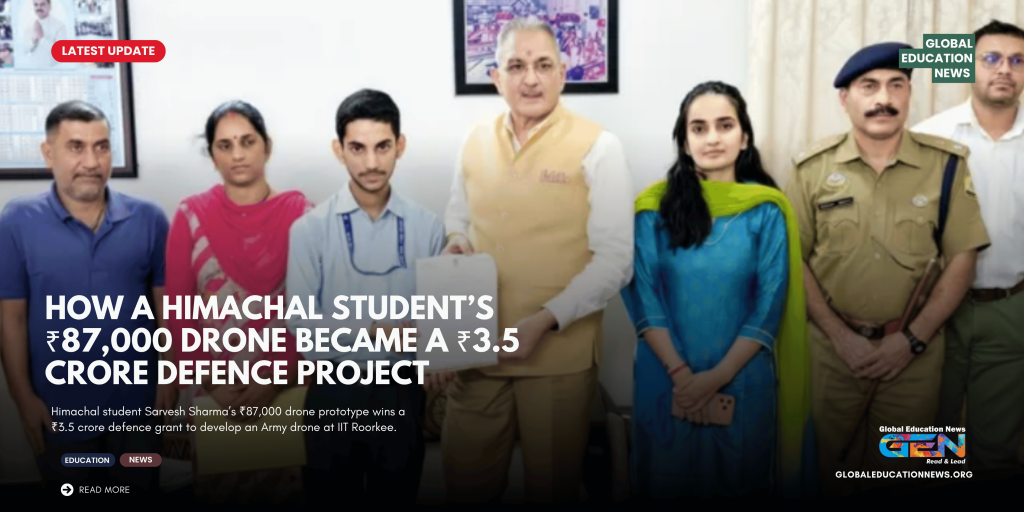
HAMIRPUR, HIMACHAL PRADESH — A small drone project built by a Himachal Pradesh polytechnic student for about ₹87,000 has now become a ₹3.5 crore defence innovation project.
Sarvesh Sharma, a fifth-semester Computer Science student at Government Polytechnic College, Hamirpur, has secured Ministry of Defence support to develop the indigenous Rudra Edge T-1 (Spectra) drone for Indian Army border surveillance. The project is being taken forward under the Defence Innovation Organisation (DIO) and Innovations for Defence Excellence (iDEX) framework.
The proposed drone has been described as being designed to reduce the risk of detection by enemy radar and withstand electronic jamming. Those are development objectives, however, rather than capabilities that have already been demonstrated; the final performance will depend on the development and testing process.
For Sharma, the story is as much about access to opportunity as it is about technology. He comes from Bahanvi village in Hamirpur, attended a government school and is the son of a daily-wage labourer. His mother is a homemaker, according to reports.
From ₹87,000 Prototype to ₹3.5 Crore Defence Project
The turning point came at a national-level Open Cardboard Drone Competition organised by IIT Jodhpur and the Konark Corps.
Around 50 teams from institutions across India participated. Sharma’s team finished fourth and received ₹10 lakh in prize money. The competition exposed the students to surveillance challenges faced by forces operating in difficult border environments and encouraged Sharma to develop his idea further.
He then invested about ₹87,000 in developing his prototype and preparing a project proposal. That proposal was subsequently submitted through the Defence Innovation Organisation and iDEX route and received approval for the ₹3.5 crore grant.
The scale of the jump is striking: a project that began as a student-built prototype has moved into a formal defence innovation programme.
Rudra Edge T-1: What the Army Drone Project Is About
The Rudra Edge T-1 (Spectra) project is intended for surveillance applications in challenging border and high-altitude environments.
Reports describe radar-evasion and resistance to electronic interference among the project’s intended design goals. But the distinction matters: the drone is still being developed, and its final capabilities cannot be treated as established until the project completes development and testing.
The project therefore represents a development programme rather than a finished operational system.
That distinction also makes the next stage crucial.
IIT Roorkee Becomes the Next Stop
The Ministry of Defence has linked the project with an incubation facility at IIT Roorkee, where Sharma will have access to laboratory facilities and professional support as development continues.
The project has a target completion period of 20 months.
The move from a government polytechnic in Hamirpur to an IIT-backed incubation environment marks a significant change in the scale of the project. What began with a student prototype will now undergo a more structured development process with institutional support.
ETDefence has highlighted this transition as an example of how student-led engineering projects can enter India’s formal defence-technology pipeline.
A Government-School Student at the Centre of a Defence Innovation Story
The personal journey behind the project has drawn almost as much attention as the drone itself.
Sharma studied at a government school in Bahanvi before joining Government Polytechnic College, Hamirpur. His father works as a daily-wage labourer, while his mother is a homemaker.
His route into defence innovation did not begin at a major engineering institute. It began with a student competition, a modest prototype and an idea that he continued developing after the competition ended.
That trajectory is significant for India’s expanding focus on student innovation: the project shows how technical education outside the country’s most prominent engineering institutions can connect with national research and defence programmes when an idea progresses beyond the classroom.
Governor Kavinder Gupta Felicitates Sarvesh Sharma
Himachal Pradesh Governor Kavinder Gupta felicitated Sharma on September 23 after news of the ₹3.5 crore grant emerged.
The Governor praised the achievement in the context of indigenous technological development and India’s broader push for domestic defence capabilities.
For Himachal Pradesh, the recognition also puts the state’s government technical-education ecosystem in the spotlight.
What Happens Next for the Himachal Drone Project?
The immediate challenge is no longer simply building a prototype. Sharma and his team must take the project through the next stages of development at IIT Roorkee, with a 20-month target.
The drone’s reported radar-related and electronic-resilience capabilities remain objectives to be developed and tested, rather than results that can already be assumed.
That makes the coming months the real test of the project.
A ₹87,000 student experiment has secured government backing, a ₹3.5 crore development grant and an IIT incubation facility. The next chapter will determine whether the idea can make the difficult transition from a promising prototype to a validated defence technology project.