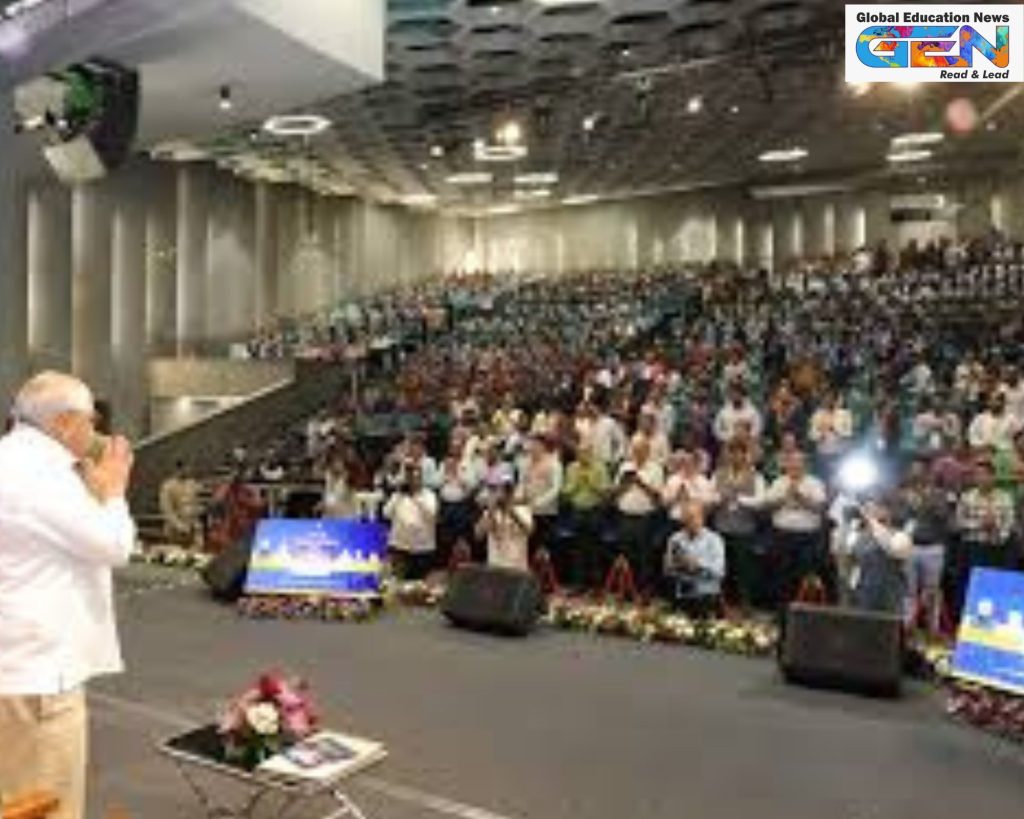
On December 12, 2025, Gujarat Chief Minister Bhupendra Patel marked a pivotal moment in the state’s educational landscape by disbursing over Rs 370 crore in scholarship aid directly to the bank accounts of more than 13 lakh students via Direct Benefit Transfer (DBT). This initiative, spanning four flagship schemes—Namo Lakshmi Yojana, Namo Saraswati Vigyan Sadhana Yojana, Mukhyamantri Gyan Sadhana Merit Scholarship Yojana, and Mukhyamantri Setu Merit Scholarship Yojana—underscores Gujarat’s unwavering commitment to accessible, merit-driven education. Drawing from Prime Minister Narendra Modi’s foundational vision of “KG to PG” seamless learning, the event in Gandhinagar highlighted transformative progress: from 775 colleges in 2001 to over 3,200 today, and medical seats expanding from 1,175 to 7,000+. Yet, as enrollment surges and dropout rates plummet, questions linger on sustainability and broader reach. This analysis dissects the schemes’ mechanics, measurable impacts, and strategic implications for a “Viksit Gujarat” by 2047.
Namo Lakshmi Yojana: Championing Girls’ Empowerment Through Financial Lifelines
Launched to echo the national “Beti Bachao Beti Padhao” ethos, this scheme targets girl students from economically modest backgrounds, providing a total of Rs 50,000 over four years (Classes 9–12). Funds are disbursed annually—Rs 5,000 in Class 9, Rs 6,000 in Class 10, Rs 10,000 in Class 11, and Rs 15,000 in Class 12—directly to Aadhaar-linked accounts, ensuring transparency and ease.
- Eligibility Criteria: Open to girls in government, aided, or private schools with family income below Rs 6 lakh annually; no cap on siblings, broadening access.
- Cumulative Impact: Over Rs 1,033 crore disbursed to 10.49 lakh beneficiaries to date, yielding a 73% spike in girls’ attendance and 13.59% rise in Class 12 enrollments; dropout rates have nosedived from 37% to under 2%.
- Broader Ramifications: By alleviating financial barriers, the scheme fosters gender parity in STEM and higher education, aligning with SDG 4 (Quality Education). Critics note urban-rural disparities persist, with rural uptake at 65% versus 85% in cities, urging targeted awareness drives.
- Success Metrics: Over 24,000 girls in medical streams have benefited via linked initiatives like Mukhyamantri Kanya Kelavani Nidhi Yojana, potentially adding 5,000+ female doctors annually by 2030.
This yojana isn’t just aid—it’s a bridge to economic independence, transforming family dynamics in a state where female labor participation lags at 25%.
Namo Saraswati Vigyan Sadhana Yojana: Fueling Science Ambitions Amid Industrial Boom
Aimed at nurturing future innovators for Gujarat’s thriving sectors like semiconductors and renewables, this scheme offers Rs 25,000 total over two years (Rs 10,000 in Class 11, Rs 15,000 in Class 12) to science stream students, easing the Rs 20,000–30,000 annual tuition burden.
- Eligibility Criteria: Students in government or aided schools opting for science; family income under Rs 8 lakh; merit-based selection via Class 10 scores above 80%.
- Disbursement Stats: Rs 151.84 crore to 1.5 lakh students, driving a 6.34% enrollment surge in science streams—from sparse village offerings to 2,834 schools now equipped.
- Strategic Value: With industries investing Rs 50,000 crore in Gujarat’s GIFT City and Dholera, this prepares a skilled workforce; early data shows 15% higher JEE/NEET qualifiers among beneficiaries.
- Challenges and Outlook: While engineering colleges have doubled to 288 since 2001, faculty shortages in rural science labs (30% vacancies) could dilute gains—recommend integrating AI-driven tutoring for equity.
By prioritizing vigyan (science), the scheme positions Gujarat as India’s “Knowledge Hub,” potentially boosting GDP contributions from education by 2–3% over the next decade.
Mukhyamantri Gyan Sadhana Merit Scholarship Yojana: Rewarding Academic Excellence from the Grassroots
This merit-focused program rewards consistent performers from primary levels, offering Rs 20,000 annually for Classes 9–10 and Rs 25,000 for Classes 11–12, with DBT ensuring zero leakage.
- Eligibility Criteria: Students from government/aided primary schools scoring 90%+ in consecutive exams; reserved for SC/ST/OBC/EWS categories (40% quota).
- Reach and Results: Rs 86.14 crore to 50,000 students, correlating with a 12% uptick in top-10% board toppers from low-income brackets.
- Holistic Benefits: Encourages continuity from rural primaries (now 95% digitized) to urban colleges, reducing urban migration pressures; linked to Shala Praveshotsav for 98% enrollment rates.
- Evaluation: Independent audits show 85% retention post-scholarship, but scaling to 1 lakh beneficiaries requires Rs 200 crore more—vital for Viksit Bharat’s talent pipeline.
It embodies “gyan sadhana” (knowledge pursuit), turning merit into mobility for 20% of Gujarat’s underprivileged youth.
Mukhyamantri Setu Merit Scholarship Yojana: Bridging Gaps for Seamless Academic Progression
Complementing the above, this “gyan setu” (knowledge bridge) scheme provides Rs 5,000–7,000 for government school students and Rs 20,000–25,000 for private ones annually, targeting smooth transitions across streams.
- Eligibility Criteria: Top 30,000 performers in Class 8/10 exams; income ceiling Rs 4 lakh; emphasis on inter-district equity.
- Financial Footprint: Rs 61.27 crore to 60,000 students, facilitating 18% more cross-stream shifts (e.g., arts to commerce).
- Impact Assessment: Has lowered discontinuation by 22% in transitional years, with 70% beneficiaries pursuing higher education; integrates with Yuva Swabhiman for skill add-ons.
- Future Potential: Amid 3,200+ colleges, it could halve equity gaps if extended to PG levels, addressing the 15% postgraduate dropout in tier-2 cities.
As a “setu,” it connects aspirations to opportunities, fortifying Gujarat’s 1.2 million annual school leavers.
Historical Context and Systemic Transformations: From Modi’s 2001 Legacy to 2025 Milestones
Gujarat’s arc—from Modi’s village-to-village campaigns auctioning gifts for girls’ education to today’s DBT revolution—reflects a 300% infrastructure leap. Total aid now exceeds Rs 1,332 crore for 13.5 lakh children, with digital platforms like the CGMS portal streamlining applications (95% online approvals). Officials like Deputy CM Harsh Sanghavi hail it as “people-centric governance,” while Education Minister Pradyuman Vaja envisions it as the bedrock for empowered societies.
- Quantitative Leaps: Village science schools: From negligible to 2,834; overall dropout: 37% to <2%.
- Qualitative Shifts: PM Modi’s “Beti Padhao” momentum has inspired state innovations, with 73% female attendance gains signaling cultural change.
- Policy Synergies: Ties into national frameworks like NEP 2020, but state-specific tweaks (e.g., science incentives) amplify local needs.
- Risks Ahead: Budgetary pressures from Rs 1.5 lakh crore education allocation demand PPP infusions; monitoring via AI could curb 5% fraud risks.
This evolution isn’t serendipity—it’s deliberate policy yielding a 20% rise in Gujarat’s Human Development Index since 2014.