The 20th G20 Leaders’ Summit commenced on November 22, 2025, at the Johannesburg Expo Centre in Nasrec, marking a milestone as the first-ever hosting on the African continent. Under South Africa’s presidency, the three-day event (November 21-23) adopts the theme “Solidarity, Equality and Sustainability,” prioritizing disaster resilience, debt sustainability for low-income nations, just energy transitions, and critical minerals for inclusive growth. Over 20 world leaders, including India’s Prime Minister Narendra Modi, converged amid heightened global tensions, with the United States notably absent due to a diplomatic boycott over disputed claims of racial mistreatment in the host nation.
- Venue and Logistics: Held at the Johannesburg Expo Centre, the summit features plenary sessions, bilateral meetings, and side events, with enhanced security following minor protests outside over unemployment, immigration, and gender-based violence.
- Attendance Highlights: Key figures include South African President Cyril Ramaphosa, China’s Premier Li Qiang, France’s Emmanuel Macron, Germany’s Friedrich Merz, UK’s Keir Starmer, Brazil’s Luiz Inácio Lula da Silva, Italy’s Giorgia Meloni, Japan’s Sanae Takaichi, and Canada’s Mark Carney.
- Opening Tone: Ramaphosa’s address emphasized Africa’s role in global equity, urging collective action on climate finance and trade reforms.
This debut amplifies the Global South’s voice, positioning Johannesburg as a hub for reshaping multilateralism.
PM Modi’s Engagements: Building Bridges and Proposing Bold Initiatives
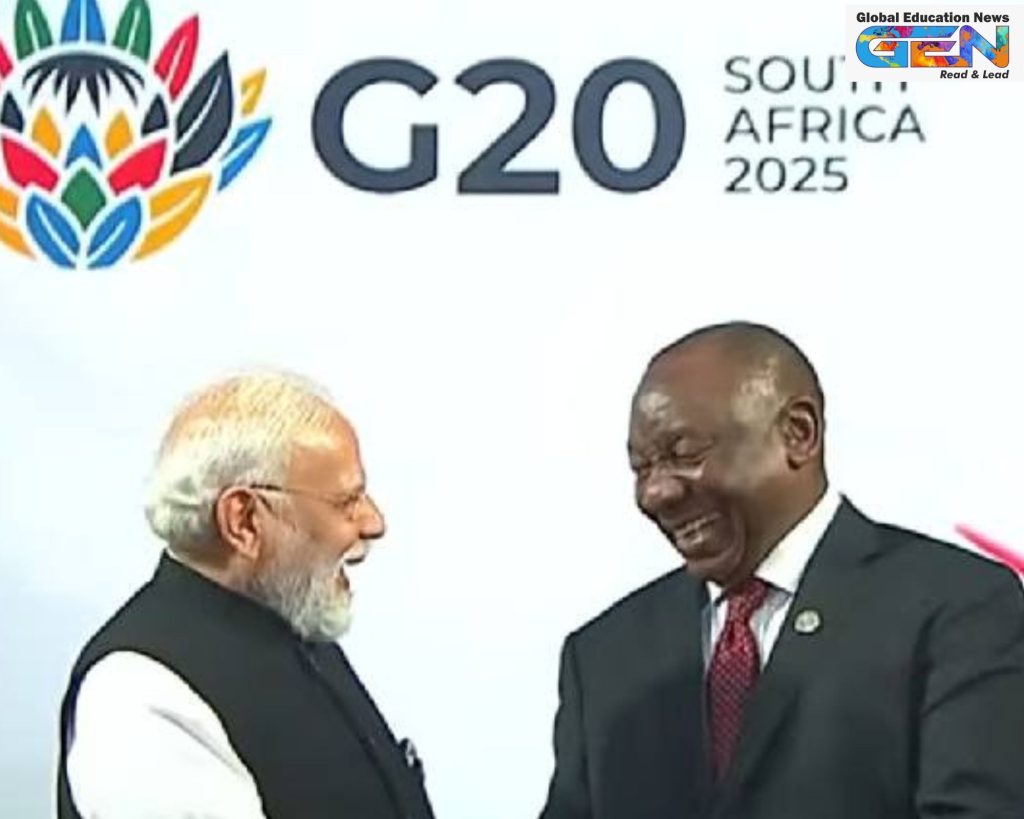
Prime Minister Narendra Modi, on his 12th G20 appearance since 2014, arrived in Johannesburg on November 21, greeted warmly by Ramaphosa with a namaste—symbolizing deepening India-South Africa ties. Modi’s itinerary blends high-level diplomacy with substantive proposals, reinforcing India’s commitment to multipolar solutions.
- Key Bilateral Meetings: Modi engaged Australian PM Anthony Albanese and Canadian PM Mark Carney on tech partnerships; British PM Keir Starmer and UN Secretary-General António Guterres on global challenges; South Korean President Lee Jae-myung on economic linkages; and Italian PM Giorgia Meloni on shared priorities.
- Trilateral Announcement: Modi unveiled a India-Australia-Canada tech pact focusing on AI, renewables, and digital infrastructure to drive innovation in emerging markets.
- Modi’s Opening Address: He proposed three initiatives—a global healthcare alliance for equitable vaccine access, preservation of traditional knowledge amid climate threats, and a unified campaign against drug trafficking—earning applause for their practicality and inclusivity.
Modi’s proactive stance underscores India’s rising influence, blending soft power with actionable diplomacy.
The Ukraine Flashpoint: US-Europe Rift Dominates Discussions
Overshadowing economic agendas, a deepening transatlantic divide over Ukraine emerged as the summit’s undercurrent. The US, under President Donald Trump, tabled a 28-point peace plan—circulated without prior European consultation—demanding Kyiv cede Donbas (Luhansk, Donetsk) and Crimea, freeze frontlines in Kherson/Zaporizhzhia, slash its military, and forgo NATO aspirations. With a Thanksgiving deadline (November 27), the proposal—welcomed by Moscow—has ignited backlash, framing the G20 as a battleground for peace terms.
- US Position: Trump, boycotting the summit, expressed frustration with stalled talks, positioning the plan as a “detailed and acceptable” path to end the war, backed by NATO-style guarantees for a neutralized Ukraine.
- European Counteroffensive: Macron, Merz, and Starmer convened sidelines meetings to revise the draft, insisting on “nothing about Ukraine without Ukraine.” EU foreign ministers in Brussels echoed: “Peace cannot mean capitulation,” rejecting territorial losses.
- Ukraine’s Stance: President Volodymyr Zelenskyy, after US consultations, vowed “honest work” but decried risks to dignity, ruling out concessions. European allies pledged sustained support, with formal briefings slated for Sunday.
This rift tests G20 unity, with non-Western leaders like Modi advocating balanced mediation to avert escalation.
Broader Agendas: From Debt Relief to Climate Finance
Beyond Ukraine, the summit tackles pressing globals:
- Economic Reforms: Starmer’s five-point plan pushes growth via trade liberalization and private capital mobilization; Netherlands’ leader urged Ukraine peace for stability.
- African Priorities: Focus on critical minerals, energy transitions, and debt sustainability, with Nigeria’s VP Kashim Shettima highlighting inclusive development.
- Declaration Breakthrough: Leaders adopted an early communiqué despite US absence, signaling resolve on sustainability goals.
Protests outside underscored domestic stakes, with clashes over jobs and inequality adding urgency.
Implications and Outlook: A Pivotal Moment for Global Order
The Johannesburg G20 could redefine alliances: Modi’s outreach bolsters India’s bridge-building role, while the Ukraine schism exposes Western fractures—potentially empowering BRICS voices. Success hinges on consensus amid boycotts and deadlines; failure risks deepened divisions.
- For India: Opportunities in tech pacts and Global South solidarity, aligning with Modi’s vision of Vasudhaiva Kutumbakam.
- Global Stakes: A revised Ukraine plan may emerge, but enforcement remains key; economic pacts could unlock $1 trillion in transitions.
- Watchpoints: Sunday’s US briefings and final declaration on November 23.