Education News Worldwide
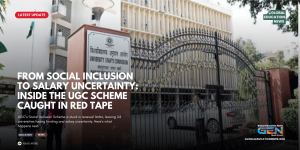
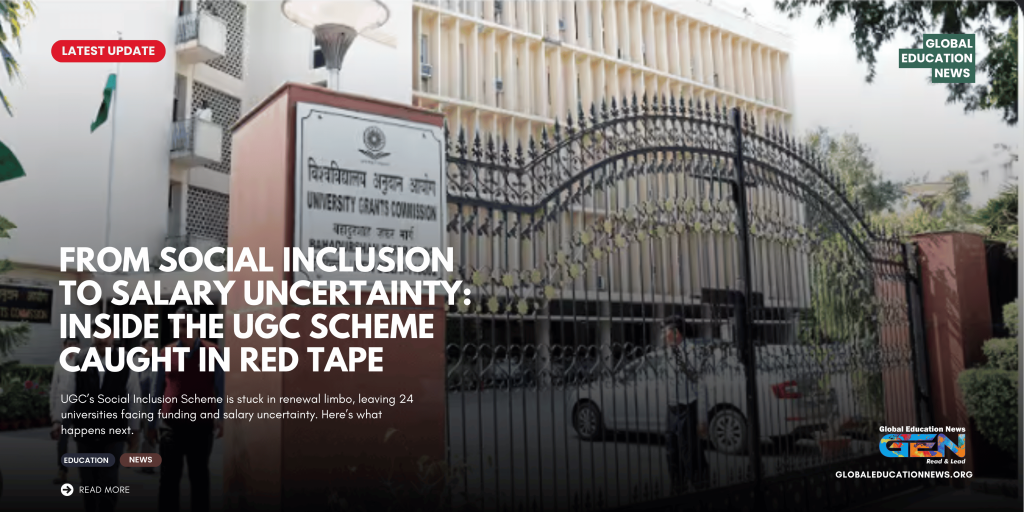
NEW DELHI, INDIA — A University Grants Commission scheme created to support research, teaching and outreach on social exclusion is itself caught in an administrative maze.
Seven months into the 2026-27 financial year, 24 central universities are still waiting for the renewal of the UGC’s Centre for the Study of Social Inclusion in Universities (CSSIU) scheme, according to information provided by the Ministry of Education. The delay has moved beyond a paperwork problem: teaching and non-teaching staff at some centres have faced delayed or withheld salaries while universities wait for the continuation order.
The Ministry has said that the proposal for continuation of the CSSIU scheme for 2026-27 is “currently under process.” Meanwhile, universities that depend on the annual UGC support are left managing a funding gap that can quickly become a payroll problem.
The episode exposes a larger question for India’s higher-education system: what happens when a programme built around inclusion is itself sustained through uncertain, year-to-year administrative arrangements?
UGC Social Inclusion Scheme Faces 2026-27 Renewal Delay
The CSSIU scheme did not begin as a short-term experiment.
The initiative grew out of the UGC’s earlier programme for establishing centres to study social exclusion and inclusive policy. The Commission later renamed it the Centre for the Study of Social Inclusion in Universities, with the scheme continuing on an annual basis. UGC records list the establishment of CSSIU among the responsibilities of its administration.
A Rajya Sabha response in August 2025 said 24 centres were functioning across the country and that the UGC had released ₹10.94 crore during 2024-25 for the centres. The government also confirmed that the scheme was being implemented annually after being renamed as CSSIU.
That annual structure is now at the heart of the current uncertainty.
Universities waiting for the continuation order
The centres operate in universities including Banaras Hindu University, Jamia Millia Islamia, the University of Hyderabad, Tata Institute of Social Sciences and Panjab University, among others. Their work goes beyond classroom teaching, covering research and outreach related to disadvantaged, tribal and marginalised communities.
But when the next financial-year approval does not arrive on time, the uncertainty travels from the university office to the people working inside these centres.
Salary Delays Turn an Administrative Problem Into a Human One
For staff members, an approval pending in a government file is not an abstract issue.
A professor at one of the centres told The Hindu that the university had paid August 2026 salaries after a delay of about 20 days, while September salaries had been withheld. Staff were reportedly told that payments would be made once the central extension was approved.
The problem is not entirely new.
Staff members have recalled similar salary-payment difficulties between 2019 and 2024, according to the report. Repeated uncertainty can affect more than household finances. It can make it harder for universities to retain researchers and teachers whose work depends on stable academic positions.
That matters particularly for centres whose purpose is long-term research into exclusion, discrimination and inequality.
The Gokhale Institute of Politics and Economics, for example, describes its CSSIU as a multidisciplinary research centre examining caste, ethnicity, gender, migration, marginalisation and inclusive public policy.
Research of that kind rarely produces its value on a one-year timetable.
How Much UGC Funding Has Been Released?
The Ministry of Education has pointed to a reimbursement-based funding mechanism.
For 2024-25, ₹26.05 crore was released to 18 centres, according to the Ministry’s response cited by The Hindu. For 2025-26, a provisional grant equivalent to 60% of the previous year’s funding — up to ₹7.59 crore — was released in advance. The total disbursed for that period was reported at ₹33.64 crore.
The Ministry has also said that settlement of 2025-26 accounts remains under process and depends on receiving and verifying the required documents from the centres.
That reimbursement model helps explain why universities can find themselves in a difficult position: they may have ongoing academic and staffing commitments while central funding remains tied to approvals, documentation and verification.
Why the CSSIU Centres Matter
The UGC social inclusion scheme is not simply a grant for another academic department.
The centres were created to build institutional capacity around subjects that sit at the intersection of education, society and public policy.
UGC’s own guidelines place centres studying social exclusion and inclusive policy under its equity initiatives. Earlier UGC material described the purpose of these centres as supporting teaching and research on social exclusion because of its theoretical and policy importance.
At university level, the research can encompass issues such as caste and exclusion, tribal communities, migration, gender discrimination, urban poverty, housing and the economic dimensions of inequality.
The consequences of an unstable funding cycle therefore extend beyond a balance sheet.
If researchers leave, projects can slow. If academic positions remain uncertain, recruitment becomes harder. If students cannot rely on stable programmes, the academic purpose of the centres is weakened.
Long-Serving Staff Want More Than Another Annual Extension
The current dispute also revives a longer-running demand: regularise the centres and their sanctioned posts instead of repeatedly renewing them on an annual basis.
Jamia Millia Islamia has reportedly made repeated representations to the UGC seeking the merger of sanctioned teaching and non-teaching posts associated with its centre into the university’s regular establishment. A July 2026 communication was described as the university’s third reminder after earlier representations in December 2024 and March 2025.
For employees who have spent many years working in these centres, annual renewal creates a particularly difficult contradiction. Their service may stretch across a decade or more, while the institutional funding that supports their positions continues to be treated as a year-by-year commitment.
The regularisation question
Some faculty members have invoked the Supreme Court’s State of Karnataka v. Uma Devi judgment in arguing for consideration of regularisation after long periods of continuous service. That argument is contested and legally dependent on the circumstances of individual appointments; the judgment does not create an automatic right to regularisation for every long-serving temporary employee.
The broader issue, however, is straightforward: how should universities retain experienced academic staff when the programmes employing them remain dependent on annual extensions?
The Policy Contradiction at the Heart of the Delay
There is an unusual irony here.
In January 2026, the UGC notified new Promotion of Equity in Higher Education Institutions Regulations, stating that higher-education institutions should promote equity and inclusion and address discrimination affecting groups including Scheduled Castes, Scheduled Tribes, socially and educationally backward classes, economically weaker sections and persons with disabilities.
At the same time, one of the UGC’s established institutional mechanisms for studying social exclusion and inclusive policy is waiting for its annual continuation.
That does not mean the two developments are formally contradictory. The regulations and CSSIU scheme have different purposes and legal structures. But together they highlight a practical challenge for higher education: policy commitments require institutions, people and predictable funding to turn them into sustained work.
What Happens Next?
For the 24 universities involved, the immediate issue is the 2026-27 continuation decision.
The Ministry of Education has said the proposal remains under process. Until the approval is issued, universities and staff are left navigating the uncertainty created by an annual funding model.
The longer-term question is harder.
If the centres are considered important enough to maintain, universities may seek a more predictable funding structure and clearer staffing arrangements. If their role is expected to expand under India’s broader equity and inclusion agenda, the pressure for stable institutional support is likely to grow.
For the researchers studying exclusion, the irony is difficult to miss: the institutions examining how marginalised communities are pushed to the edges of systems are themselves waiting for a system to decide what happens to them next.