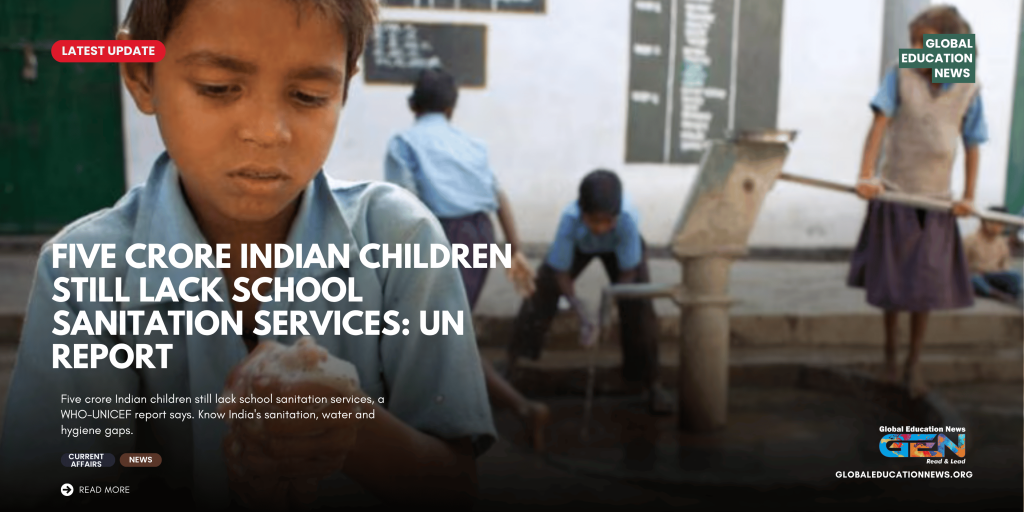
India has made substantial progress in school water and sanitation infrastructure, but a new WHO-UNICEF report says about 50 million Indian schoolchildren still attend schools without a sanitation service, highlighting the gap between infrastructure coverage and genuinely usable facilities.
New Delhi, India —
For a child, a school toilet is not a peripheral facility. It can determine whether a student can get through a full school day with dignity, whether a girl feels comfortable attending during menstruation, and whether basic hygiene becomes part of everyday life.
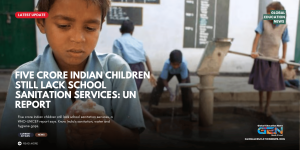
Yet a new WHO-UNICEF school sanitation report has put a striking number behind India’s remaining challenge: around 50 million Indian school-age children had no sanitation service at school in 2025. Globally, the figure stood at 244 million children. India accounted for the largest national share, ahead of Nigeria, Ethiopia, the Democratic Republic of the Congo and Indonesia.
The finding comes from the WHO/UNICEF Joint Monitoring Programme (JMP) report, “Progress on Drinking Water, Sanitation and Hygiene in Schools 2015–2025,” released on September 22, 2026. The report examines the first decade of the Sustainable Development Goal period and warns that the world is not moving quickly enough to achieve universal school WASH coverage by 2030.
For India, the figures tell a more complicated story than a simple infrastructure shortfall. The country has expanded school toilets, drinking-water facilities and hygiene infrastructure substantially over the past decade. But the international WASH measure asks a tougher question: Is the facility improved, private, usable and available when students need it?
School Sanitation in India: What the UN Report Actually Found
The WHO-UNICEF JMP uses a specific definition of a basic sanitation service in schools: an improved sanitation facility that is usable and provides separate facilities for different sexes.
In 2025, 77% of schools globally had basic sanitation services, while 11% had limited services and 12% had no sanitation service. Among school-age children worldwide, 460 million lacked a basic sanitation service. Of those, 244 million had no sanitation service at all, while another 216 million attended schools where improved facilities were either not single-sex or not usable.
India’s position is therefore not simply about whether a toilet exists on a school campus.
A toilet that cannot be used, is not properly separated, or lacks the conditions required by the JMP definition does not qualify as a basic sanitation service.
That distinction is crucial when interpreting the headline figure.
Five Crore Children Without Sanitation: Why the Number Matters
India’s estimated 50 million children without a sanitation service at school represented the largest national population without such access in the 2025 data.
Nigeria followed with about 34 million, Ethiopia with 26 million, the Democratic Republic of the Congo with 11 million and Indonesia with 8 million, according to reporting based on the new JMP data.
The number is large partly because India has one of the world’s biggest school-age populations. But scale does not make the problem abstract.
A sanitation gap can affect the daily experience of children in classrooms, particularly younger students and adolescents. UNICEF notes that functional and private school toilets can positively affect health and learning outcomes, with particular significance for girls.
For schools, therefore, sanitation is not merely a construction issue. It is part of the environment in which children are expected to learn.
India Has Made Progress Since 2015
The new report does not present India only as a country falling short.
There has been measurable progress.
The data cited in current reporting on the JMP findings show that India recorded a 14% reduction in schools with no sanitation service over the decade. The period also overlaps with India’s intensified push on sanitation following the launch of the Swachh Bharat Mission in 2014.
India’s domestic school-infrastructure data show the same broad direction of travel.
According to NITI Aayog’s analysis of UDISE+ data, 92.4% of schools reported functional boys’ toilets and 94% reported functional girls’ toilets in 2024-25. The government also reported that 99.3% of schools had access to drinking water in 2024-25.
Those figures and the WHO-UNICEF estimates are not necessarily contradictory. They measure different things and use different definitions.
That is where much of the debate around India’s school sanitation numbers can become confusing.
Toilets on Campus Are Not the Same as Basic Sanitation
A school may report having a toilet facility, while the JMP framework may classify the school at a lower service level if the facility is not usable or does not meet the required criteria.
The distinction between availability and usability is one of the most important takeaways from the report.
UNICEF’s WASH framework separates schools into basic, limited and no-service categories. For sanitation, a basic service requires an improved facility that is usable and appropriately separated.
This shifts the question from:
“Does the school have a toilet?”
to:
“Can every child actually use a suitable toilet when they need it?”
That is a much harder standard—and a more meaningful one for everyday school life.
Water and Hygiene Gaps Remain Too
Sanitation is only one part of the broader WASH in schools picture: water, sanitation and hygiene.
The 2025 global figures show that 429 million school-age children lacked a basic drinking-water service, while 545 million lacked a basic hygiene service at school.
India also appears in these wider gaps.
Current reporting on the JMP data puts the number of Indian children without a school drinking-water service at about 12 million, while around 20 million Indian children lacked a hygiene service. The JMP data also point to limitations in India’s recent hygiene trend estimates, meaning the latest national picture for hygiene needs to be interpreted with care.
The message is straightforward: a toilet without water, soap or maintenance cannot deliver the full health benefit expected from school WASH infrastructure.
The 2030 Target Is Moving Further Away
The problem is not unique to India.
Globally, the WHO-UNICEF report says universal access to basic sanitation services in schools by 2030 would require the world to accelerate its current rate of progress by five times. If the present trajectory continues, only about 81% of schools would have basic sanitation services by 2030, leaving approximately 364 million school-age children without a basic sanitation service.
The picture is similarly difficult for drinking water and hygiene.
At current rates, global basic drinking-water coverage is projected to reach about 84% by 2030, while hygiene coverage could reach only 79%.
The numbers turn the school sanitation debate into a race against time.
There are only five years left in the SDG period.
Why Girls and Vulnerable Students Need Particular Attention
School sanitation has a dimension that goes beyond infrastructure statistics.
Private, functional toilets can affect attendance and comfort, particularly for girls. UNICEF specifically identifies the availability of functional and private school toilets as an issue linked to health and learning outcomes, with particular importance for girls.
The question is also one of inclusion.
Earlier JMP research found that accessibility can be far weaker for students with disabilities than headline toilet-availability numbers suggest. A previous WHO-UNICEF assessment reported that only 29% of Indian schools in the relevant national data had toilets accessible to students with special needs, while just 6% met a more comprehensive standard involving a ramp, handrail and wide door for wheelchair access.
That older evidence should not be mistaken for the 2025 national position, but it illustrates why “toilet available” is an incomplete measure of a child’s actual access.
Swachh Bharat’s School Legacy Faces a Last-Mile Test
India’s school sanitation drive has a long policy history.
The Swachh Vidyalaya initiative, launched in 2014, followed the government’s push to provide separate toilets for boys and girls in schools. The programme placed sanitation, cleanliness and handwashing within the broader school-education agenda.
A decade later, the policy challenge has changed.
The country is no longer dealing only with the question of building toilets at scale. The harder task is keeping facilities functional, ensuring water availability, maintaining cleanliness and making them accessible to every child.
The last mile is often less visible than the construction phase—but for students, it is the part they encounter every day.
India’s School Sanitation Challenge Is Now About Quality
The latest WHO-UNICEF findings should therefore be read alongside India’s domestic progress rather than in isolation.
India has expanded access to school toilets and drinking water considerably. Government data show high reported coverage of several school facilities. Yet the JMP’s stricter service-level approach continues to identify millions of children who do not have access to sanitation that meets the definition of a basic service.
That gap between infrastructure and usable service is where the next phase of India’s school sanitation effort will be decided.
A toilet block can be counted.
A water tap can be photographed.
But the real measure is whether a child can walk into a clean, private, functional and accessible facility—and return to the classroom without having to think twice about it.
For roughly five crore Indian children identified as lacking a school sanitation service in the latest international estimates, that distinction remains very real.