Published on October 27 , 2025
Delhi, India
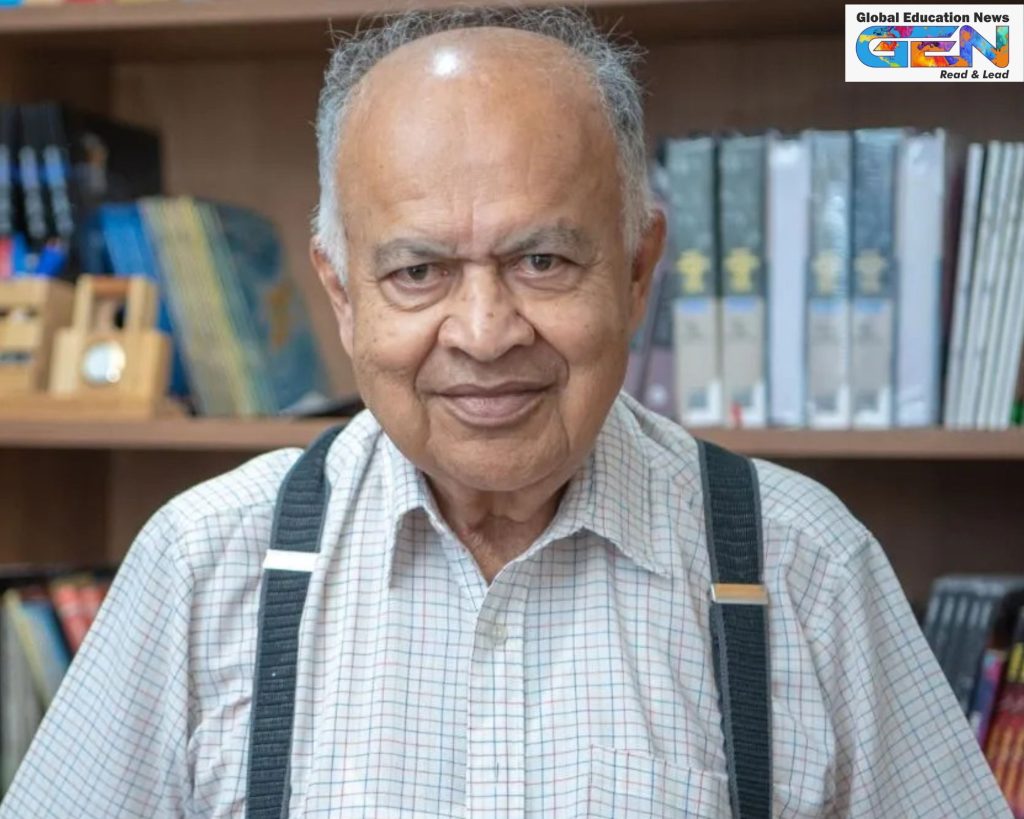
The late astrophysicist Jayant Vishnu Narlikar has been posthumously selected for the prestigious Vigyan Ratna Puraskar 2025—the crown jewel of India’s Rashtriya Vigyan Puraskar. Announced on October 27, 2025, this honor celebrates Narlikar’s groundbreaking work in cosmology, particularly his co-development of the Steady State theory that boldly questioned the dominant Big Bang model. Passing away on May 20, 2025, at 86, Narlikar leaves behind a legacy of intellectual daring, from founding Pune’s Inter-University Centre for Astronomy and Astrophysics (IUCAA) to penning science fiction that sparked curiosity in generations. As the second edition of these national awards unfolds, Narlikar’s selection underscores India’s commitment to honoring visionaries who reshape our understanding of the universe, inspiring today’s Indian STEM innovators to push cosmic boundaries.
Key Points
- Announcement Details: Winners revealed via the government’s awards portal on October 27, 2025; Vigyan Ratna is the highest tier, modeled after Padma honors for lifetime scientific impact.
- Narlikar’s Milestone: First posthumous recipient, highlighting flexibility in recognizing enduring contributions despite timing.
- Broader Scope: Awards span Vigyan Ratna (1), Vigyan Shri (8 senior scientists), Vigyan Yuva (14 young talents), and Vigyan Team (1 collaborative effort), covering fields from agriculture to space tech.
Jayant Narlikar’s Cosmic Journey: From Steady State Pioneer to Science Evangelist
Born in 1938 in Kolhapur, Maharashtra, Jayant Narlikar emerged as a prodigy, earning a PhD from Cambridge under Fred Hoyle’s guidance. His career defied conventions, blending rigorous math with philosophical inquiry into the universe’s origins. Narlikar’s Steady State theory, refined into the quasi-steady state model, posited an eternal, expanding cosmos with continuous matter creation—countering the explosive birth narrative of the Big Bang. This wasn’t mere theory; it incorporated Mach’s principle, suggesting gravity’s influence from distant galaxies, and even predicted cosmic microwave background radiation before its discovery.
Beyond equations, Narlikar championed science outreach. As IUCAA’s founder-director from 1988 to 2003, he mentored hundreds, fostering India’s astrophysics hub. His 50+ sci-fi novels in Marathi and English, like “The Return of Vaman,” wove quantum mysteries into thrilling tales, making cosmology accessible to lay readers. Awards like Padma Bhushan (1965) and Padma Vibhushan (2004) dotted his path, but the Vigyan Ratna cements his status as a national science icon.
Key Points
- Key Theories: Co-authored Hoyle-Narlikar theory of gravity, modifying Einstein’s relativity for matter creation; quasi-steady state cosmos (1993) as Big Bang alternative.
- Academic Milestones: Tata Institute scholar; Cambridge PhD (1963); professor at Tata Institute of Fundamental Research; IUCAA visionary, training global astronomers.
- Public Impact: Over 400 research papers; sci-fi blending hard science with Indian folklore; promoted pseudoscience debunking and girls in STEM.
The Vigyan Ratna Puraskar: Pinnacle of Rashtriya Vigyan Puraskar 2025
Launched in 2024, the Rashtriya Vigyan Puraskar revives and elevates India’s science honors, filling gaps left by discontinued awards like the Bhatnagar Prize. The Vigyan Ratna, for lifetime excellence, carries a ₹25 lakh cash prize, medallion, and citation—bestowed by the President. Narlikar’s selection, just five months post-passing, breaks new ground, symbolizing that true innovation transcends mortality. This edition’s 25+ recipients reflect diverse fields, from atomic energy to environmental tech, aligning with national goals like Atmanirbhar Bharat in R&D.
Key Points
- Award Structure: Vigyan Ratna (lifetime); Shri (distinguished seniors); Yuva (under-45 innovators); Team (collaborative breakthroughs); ceremony likely January 2026.
- Selection Rigor: Nominations via portals; vetted by domain experts and inter-ministerial committees; emphasizes societal impact and innovation.
- Evolution: Builds on Shanti Swarup Bhatnagar legacy; 2025’s posthumous nod sets precedent for honoring overlooked pioneers.
Spotlight on 2025 Winners: A Galaxy of Indian Scientific Stars
The Rashtriya Vigyan Puraskar 2025 roster brims with trailblazers, showcasing India’s depth in science innovation across disciplines. From wheat breeding revolutions to lavender cultivation triumphs, these honorees drive sustainable progress.
Key Points
- Vigyan Shri (8 Recipients): Gyanendra Pratap Singh (Agricultural Science – wheat varieties boosting yields); Yusuf Mohammad Seikh (Atomic Energy – BARC physics advancements); K. Thangaraj (Biological Sciences – CCMB genomics); Pradeep Thalappil (Chemistry – IIT-Madras nanomaterials); Aniruddha Bhalchandra Pandit (Engineering Sciences – ICT VC, process tech); S. Venkata Mohan (Environmental Science – NEERI bio-remediation); Mahan Maharaj (Mathematics/Computer Science – TIFR monk-scientist algorithms); Jayan N. (Space Science – LPSC propulsion innovations).
- Vigyan Yuva (14 Young Scientists): Standouts include Deepa Agashe (Biological Sciences – evolution research); Dibyendu Das (Chemistry – molecular designs); Waliur Rahaman (Earth Sciences – climate modeling); Arkaprava Basu (Engineering – AI optics); Suresh Kumar (Medicine – drug discovery); Amit Kumar Agarwal & Surhud More (Physics – quantum & astrophysics); Ankur Garg (Space Tech – satellite systems).
- Vigyan Team: CSIR Aroma Mission squad for Jammu & Kashmir’s “Lavender Revolution,” transforming arid lands into aromatic economies.
Posthumous Honor’s Ripple Effect: Inspiring Future Cosmologists
Narlikar’s Vigyan Ratna, though “a bit late” as IUCAA colleagues muse, amplifies his challenge to orthodoxy—reminding us that science thrives on dissent. This award spotlights posthumous recognition’s power: it immortalizes legacies, motivates mentees, and signals government agility in honoring the unsung. In an era of space ambitions like Chandrayaan, it fuels Indian science awards momentum, potentially drawing youth to astrophysics amid global talent wars. As one tribute notes, Narlikar’s Steady State endures like the universe he envisioned—eternal, expansive, and full of wonder.
Key Points
- Legacy Boost: Elevates IUCAA’s profile; inspires 100+ alumni in global observatories; counters Big Bang dominance in curricula.
- National Pride: Aligns with Padma-series; encourages nominations from underrepresented fields like cosmology.
- Broader Waves: Sparks debates on award inclusivity; ties to STEM equity, with more women like Shweta Prem Agrawal shining.