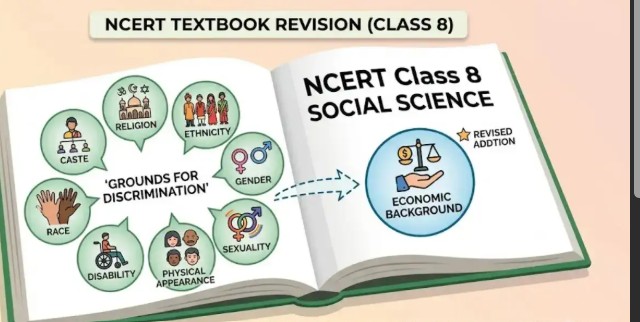
India’s school curriculum is undergoing another significant transformation. In its revised Class 8 Social Science textbook, the National Council of Educational Research and Training (NCERT) has expanded the definition of discrimination by including economic background alongside factors such as caste, religion, ethnicity, disability, race, gender, sexuality, and physical appearance.
The change appears in the chapter on Citizenship: Rights and Duties, reflecting an effort to encourage students to understand that prejudice and unequal treatment are not limited to traditional social identities but can also stem from financial status and socio-economic conditions.
Education experts believe the revision reflects evolving social realities, where children from economically weaker families often encounter barriers in education, healthcare, housing, employment, and everyday social interactions.
Why This Change Matters
Discrimination is generally associated with caste, religion or gender. However, economic inequality has increasingly emerged as another factor influencing how people are treated in society.
Children from low-income households may experience:
- Social exclusion among peers
- Unequal access to educational opportunities
- Digital divide and technology gaps
- Bias based on clothing, appearance or living conditions
- Limited participation in extracurricular activities
- Reduced access to healthcare and nutrition
By introducing economic background into classroom discussions, NCERT aims to help students understand that fairness and equality extend beyond constitutional categories and include everyday social behaviour.
Understanding the New Definition of Discrimination
The revised textbook explains discrimination as unfair treatment of individuals or groups based on various characteristics.
The updated list now includes:
- Caste
- Religion
- Ethnicity
- Disability
- Race
- Gender
- Sexuality
- Physical appearance
- Economic background
This broader definition encourages students to recognise that prejudice can arise from multiple social and economic factors and that such behaviour is inconsistent with the principles of equality and dignity.
Why Economic Background Is Increasingly Relevant
India has made remarkable progress in expanding education and reducing poverty, yet economic disparities continue to influence opportunities available to children.
Students from financially weaker households often face challenges such as:
Educational Resources
Limited access to private coaching, digital devices, stable internet connectivity and learning materials.
School Participation
Difficulty participating in educational tours, competitions or extracurricular programmes due to financial constraints.
Social Perceptions
Economic differences can sometimes become reasons for teasing, exclusion or stereotyping among classmates.
Future Opportunities
Economic status frequently affects access to higher education, skill development and career pathways.
Recognising these realities in school education can encourage empathy and inclusive behaviour from an early age.
Connecting Classroom Learning with Constitutional Values
The revision reinforces the constitutional ideals of:
- Equality
- Justice
- Liberty
- Fraternity
- Human dignity
Although the Constitution specifically prohibits discrimination on certain protected grounds, it also promotes equal opportunity and social justice through various provisions and welfare measures. The updated textbook encourages students to appreciate these broader values in everyday life.
Part of a Wider NCERT Curriculum Revision
The inclusion of economic background is one among several revisions introduced in the latest Class 8 Social Science textbook.
Other significant updates include:
- Revision of the judiciary chapter following earlier controversy.
- Updated discussion on citizenship and civic responsibilities.
- Changes to historical narratives relating to Partition.
- Removal of references to Adolf Hitler and Nazi ideology from specific sections.
- Inclusion of additional historical and constitutional perspectives.
Together, these revisions reflect NCERT’s ongoing effort to align textbooks with the National Curriculum Framework while responding to legal, academic and societal developments.
Educational Significance for Students
Introducing economic discrimination at the middle-school level has several educational benefits.
Promotes Empathy
Students become more aware of the challenges faced by classmates from different economic backgrounds.
Strengthens Civic Values
The lesson reinforces respect, inclusion and equal treatment.
Develops Critical Thinking
Students learn that inequality is complex and influenced by multiple social and economic factors.
Encourages Responsible Citizenship
The chapter highlights individual responsibility in creating inclusive communities free from prejudice.
Implications for Schools and Teachers
The revised content places greater responsibility on educators to facilitate thoughtful classroom discussions.
Teachers can help students:
- Understand different forms of discrimination.
- Respect diversity in all its forms.
- Challenge stereotypes.
- Promote inclusive classroom practices.
- Encourage empathy through real-life examples.
Schools may also strengthen awareness programmes on inclusion, anti-bullying and equal opportunity.
Challenges in Classroom Implementation
While the revision is significant, effective implementation will require careful classroom engagement.
Some challenges include:
- Explaining socio-economic inequality in age-appropriate ways.
- Avoiding oversimplification of complex issues.
- Training teachers to facilitate balanced discussions.
- Ensuring examples remain relatable to students from diverse backgrounds.
Educational experts suggest that textbooks alone cannot eliminate discrimination; meaningful classroom dialogue and inclusive school environments are equally important.
A Reflection of Changing Social Realities
Economic inequality has become an increasingly visible aspect of modern society.
Whether in access to education, technology, healthcare or employment opportunities, financial status often influences life outcomes.
Recognising this reality within school education represents an attempt to prepare students for a more nuanced understanding of social justice and equality.
Rather than limiting discussions to traditional categories of discrimination, the revised textbook encourages learners to appreciate that dignity, respect and equal treatment should extend to every individual regardless of their economic circumstances.