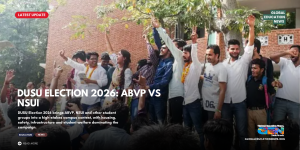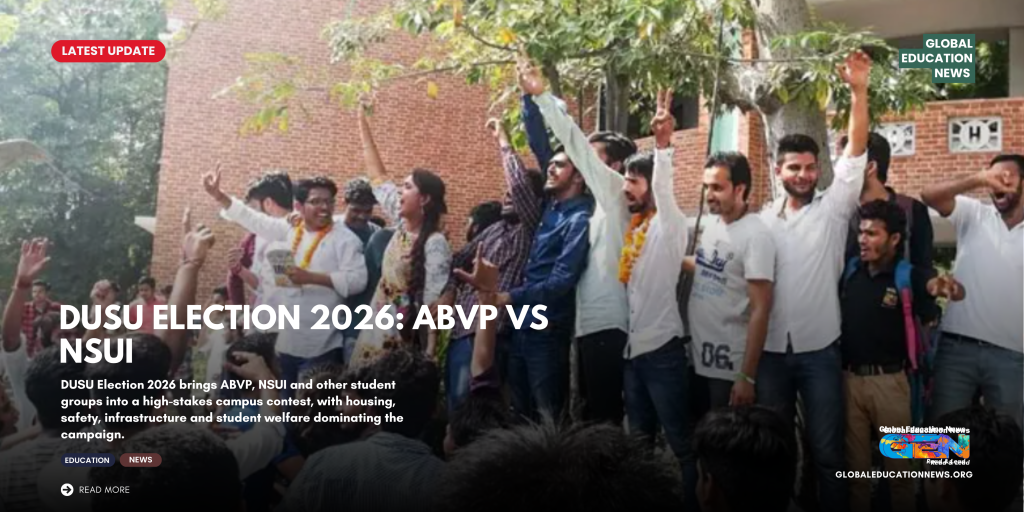
New Delhi — The Delhi University Students’ Union (DUSU) Election 2026 has entered its final stretch, with student organisations and independent candidates making their last push ahead of polling on September 18.
The headline contest features ABVP and NSUI, which have announced their panels for president, vice-president, secretary and joint secretary. But the election is not only about organisational strength. Student accommodation, campus safety, facilities, academic concerns and representation before the university administration have emerged as some of the key issues shaping the campaign.
Seven candidates are contesting the president’s post, while five are in the vice-president race and four each are contesting for secretary and joint secretary. Vote counting is scheduled for September 19.
DUSU Election 2026: ABVP vs NSUI Presidential Contest
The presidential race has drawn the most attention.
ABVP has nominated Yash Dabas, while NSUI has fielded Vijay Shankar Meena. The AISA-SFI alliance has nominated Ananya Raturi, while four other candidates are contesting independently.
The four-member panels announced by the two major student organisations are:
| DUSU Post | ABVP | NSUI |
|---|---|---|
| President | Yash Dabas | Vijay Shankar Meena |
| Vice-President | Ishu Maurya | Veer Chhatrath |
| Secretary | Riya Chhawadi | Namrata Chaudhary |
| Joint Secretary | Lakshya Raj Singh | Gopal Choudhary |
The candidate profiles also bring a strong sporting and extracurricular element to this year’s election. Dabas has an international-level tennis background, while Lakshya Raj Singh has represented India in handball. ABVP’s other nominees also have backgrounds in student activities and sport.
NSUI’s panel is led by Meena, who is pursuing an MA in Buddhist Studies at DU, along with Veer Chhatrath, Namrata Chaudhary and Gopal Choudhary.
Why Student Housing Has Become a Major DUSU Election Issue
One of the defining issues of the DUSU Election 2026 is accommodation.
The debate has intensified after the recent building collapse in Delhi’s Satya Niketan area, in which DU students were among those killed. The incident has drawn attention to the number of students who live in private accommodation outside university hostels and the safety conditions they may face.
The shortage is not a new problem. Recent reporting has highlighted the limited availability of university hostel accommodation compared with the size of Delhi University’s student population.
That has pushed housing higher up the student-election agenda.
ABVP’s Housing and Safety Proposals
ABVP’s manifesto has placed student accommodation and safety prominently on its agenda. Its proposals include new hostels, a student housing helpline, fire-safety measures and other campus facilities.
The organisation has also highlighted an “Awas” agenda involving measures such as separate girls’ hostels, a Student Housing Cell, an emergency helpline and fire-safety audits.
NSUI’s Campus-Welfare Focus
NSUI has also put student welfare at the centre of its campaign.
Its manifesto, titled “Accountable DU-Accountable DUSU,” includes proposals concerning hostels, affordable metro travel, libraries, canteens, campus infrastructure, academic processes and institutional accountability.
The competing proposals show how the 2026 DUSU campaign has moved beyond traditional campus politics towards everyday concerns such as where students live, how they travel and how they interact with university systems.
DUSU Election Rules: Why the Campaign Looks Different This Year
The 2026 election is also being conducted under strict campaign rules.
Delhi University has prohibited printed posters, banners, flex material and similar campaign material on campus and in nearby areas. The university said the measures are intended to ensure a fair, peaceful and environmentally responsible election and are linked to court directions and the recommendations of the Lyngdoh Committee.
The official election information also lays out rules, candidate requirements, complaint mechanisms and the election code of conduct for students and colleges.
These restrictions have made digital outreach, student meetings and direct campaigning more significant during the short election period.
What the Lyngdoh Rules Mean for DUSU Candidates
The DUSU election framework continues to operate within the broader principles recommended by the Lyngdoh Committee, including restrictions intended to prevent excessive money and external political influence in student elections.
The recommendations state that the complete election process, including campaigning, should not exceed 10 days. They also establish eligibility principles relating to age and student status.
The role of political organisations in DUSU elections has itself become a point of legal and institutional debate this year, with the Delhi High Court hearing challenges concerning the participation of political student organisations and candidate nominations.
That makes the 2026 election significant not only for the candidates but also for the continuing question of how student politics should operate within university rules.
DUSU Election 2026: Who Else Is in the Race?
Although ABVP and NSUI command much of the attention, the presidential contest is not a two-candidate race.
Seven candidates are contesting for president. Besides Yash Dabas and Vijay Shankar Meena, the list includes Ananya Raturi of the AISA-SFI alliance, along with independent candidates Ashmit Kumar, Ejaj Mansuri, Samarth Beniwal and Sameer Kumar.
Across the four central posts, the final field includes candidates from established student organisations as well as independent contenders.
This wider field matters because the final result will be determined by student votes across the university rather than by the strength of any single organisation’s campaign alone.
What Happened in the DUSU Election 2025?
The previous election provides useful context, although it does not determine the 2026 outcome.
In the 2025 DUSU elections, ABVP won three of the four key central posts, including president, secretary and joint secretary. NSUI won the vice-president position. ABVP’s Aryan Maan secured the president’s post with 28,841 votes, while NSUI’s Rahul Jhansla won the vice-president position with 29,339 votes.
The 2026 contest therefore begins with an existing organisational and electoral history, but the candidates, campaign issues and student concerns are different this year.
DUSU Election 2026 Voting Date, Timing and Result Date
Students preparing to vote should keep the key dates in mind.
DUSU Election 2026 voting: September 18, 2026
Vote counting: September 19, 2026
According to the published schedule, day-class students will vote from 8:30 am to 1 pm, while evening-class students will vote from 3 pm to 7:30 pm.
The election covers the four central office-bearer positions — president, vice-president, secretary and joint secretary — as well as the central council process.
The Bigger Question Behind DUSU Election 2026
The most consequential part of this year’s DUSU campaign may ultimately have little to do with slogans.
For students, the practical questions are straightforward: Is there affordable and safe accommodation? Are campus facilities adequate? How quickly are student grievances addressed? Are academic and examination processes transparent? And does the elected union have an effective channel to the university administration?
Those questions have given the 2026 election a distinctly student-welfare-focused dimension.
ABVP and NSUI have put forward different campaign proposals, while AISA-SFI and independent candidates are also seeking to shape the debate. The final choice will be made by DU’s student electorate on September 18.
For Delhi University, the DUSU election remains more than an annual campus contest. It is also a test of how effectively student organisations can turn campaign promises into sustained representation once the voting ends.