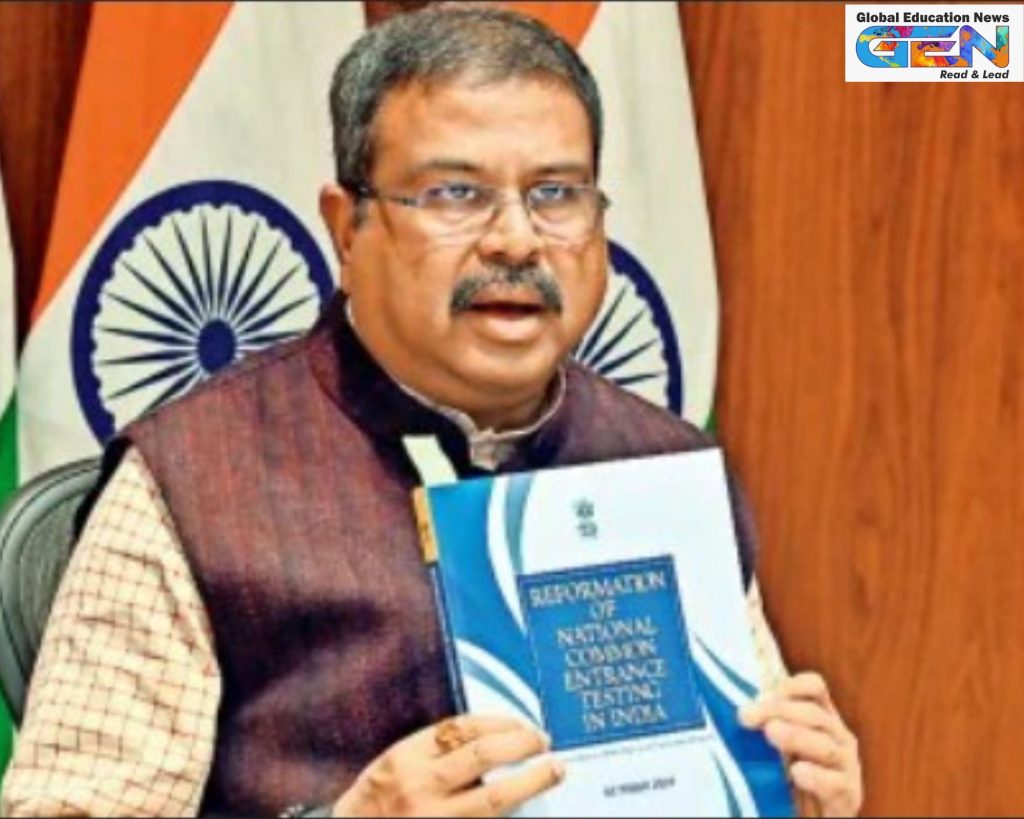
Union Education Minister Dharmendra Pradhan has positioned the National Education Policy (NEP) 2020 as a revolutionary force to infuse traditional Indian ethos into an education system long dominated by colonial Macaulay-era structures. Addressing a pivotal workshop on “Implementation of National Education Policy-2020: Challenges and Possibilities” in Bhopal on December 9, 2025, Pradhan called for a paradigm shift from rote memorization to innovative, culturally rooted learning that integrates artificial intelligence (AI) and ancient knowledge systems. Organized by Madhya Pradesh’s higher education department and graced by Governor Mangubhai Patel and Chief Minister Mohan Yadav, the event celebrated the state’s vanguard role in NEP execution, including its Sandipani Schools model. Pradhan’s vision aligns with NEP’s ambitious targets, such as a 50% Gross Enrolment Ratio (GER) by 2035, to reclaim India’s global educational stature through heritage-driven progress.
Key Statements: Dharmendra Pradhan’s Call for Cultural and Technological Fusion
Pradhan’s keynote dissected the Macaulay system’s historical alienation of Indian intellect, advocating for a renaissance that honors indigenous wisdom.
- Ethos-Centric Reform: “The objective of the NEP was to infuse Indian ethos into the Macaulay-era education system,” Pradhan asserted, pushing for curricula that revive scientific, philosophical, and spiritual foundations from ancient texts.
- Bridging Eras: He urged linking “India’s ancient education system with modern artificial intelligence,” citing Ujjain’s Vedic contributions to astronomy as proof of India’s innate scientific prowess, to elevate the nation’s cultural narrative globally.
- Holistic Empowerment: Stressed universal Class 12 completion, community involvement in school management and nutrition, and skill-building in emerging fields like quantum computing. Pradhan proposed practical gestures, such as fruit baskets over flowers at events, to champion health and sustainability.
- Accountability Imperative: Envisioned education as a “mass movement” where institutions serve society, grounded in “scientific temper, philosophical clarity, and spirituality.”
Governor Patel reinforced NEP as a “visionary action plan” demanding innovative AI integration and parental engagement, while Chief Minister Yadav lauded Madhya Pradesh’s strides, addressing educators as ‘kul-gurus’ in homage to gurukul traditions under Prime Minister Narendra Modi’s leadership.
Historical Context: Dismantling Macaulay’s Colonial Imprint
The 1835 Macaulay Minute institutionalized English-centric education to produce a subservient elite, sidelining India’s rich pedagogical heritage from Nalanda to Taxila. Dharmendra Pradhan’s critique frames NEP 2020 as a corrective, resurrecting Madhya Pradesh’s legacy in knowledge preservation—from psychological insights in Upanishads to astronomical feats in Ujjain.
- Legacy Critique: The colonial model bred cultural disconnection, Pradhan noted, contrasting it with guru-shishya bonds that propelled ancient innovations.
- Revival Strategy: NEP promotes multilingualism, ethical education, and value infusion to counter monolingual biases, ensuring curricula reflect India’s philosophical depth over imported paradigms.
This reclamation supports NEP’s flexible, multidisciplinary approach, fostering pride in indigenous systems.
NEP Reforms: Harmonizing Heritage with High-Tech Horizons
Under Dharmendra Pradhan’s guidance, NEP 2020 reimagines education as inclusive and forward-looking, merging classical elements with technological imperatives.
- Cultural Integration: Incorporates yoga, Ayurveda, and classical languages alongside STEM, backed by a 6% GDP education spend for comprehensive growth.
- Tech-Infused Learning: Embeds AI, quantum computing, and vocational training from Class 6, preparing learners for Industry 4.0 disruptions.
- Systemic Overhaul: Adopts a 5+3+3+4 structure, multiple entry-exit pathways, and research tied to community needs, enhancing retention via nutrition and governance reforms.
- Excellence Ecosystems: Advocates integrated universities and district-level centers, linking academia to local economies for enduring impact.
These pillars drive GER elevation from 28.4% (2022-23) to 50% by 2030, cementing India’s “knowledge superpower” status.
Implementation Spotlight: Madhya Pradesh’s Trailblazing NEP Model
Madhya Pradesh exemplifies Dharmendra Pradhan’s vision, pioneering initiatives that tackle rollout barriers like funding and capacity-building.
- Signature Programs:
- Sandipani Schools: 370 operational, fusing gurukul methods with digital pedagogy for holistic skill development.
- Prime Minister Excellence Colleges: District-wise hubs honoring local icons, delivering multidisciplinary education.
- Integrated Universities: Stream-unified campuses for seamless access across disciplines.
- Achievement Metrics: Rural enrollment up 15% since 2023; community nutrition models like Gujarat’s “Dudh Sanjivani” scaled for malnutrition combat.
- Overcoming Hurdles: Workshop dialogues emphasized creative solutions for digital equity and self-paced learning; Pradhan rallied for nationwide synergy to surmount execution gaps.
By 2025, these efforts have positioned MP as a NEP benchmark, inspiring peer states.