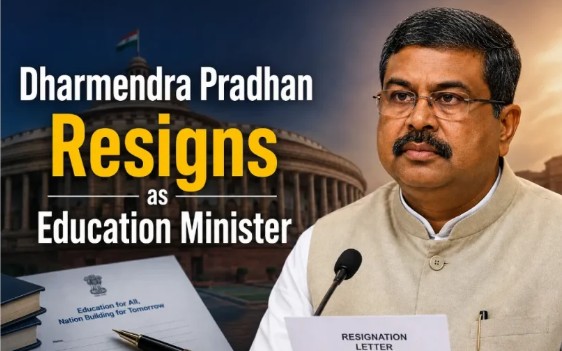
Union Education Minister Dharmendra Pradhan has tendered his resignation to President Droupadi Murmu, citing moral responsibility for the irregularities surrounding the NEET-UG 2026 examination and the widespread distress among students.
In a statement shared publicly, Pradhan said the developments of the past ten days had caused him deep pain. He stated that India’s youth “will not be trapped in any illusion” and that he had decided to step down after careful reflection, taking into account the situation at Jantar Mantar and across the country.
Context of the Decision
The resignation follows more than two weeks of sustained protests led by the Cockroach Janta Party (CJP) at Jantar Mantar in Delhi. The student group had made the minister’s exit a central and non-negotiable demand, linking it to broader concerns over examination integrity and accountability.
The NEET-UG examination held on May 3 was cancelled after evidence of a paper leak emerged. A Central Bureau of Investigation probe was ordered, and a re-test was conducted on June 21 in computer-based mode. Pradhan had earlier acknowledged the breach during a media briefing in mid-May.
Only a day before the resignation, government sources had indicated that the minister would not step down, describing such a move as “running away from responsibility” and pointing instead to ongoing reforms within the National Testing Agency. Those reforms have included the termination of 47 officials and the notification of new specialist positions.
Recent Developments Leading Up to the Resignation
In the preceding 24 hours, CJP representatives held discussions with Union Ministers J.P. Nadda and Jitendra Singh. The government is reported to have agreed in principle to provide ₹1 crore compensation to the families of students who died by suicide in connection with the examination crisis, and to withdraw FIRs against protesters booked during the July 20 “Sansad Chalo” march.
Separately, education reformer Sonam Wangchuk ended his 26-day hunger strike after receiving government assurances on examination-related issues.
Protests, however, continued in Delhi and other cities, maintaining pressure on the government.
Pradhan’s Statement and Background
In his resignation communication, Pradhan referred to his more than four decades of work in education and reform. He expressed the belief that a strong and inclusive education system forms the foundation of a strong nation. He thanked the Prime Minister, Cabinet colleagues and ministry officials, and reaffirmed his commitment to Odisha and to the youth of India.
The resignation marks a significant political development in a controversy that has dominated public discourse for weeks, disrupted parliamentary proceedings and drawn attention to long-standing concerns over the integrity of national-level examinations.
Further official confirmation regarding the acceptance of the resignation and any consequent Cabinet changes is awaited.