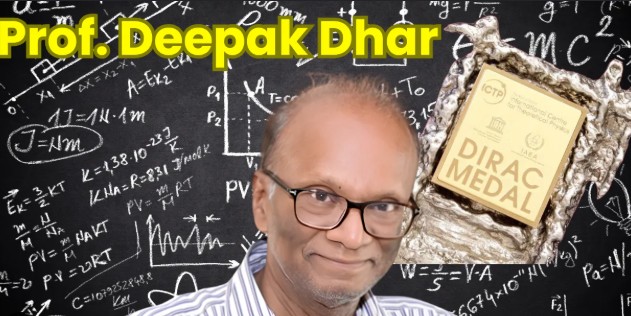
Indian theoretical physicist Professor Deepak Dhar has been awarded the 2026 Dirac Medal and Prize by the International Centre for Theoretical Physics (ICTP), recognising his influential contributions to statistical mechanics and the understanding of complex physical systems.
The honour, announced around the annual Dirac Medal date of August 8, places Dhar among an elite group of theoretical physicists whose work has significantly shaped modern physics. The ICTP describes the Dirac Medal as its premier physics prize and awards it annually to scientists who have made significant contributions to theoretical physics.
For Indian science, the recognition is particularly significant. Dhar has spent decades developing analytical approaches to difficult problems involving statistical physics, random systems, fractals and collective behaviour.
What Is the Dirac Medal?
The Dirac Medal was established by ICTP in 1985 in honour of British physicist Paul Adrien Maurice Dirac, one of the major figures of 20th-century theoretical physics.
The award is presented annually on Dirac’s birthday, August 8, to scientists who have made significant contributions to theoretical physics.
An international committee of distinguished scientists selects the recipients from nominated candidates. Previous recipients include some of the most influential physicists of the modern era.
The award has particular prestige within theoretical physics because it recognises fundamental work that can reshape how scientists understand complex physical phenomena.
Why Deepak Dhar Was Recognised
Dhar’s research has focused extensively on statistical mechanics, a branch of physics that uses mathematical methods to understand how the collective behaviour of enormous numbers of particles produces observable physical properties.
His work has addressed challenging problems involving:
- Random systems
- Statistical mechanics
- Stochastic processes
- Fractals
- Percolation
- Random lattices
- Self-organised criticality
- Collective behaviour in complex systems
The importance of Dhar’s research lies partly in his ability to obtain exact analytical results in areas where complex interactions often make mathematical solutions extremely difficult.
Understanding Statistical Mechanics in Simple Terms
Statistical mechanics may sound highly specialised, but its central question is relatively intuitive:
How does the behaviour of countless individual particles produce the properties we observe in the world around us?
A physical system may contain an enormous number of particles. Tracking every particle individually is usually impossible.
Statistical mechanics provides mathematical tools for studying the system collectively.
It helps physicists understand phenomena associated with:
Particles → Interactions → Collective behaviour → Observable physical properties
This framework has applications across physics and connects with areas including materials science, condensed matter physics and complex systems.
Dhar’s work has contributed to understanding systems in which randomness, disorder and collective behaviour play important roles.
Deepak Dhar and Self-Organised Criticality
One of the areas strongly associated with Dhar’s scientific career is self-organised criticality.
The concept describes systems that can naturally evolve towards a critical state without requiring an external controller to tune them precisely.
A classic conceptual example is a pile of grains. As grains are gradually added, the system can reach a state where small additions sometimes cause only minor changes while at other times they trigger much larger rearrangements.
The idea provides a framework for understanding how complex systems can develop large-scale behaviour through simple local interactions.
Dhar’s theoretical work on such systems helped establish exact mathematical results and contributed to the broader development of statistical physics.
From Statistical Physics to Complex Systems
Dhar’s research has also explored problems involving random lattices, fractals, percolation and stochastic processes.
These subjects examine systems where randomness and structure interact.
For example, percolation theory studies how connected structures emerge when elements are randomly added or removed from a system.
Such mathematical models can help researchers understand broader questions involving connectivity, disorder and phase transitions.
Dhar’s contributions have helped deepen the theoretical understanding of these systems and demonstrated how seemingly complicated phenomena can sometimes yield precise mathematical descriptions.
A Career Built Around Fundamental Physics
Dhar’s latest international recognition is the result of a scientific career spanning several decades.
His contributions to statistical physics have already received major recognition in India.
The official record of the Shanti Swarup Bhatnagar Prize notes that Dhar received the award in 1991 in the Physical Sciences category. His citation highlighted his work on the theoretical understanding of statistical mechanics and kinetics on random lattices, including research involving fractals, directed lattice animals, directed percolation and self-organised criticality.
That earlier recognition provides context for the significance of the 2026 Dirac Medal.
Why the 2026 Dirac Medal Matters for Indian Science
The award is important beyond the individual achievement.
Dhar’s recognition highlights the continuing global relevance of fundamental theoretical research conducted by Indian scientists and institutions.
Fundamental physics does not always produce immediate commercial applications. Its value often emerges over decades, as mathematical frameworks developed to understand abstract problems eventually influence other areas of science and technology.
The recognition therefore also underscores the importance of supporting:
- Fundamental research
- Mathematics-intensive sciences
- Long-term academic projects
- Theoretical physics
- Research institutions
- Young scientists and doctoral researchers
Deepak Dhar Joins an Elite List of Dirac Medallists
The Dirac Medal’s history includes many leading theoretical physicists.
The award has been given to scientists working across areas such as:
- General relativity
- Quantum physics
- Cosmology
- String theory
- Statistical physics
- Condensed matter physics
- Particle physics
Recent recipients include prominent scientists whose work has had a profound impact on modern theoretical physics. ICTP notes that the medal is often awarded to pioneers whose contributions influence generations of researchers.
Dhar’s recognition adds an important statistical-physics contribution to that history.
Why Exact Solutions Matter in Physics
A major feature of Dhar’s research has been the pursuit of exact results.
In theoretical physics, many real-world systems are so complicated that researchers have to rely on approximations, numerical calculations or simulations.
An exact analytical solution, when possible, can reveal deeper principles.
It can tell researchers not merely what happens in one numerical experiment but why a particular behaviour occurs and how it changes under different conditions.
This is one reason theoretical contributions to statistical mechanics can remain influential long after the original research is published.
A Scientist’s Work That Connects Order and Randomness
At the heart of Dhar’s research is a recurring scientific challenge:
How can simple rules and random interactions produce organised, large-scale behaviour?
This question appears in many areas of modern science.
Statistical physics provides tools for approaching it, while concepts such as percolation, fractals and self-organised criticality offer different mathematical perspectives.
Dhar’s work has helped demonstrate that even systems dominated by randomness can sometimes exhibit highly structured and mathematically predictable behaviour.
Deepak Dhar’s Recognition and the Future of Theoretical Physics
The Dirac Medal comes at a time when theoretical physics continues to expand into new areas.
Statistical mechanics increasingly intersects with:
- Quantum information
- Complex systems
- Biological physics
- Materials science
- Computational science
- Network science
- Machine learning
The mathematical tools developed for studying collective behaviour can therefore find relevance far beyond traditional statistical physics.
This makes foundational research such as Dhar’s particularly valuable for the next generation of scientists.
Deepak Dhar 2026 Dirac Medal: Key Facts
| Key Point | Details |
|---|---|
| Scientist | Professor Deepak Dhar |
| Award | 2026 Dirac Medal and Prize |
| Awarding body | International Centre for Theoretical Physics (ICTP) |
| Field | Theoretical physics / statistical mechanics |
| Key research areas | Statistical mechanics, random systems, fractals, percolation, self-organised criticality |
| Dirac Medal established | 1985 |
| Named after | P. A. M. Dirac |
| Award date tradition | August 8, Dirac’s birthday |
| Major Indian award | Shanti Swarup Bhatnagar Prize, 1991 |
| Bhatnagar discipline | Physical Sciences |
The ICTP confirms that the Dirac Medal was first awarded in 1985 and is presented annually to scientists for significant contributions to theoretical physics. India’s official award record confirms Dhar’s 1991 Shanti Swarup Bhatnagar Prize in Physical Sciences.
The Bigger Significance of the Dirac Medal
Deepak Dhar’s 2026 Dirac Medal is more than another addition to an already distinguished list of awards.
It is recognition of a body of work that has helped explain how randomness, interactions and collective behaviour can produce complex physical phenomena.
For Indian science, the honour is also a reminder that globally influential research can emerge from sustained engagement with fundamental questions.
As physics increasingly explores complex systems and the boundaries between different scientific disciplines, the mathematical ideas developed through statistical mechanics are likely to remain relevant.