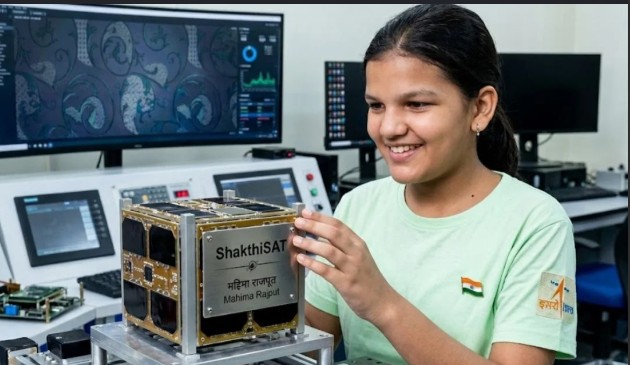
In an inspiring story that showcases the growing scientific potential of India’s youth, Class 10 student Mahima Rajput has been selected to contribute to ShakthiSAT, a student-led lunar mission that aims to carry innovative payloads to the Moon. Her achievement has captured national attention, highlighting how school students are increasingly becoming active participants in India’s expanding space ecosystem.
Mahima’s selection is not just a personal milestone but also reflects the growing opportunities available to young innovators through space education programmes, STEM initiatives, and hands-on scientific research. As India continues to strengthen its presence in global space exploration, stories like hers demonstrate that the next generation of scientists is already making its mark.
A Young Innovator Making National Headlines
Mahima Rajput, a Class 10 student from Madhya Pradesh, has earned a coveted place in the ShakthiSAT Moon Mission, becoming one of the youngest participants associated with an Indian lunar research initiative.
Her journey reflects the increasing role of school students in advanced scientific projects. Rather than limiting learning to textbooks, programmes like ShakthiSAT encourage students to apply scientific concepts to real-world challenges, fostering creativity, problem-solving and innovation from an early age.
Her achievement also underscores the importance of nurturing curiosity and providing students with platforms where they can contribute to cutting-edge research.
What Is the ShakthiSAT Moon Mission?
ShakthiSAT is an educational and research-oriented satellite mission designed to engage students in the rapidly evolving field of space science. The mission seeks to provide young learners with practical exposure to satellite technology, payload development and lunar exploration.
Unlike traditional classroom projects, ShakthiSAT enables students to participate in scientific research that has the potential to contribute to future space missions. By involving school and college students, the initiative aims to inspire a new generation of scientists, engineers and innovators.
The project reflects India’s growing emphasis on making space education more accessible and encouraging youth participation in emerging technologies.
Why Mahima’s Achievement Is Significant
Mahima’s selection demonstrates that scientific talent can emerge at any age when students are provided with the right opportunities and mentorship.
Her success highlights several important trends shaping India’s education landscape:
Growing Focus on STEM Education
Schools across India are increasingly encouraging students to explore science, technology, engineering and mathematics through practical learning rather than theoretical instruction alone.
Early Research Opportunities
Students today have access to innovation competitions, science fairs, robotics programmes and satellite projects that were once limited to higher education institutions.
Encouraging Scientific Temper
Participation in space-related initiatives nurtures curiosity, analytical thinking and problem-solving—qualities that are essential for the future workforce.
India’s Expanding Space Education Ecosystem
Over the past decade, India has witnessed remarkable growth in space education and student participation.
Several initiatives have opened new avenues for young learners:
- Student satellite development programmes
- Space innovation competitions
- Astronomy clubs in schools
- Robotics and coding initiatives
- STEM laboratories
- Research mentorship programmes
- Space technology workshops
These programmes complement India’s broader achievements in space exploration and encourage students to view science as a career filled with opportunities.
The Rise of Student Participation in Space Missions
India’s space sector is no longer limited to scientists working in research laboratories. Students are increasingly contributing through innovative ideas, experimental payloads and technology projects.
Educational missions such as ShakthiSAT aim to:
- Promote scientific curiosity among school students.
- Encourage innovation through project-based learning.
- Provide exposure to satellite technology.
- Develop future researchers and engineers.
- Strengthen India’s innovation ecosystem.
By participating in such missions, students gain valuable experience that extends beyond classroom learning.
How Schools Are Becoming Innovation Hubs
Mahima’s journey reflects a broader transformation taking place in Indian schools.
Modern education is placing greater emphasis on:
Experiential Learning
Students are encouraged to learn through experiments, projects and real-world applications.
Research-Based Education
Schools increasingly support participation in national and international science competitions.
Technology Integration
Artificial intelligence, robotics, coding and space science are becoming part of co-curricular learning.
Innovation and Entrepreneurship
Students are motivated to develop original ideas and solve practical challenges through scientific thinking.
What This Means for Young Aspirants
Mahima Rajput’s achievement sends an important message to students across the country: meaningful contributions to science and technology are possible even during school years.
Her story demonstrates that success in scientific fields depends not only on age but also on curiosity, perseverance and the willingness to explore new ideas.
For aspiring young innovators, participation in STEM clubs, science exhibitions, coding competitions and research initiatives can serve as valuable stepping stones towards future careers in science and technology.
The Bigger Picture: Inspiring the Next Generation
India’s growing investment in science education is creating opportunities that were unimaginable for school students a decade ago. As the country expands its ambitions in space exploration, artificial intelligence, clean energy and advanced technologies, nurturing young talent has become increasingly important.
Achievements like Mahima’s highlight how early exposure to scientific research can inspire lifelong careers in innovation and contribute to building a knowledge-driven economy.