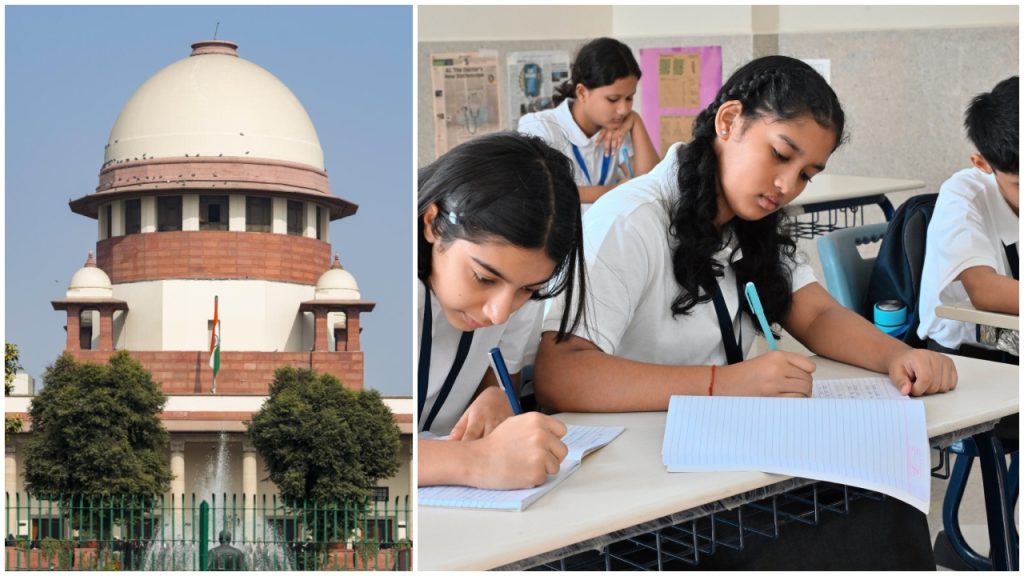
India’s push towards multilingual education has encountered a significant implementation hurdle, with the Supreme Court asking the Central Board of Secondary Education (CBSE) to consider exempting the current Class 6 batch from the new three-language framework.
The development comes amid petitions challenging aspects of CBSE’s decision to introduce a mandatory three-language structure as part of its alignment with the National Education Policy (NEP) 2020 and the National Curriculum Framework for School Education (NCF-SE) 2023.
Why the Current Class 6 Batch Is at the Centre of the Debate
The issue is not simply about whether students should learn more languages. It is about when and how a major curriculum change should be introduced.
The court has previously indicated that introducing the three-language approach is not inherently problematic, but expressed concern about the manner and timing of its implementation. The latest intervention seeks to prevent students who have already begun their academic journey under existing arrangements from facing an abrupt change in requirements.
For students and parents, the concern is practical. A new language requirement can mean additional classes, textbooks, teachers and assessments. If introduced without sufficient preparation, a policy designed to broaden learning could instead become an additional academic burden.
What Does the New CBSE Three-Language Policy Say?
Under the revised framework, students are expected to study three languages, with at least two being Indian languages. The reform is part of CBSE’s effort to bring its school curriculum in line with NEP 2020 and NCF-SE 2023.
The framework also changes the position of foreign languages. A student choosing a foreign language cannot simply substitute it for one of the required Indian languages. Instead, a foreign language can be taken as the third language after two Indian languages, or as an additional fourth language.
The policy is intended to strengthen multilingual learning while giving greater space to Indian languages within the school curriculum.
The Class 9 Question
The controversy has also centred on students entering Class 9, for whom the three-language structure became compulsory from July 1, 2026.
CBSE’s framework requires R1, R2 and R3, with at least two languages being Indian languages. To reduce pressure, the Board has said that there will be no Class 10 board examination for the third language. Until dedicated R3 textbooks become available, schools have also been instructed to use the relevant Class 6 R3 textbooks for the current academic session.
This arrangement highlights the larger challenge facing the reform: policy changes require not only new rules but also teachers, textbooks, timetables and clear instructions for schools.
Language Learning vs Academic Load
There is little doubt that multilingual education can provide students with broader cultural and communication skills. India’s linguistic diversity also makes language education an important part of its school system.
But educational reform has to consider the realities of classrooms.
A student already following an established timetable may suddenly have to accommodate another language without corresponding changes to teaching resources or school schedules. The Supreme Court has stressed that children should not be subjected to unnecessary pressure because of the way the policy is introduced.
That distinction is important. The debate is increasingly about implementation rather than the broader objective of multilingual education.
Schools Face a Practical Challenge
For CBSE schools, implementing the policy across classes requires considerable preparation.
Schools need qualified language teachers, appropriate learning materials and sufficient classroom time. They also need to communicate clearly with parents about available language choices and assessment arrangements.
CBSE had earlier asked schools to update their third-language offerings for Classes 6 to 9 through the OASIS portal.
These administrative requirements may appear routine, but they determine whether a curriculum reform works effectively on the ground.
A Wider NEP 2020 Reform
The three-language policy should also be viewed within the larger transformation envisaged by NEP 2020.
The policy places considerable emphasis on multilingualism and encourages learning in Indian languages. The new CBSE framework represents an attempt to translate those broader objectives into classroom practice.
The challenge is to ensure that the transition does not undermine the educational benefits the reform seeks to create.
For policymakers, the Supreme Court’s intervention therefore offers an opportunity to reconsider the sequencing of implementation. A phased approach could allow schools more time to recruit teachers, develop materials and prepare students and parents.
What Happens Next?
The Supreme Court’s latest direction does not amount to a rejection of the three-language policy itself. Instead, it puts the spotlight on the transition arrangements for students already enrolled in the system.
The government and CBSE are expected to work through the practical modalities of implementation while the legal proceedings continue. Earlier, the Centre had told the court that it was working on suggestions for implementing the policy and had sought additional time.
For students and parents, the immediate issue is clarity.
Curriculum reforms can succeed only when schools have the resources to implement them and families understand what is expected. The Supreme Court’s intervention has brought that principle into sharp focus.
The CBSE three-language policy may ultimately become an important step towards multilingual education, but its success will depend not merely on the number of languages students are asked to learn. It will depend on whether the transition is gradual, adequately resourced and sensitive to the academic realities of children already inside the system.