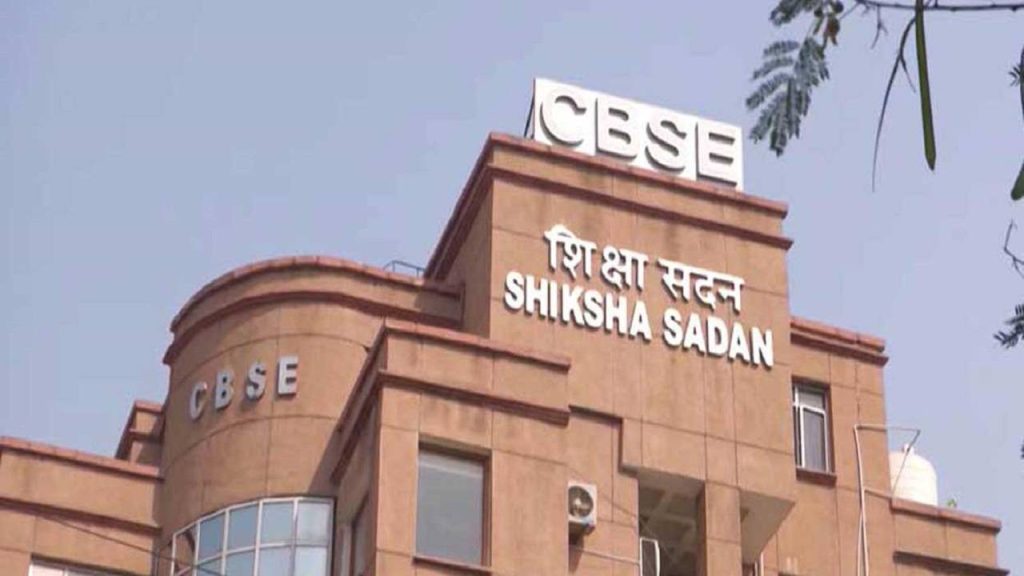
The CBSE Board Exams 2027 may still be months away, but the Central Board of Secondary Education has already begun one of the most important stages of the examination process: preparing and verifying candidate data.
The board has initiated its pre-examination activities for students appearing in CBSE Class 10 and Class 12 board exams 2027, with a major focus on digitising examination-related records. The move is aimed at managing the enormous volume of student information while reducing errors that could arise from manual processing.
The exercise involves scanning and processing “flying slips” containing important candidate information such as names, identification numbers, roll numbers, centre numbers and subject codes. CBSE has invited bids to appoint an agency equipped to process these records using Intelligent Character Recognition (ICR), Optical Character Recognition (OCR) and Optical Mark Recognition (OMR) technologies.
Nearly 30 lakh students expected to appear
The scale of the operation explains why CBSE is relying increasingly on digital systems.
According to the details of the exercise, approximately 29.89 lakh students from Classes 10 and 12 are expected to appear for the 2027-28 board examinations across CBSE’s 24 regional offices. The projected numbers include around 18 lakh Class 12 students and roughly 25–26 lakh Class 10 students, with the figures reflecting the large volume of examination records that must be processed.
Handling such a volume entirely through manual processes would be both time-consuming and vulnerable to errors. CBSE has therefore been moving its pre-examination procedures online and using digital verification systems over the past few years.
For students, this behind-the-scenes process is significant because accurate candidate information is essential for everything from examination centre allocation to roll numbers and subject details.
What are CBSE flying slips?
Flying slips are documents containing key information about candidates appearing for the board examinations.
The records include details such as the candidate’s name, roll number, identification number, centre number and subject code. The information captured from these slips is subsequently matched against the admission master maintained by CBSE.
The digitisation process will involve scanning the documents, generating raw data, checking the information and identifying discrepancies. Invalid or duplicate entries will also have to be detected and corrected before the final database is prepared.
This creates an additional layer of verification before students finally sit for their examinations.
OCR, OMR and ICR to power the process
The CBSE Board Exams 2027 preparations highlight how technology is becoming increasingly important in managing India’s large-scale school examinations.
OCR, or Optical Character Recognition, enables printed information to be converted into machine-readable data. OMR, or Optical Mark Recognition, is commonly used to read marked responses on specially designed forms, while ICR, or Intelligent Character Recognition, is used for recognising handwritten or more complex character information.
The agency selected for the project will be responsible for scanning the flying slips, processing the resulting information and checking it against CBSE’s existing candidate database.
Any mismatch in candidate names, roll numbers, identification numbers, centre numbers or subject codes will have to be reported and corrected.
Schools still have a role in checking student details
Although the process is increasingly digital, schools and families remain an important part of candidate-data verification.
Once candidate information is generated, schools can provide students and parents with the relevant details for checking. Corrections can then be made before the final data is submitted.
This step is particularly important because even a small discrepancy in a student’s personal or examination information can create complications later in the examination process.
The shift from manual to digital verification is therefore not simply about speed. It is also intended to create a more systematic mechanism for identifying and correcting errors before the examination stage.
Pre-examination work is now a year-round process
The CBSE examination system operates in three broad stages: pre-examination activities, the examination period and post-examination activities.
The current flying-slip exercise falls under the first category. According to the reported tender details, the scanning and data-processing work is generally undertaken multiple times during the year, including for the main board examinations and compartment examinations.
This means that the infrastructure being developed for CBSE board exam preparation is not limited to a single examination cycle. It supports the board’s wider examination-management system.
Why the move matters for CBSE students
For students preparing for CBSE Class 10 and 12 board exams 2027, the digitisation exercise may appear distant from their everyday studies. Yet accurate examination data is one of the foundations of a smooth board examination.
With millions of students, thousands of schools and multiple regional offices involved, CBSE needs systems capable of handling large volumes of information quickly and accurately.
The move also reflects a broader transformation in India’s examination ecosystem, where technology is increasingly being used for registration, candidate verification, evaluation, result processing and other administrative functions.
A digital foundation for Board Exams 2027
The early start to preparations sends a clear message: conducting a national-level board examination is a massive logistical exercise that begins long before students enter examination halls.
For CBSE Board Exams 2027, the emphasis on OCR, OMR and ICR-based processing is part of an effort to make candidate-data management faster, more accurate and less dependent on manual intervention.
As nearly 30 lakh students prepare for their academic milestones, much of the groundwork will happen quietly behind the scenes. The success of these systems could ultimately help CBSE reduce administrative errors and ensure that the examination process remains organised at a scale few school examinations can match.