Date: November 28, 2026
Place: Hong Kong
Education News: Study Abroad, International Admissions and Robotics Engineering
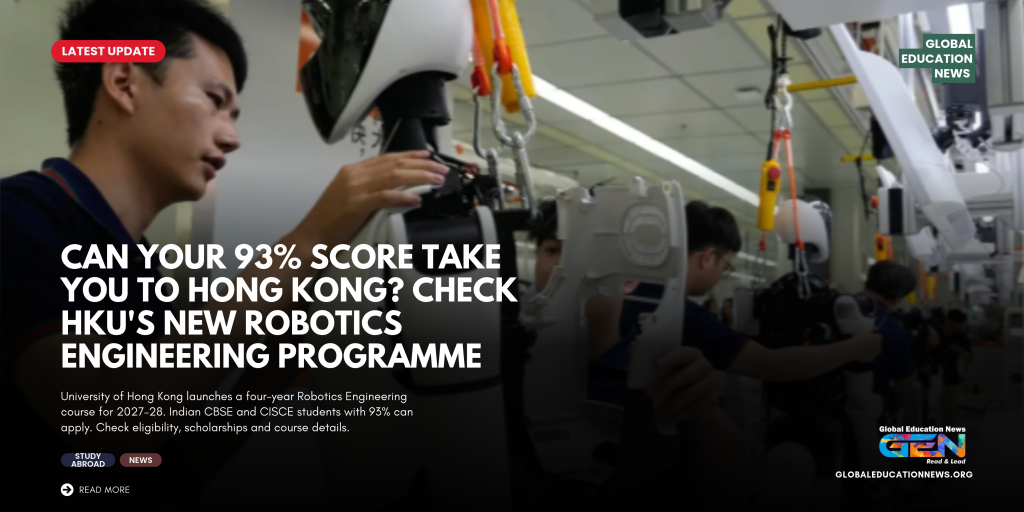
Hong Kong, Education News: Indian students interested in robotics, artificial intelligence and advanced engineering have a new international study opportunity. The University of Hong Kong (HKU) has introduced a four-year Bachelor of Engineering (BEng) programme in Robotics Engineering for the 2027–28 academic session. Indian students with an expected overall average of at least 93% in five CBSE or CISCE Class 12 subjects can apply.
The new programme is designed to prepare students for emerging technology careers involving intelligent robots, autonomous systems, artificial intelligence and advanced manufacturing. It combines engineering fundamentals with practical laboratory work, design projects, research opportunities and industry exposure.
One of its distinctive features is a two-city academic model. Students will spend their third year at HKU’s Zhangjiang Base in Shanghai, gaining exposure to one of China’s major technology and manufacturing ecosystems. The university is also offering a HK$50,000 studentship to support eligible expenses associated with this study period.
For Indian students considering engineering education abroad, the announcement raises important questions about eligibility, course structure, scholarships, fees and future career opportunities.
HKU Robotics Engineering Admission 2027–28: Who Can Apply With 93% in Class 12?
The University of Hong Kong has specified an expected academic benchmark for Indian applicants from CBSE and CISCE boards.
Students with an overall average of 93% or better in five Class 12 subjects can apply for the programme.
However, meeting this academic benchmark does not guarantee admission. HKU will consider applications through a broader assessment process that may include:
- Class 12 academic performance
- Mathematics and science subject requirements
- English-language requirements
- Personal statement
- Interview performance
- Reference letters and supporting documents
The programme welcomes applicants from different educational systems, including CBSE, CISCE, International Baccalaureate (IB) and Cambridge A-level qualifications.
What Are the Academic Requirements for Other Boards?
The university has also outlined expected academic benchmarks for other international qualifications.
| Educational qualification | Expected academic benchmark |
|---|---|
| CBSE | 93% or better average in five subjects |
| CISCE | 93% or better average in five subjects |
| International Baccalaureate | 39 points |
| GCE A-level / International A-level | Three A* grades |
These are expected academic benchmarks. Applicants should check the university’s official admissions requirements for subject prerequisites, English-language qualifications and any changes to the requirements for the 2027–28 intake.
What Will Students Study in HKU’s Robotics Engineering Programme?
The new degree is a four-year interdisciplinary engineering programme developed through the collaboration of four departments within HKU’s Faculty of Engineering.
The programme combines knowledge from:
- Mechanical Engineering
- Electrical and Computer Engineering
- Data and Systems Engineering
- Civil Engineering
The objective is to help students understand how different engineering disciplines work together to design and develop intelligent robotic systems.
Year 1 and Year 2: Engineering Fundamentals
The first two years focus on building a strong foundation in engineering and technology.
Students will study subjects such as:
- Engineering mathematics
- Mechanics
- Electrical circuits
- Programming
- Artificial intelligence
- Fundamental engineering concepts
Students without previous coding or robotics experience can also apply, provided they meet the programme’s academic and subject requirements. The curriculum is designed to introduce important fundamentals before progressing to specialised robotics topics.
Advanced Years: Robotics, AI and Autonomous Systems
As students progress through the programme, they will explore specialised areas, including:
- Robotic modelling
- Sensing and perception
- Control systems
- Embedded computing
- AI-driven autonomous systems
- Intelligent robotics
Laboratory sessions, multidisciplinary design projects and an integrated final-year project will help students connect theoretical knowledge with practical engineering applications.
Hong Kong–Shanghai Study Model: Why Will Students Spend Their Third Year in China?
One of the most distinctive features of the programme is its two-city academic structure.
Students will complete their first two years at HKU in Hong Kong before spending their entire third year at the university’s Zhangjiang Base in Shanghai.
The arrangement is designed to expose students to two major technology and innovation environments.
| Study location | Academic exposure |
|---|---|
| Hong Kong | Engineering fundamentals, university research and international academic environment |
| Shanghai | Advanced manufacturing, robotics companies and technology ecosystem |
Shanghai is an important centre for manufacturing, robotics and intelligent hardware. Studying there will give students an opportunity to understand how engineering research and technology are translated into practical applications.
What Is the HK$50,000 Studentship?
HKU is offering a HK$50,000 studentship to support students during their third-year stay in Shanghai.
The financial support is intended to help with:
- Round-trip airfare
- Accommodation near the study location
- Living expenses during the academic stay
Students should check the university’s official programme and financial-aid information for the applicable conditions and payment arrangements.
What Scholarships Can Indian Students Get at HKU?
Apart from the Shanghai studentship, the university offers merit-based entrance scholarships for non-local students.
Some scholarships for high-performing CBSE applicants may cover:
- Full tuition fees
- Accommodation
- A living allowance
Scholarship awards are competitive and depend on the university’s eligibility and selection criteria. Students should not assume that meeting the 93% academic benchmark automatically makes them eligible for a full scholarship.
The programme also includes the ROBO Undergraduate Research Matching Scheme. It connects academically strong and motivated students in Year 2 or above with professors working in relevant robotics research areas.
Eligible graduates may also apply for a HK$100,000 entrance scholarship for selected taught master’s programmes in HKU Engineering, subject to the applicable academic requirements and admission decisions.
What Career Opportunities Can Students Explore After a Robotics Engineering Degree?
Robotics is increasingly connected with industries that use automation, intelligent machines and AI-powered systems.
Graduates of the programme will be prepared to explore career and higher-study opportunities in areas such as:
| Career area | Potential work |
|---|---|
| Robotics engineering | Designing and developing robotic systems |
| Artificial intelligence | Building intelligent software and machine-learning applications |
| Autonomous vehicles | Working on perception, navigation and control technologies |
| Drones and aerial robotics | Developing autonomous aerial systems |
| Advanced manufacturing | Improving automated industrial processes |
| Healthcare technology | Supporting the development of medical and assistive robotics |
| Research and development | Working on new robotic technologies and intelligent systems |
Students may also consider postgraduate education, including master’s and doctoral research in robotics, artificial intelligence and related engineering fields.
The actual career opportunities will depend on students’ skills, experience, academic performance and the employment requirements of different countries and organisations.
Why Is Robotics Engineering Becoming an Important Course for Indian Students?
Robotics is no longer limited to industrial manufacturing. Its applications are expanding across healthcare, agriculture, logistics, construction, transportation and research.
The technology combines several engineering disciplines. A modern autonomous robot may require mechanical components, electrical systems, sensors, computing hardware, software and artificial intelligence to work together.
This interdisciplinary approach is one reason universities are introducing dedicated robotics programmes instead of teaching robotics only as a specialised subject within conventional engineering degrees.
For Indian students, the HKU programme offers an opportunity to study these technologies in an international academic environment while gaining exposure to the manufacturing and innovation ecosystems of Hong Kong and Shanghai.
How Can Indian Students Apply for HKU Robotics Engineering Admission 2027–28?
Indian applicants can explore the programme through the university’s international and Non-JUPAS admissions routes.
The application process generally requires candidates to:
- Visit the official University of Hong Kong admissions website.
- Find the Bachelor of Engineering in Robotics Engineering programme.
- Review the academic eligibility requirements for their board or qualification.
- Check the Mathematics, science and English-language requirements.
- Prepare academic transcripts and supporting documents.
- Submit the application through the relevant admissions route.
- Follow any interview or additional assessment instructions issued by the university.
Official university website: https://www.hku.hk/
Important: Applicants should confirm the application deadline, tuition fees, required documents and scholarship conditions directly through HKU’s official admissions portal. These details should not be assumed from the 93% academic benchmark alone.
Frequently Asked Questions (FAQs)
1. Which university has launched the new Robotics Engineering programme?
The University of Hong Kong (HKU) has introduced a four-year Bachelor of Engineering in Robotics Engineering for the 2027–28 academic session.
2. Can Indian students with 93% in Class 12 apply?
Yes. Indian students from CBSE and CISCE boards with an expected overall average of at least 93% in five subjects can apply. Meeting the benchmark does not guarantee admission.
3. Is the HKU Robotics Engineering programme a four-year degree?
Yes. It is a four-year undergraduate Bachelor of Engineering programme.
4. Will students need previous coding or robotics experience?
Previous coding or robotics experience is not essential. The programme begins with engineering fundamentals, including mathematics, mechanics, electrical circuits, programming and AI.
5. Why will students study in Shanghai during the third year?
Students will spend their entire third year at HKU’s Zhangjiang Base in Shanghai to gain exposure to the city’s technology, robotics and advanced manufacturing ecosystem.
6. What is the HK$50,000 studentship offered by HKU?
The studentship is intended to help cover round-trip airfare, accommodation near the study location and living expenses during the third-year stay in Shanghai.
7. Can Indian students receive scholarships at HKU?
Yes. HKU offers merit-based scholarships for non-local students, including awards for top CBSE applicants that may cover tuition, accommodation and living expenses. Awards are subject to eligibility and selection.
8. What subjects are important for admission to Robotics Engineering?
Mathematics is particularly important. Applicants must also meet the programme’s science and English-language requirements. Biology, Chemistry or Physics may satisfy the specified science-subject requirement, subject to the university’s admission rules.
9. What career opportunities are available after studying Robotics Engineering?
Graduates can explore opportunities in robotics, AI, autonomous vehicles, drones, advanced manufacturing, research and related technology fields.
Conclusion
The University of Hong Kong’s new Robotics Engineering programme creates another international study opportunity for Indian students interested in artificial intelligence, automation and intelligent machines. With an expected 93% academic benchmark for CBSE and CISCE applicants, a four-year interdisciplinary curriculum and a third-year study experience in Shanghai, the programme offers a distinctive combination of engineering education and international exposure.
For students considering engineering after Class 12, it is worth exploring the eligibility requirements, scholarship opportunities and financial commitments before applying. The 93% benchmark is an important starting point, but admission will depend on the university’s complete selection process.
Follow Global Education News for the latest international university admissions, study-abroad opportunities, engineering courses, scholarships and career updates.