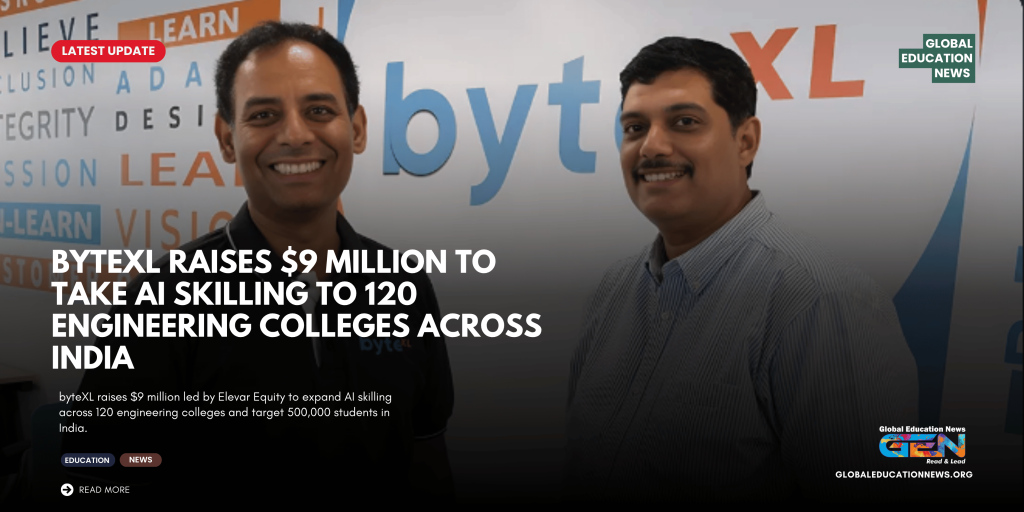
October 8, 2026 | Hyderabad | Education News: India’s education technology sector is seeing another major investment in AI and technology skilling, with EdTech company byteXL raising $9 million in a funding round led by Elevar Equity.
The company plans to use the fresh capital to strengthen its AI-driven learning platform and significantly expand its presence across India’s engineering education ecosystem. byteXL aims to grow from around 40 engineering institutions to 120 institutions across 15 states, with a longer-term target of reaching 500,000 students over the next two years.
The expansion will particularly focus on partnerships with tier-II and tier-III engineering colleges, where demand for industry-aligned AI, software and technology skills is increasing.
byteXL Funding: What is the $9 Million Investment for?
The latest byteXL funding will support the company’s next phase of growth, with artificial intelligence positioned at the centre of its learning and skilling strategy.
Rather than focusing only on direct-to-student online courses, the company is targeting engineering institutions through partnerships that can integrate technology training into students’ academic journeys.
| Key detail | Information |
|---|---|
| Company | byteXL |
| Sector | EdTech and technology skilling |
| Latest funding | $9 million |
| Lead investor | Elevar Equity |
| Current institutional reach | Around 40 engineering institutions |
| Expansion target | 120 institutions |
| Target geography | 15 states |
| Student target | 500,000 students |
| Target period | Next two years |
| Priority segment | Tier-II and tier-III engineering colleges |
| Key focus | AI and technology skilling |
Why is byteXL expanding AI skilling in engineering colleges?
The expansion comes at a time when artificial intelligence is rapidly changing the skills expected from engineering graduates.
Traditional engineering degrees increasingly need to be supplemented with practical capabilities in areas such as AI, software development, data technologies and emerging digital tools.
For colleges, particularly those outside India’s largest metropolitan education hubs, partnerships with specialised technology-skilling companies can provide access to industry-oriented curriculum, learning platforms and practical training.
byteXL’s strategy is therefore aimed at connecting engineering education more closely with the changing requirements of technology employers.
How will byteXL expand from 40 to 120 engineering institutions?
The company plans to more than double its institutional footprint, moving from approximately 40 engineering institutions to 120 across 15 states.
A major part of this strategy is expected to involve tier-II and tier-III engineering colleges.
These institutions represent a large potential student base, particularly as India’s technology workforce expands beyond traditional metropolitan centres.
By working directly with colleges, byteXL can potentially reach larger groups of students through institutional programmes rather than relying solely on individual student acquisition.
What does byteXL’s 500,000-student target mean?
byteXL has set a target of reaching 500,000 students over the next two years.
The target indicates the scale at which the company intends to operate its technology-skilling platform following the new investment.
Reaching this number would require significant expansion in institutional partnerships, course delivery and student participation.
The figure should be understood as a company-stated growth target, rather than an already achieved student count.
Why are tier-II and tier-III engineering colleges important for AI skilling?
India has a large and geographically distributed engineering education system.
While leading technology institutes and major metropolitan colleges often have greater access to specialised industry partnerships, many tier-II and tier-III institutions are looking for ways to strengthen students’ employability in emerging technology fields.
This makes such colleges an important market for AI skilling in India.
Partnership-based models can allow institutions to introduce additional technology training without having to build every component of an advanced AI curriculum internally.
For students, the potential benefit is access to practical technology learning alongside their conventional engineering programmes.
How could AI-driven learning change engineering education?
AI is increasingly influencing not only what engineering students learn but also how they learn.
AI-powered learning platforms can potentially support personalised learning paths, automated assessments, adaptive practice and targeted skill development.
However, the effectiveness of such platforms depends on curriculum quality, faculty involvement, student engagement and how closely the training is connected to real-world technology requirements.
The byteXL expansion places this model at the centre of its growth strategy.
What does the byteXL funding mean for engineering students?
For engineering students, the expansion could translate into greater access to AI, coding and technology-skilling programmes through their colleges.
Potential benefits include:
- Exposure to industry-oriented technology curricula.
- Greater access to AI-focused learning.
- Practical software and technology training.
- Additional opportunities for technology projects and assessments.
- Skill development alongside conventional engineering coursework.
- Greater access to technology training in tier-II and tier-III institutions.
The actual student experience, however, will depend on the programmes adopted by individual partner institutions.
Why is AI skilling becoming a major EdTech opportunity in India?
The rapid adoption of generative AI and other AI technologies is changing the employment landscape across technology and non-technology sectors.
For engineering graduates, skills that were once considered specialised are increasingly becoming part of broader technology roles.
This has created opportunities for EdTech companies that can provide structured AI and technology training at scale.
The institutional model is particularly significant because colleges can integrate such programmes into the student journey instead of leaving students to independently identify and purchase external courses.
What makes byteXL’s expansion strategy different?
The company’s stated strategy combines institutional partnerships, AI-driven learning and geographic expansion.
Instead of concentrating exclusively on India’s most prominent engineering institutes, byteXL is targeting a much broader network of colleges.
Its planned expansion from 40 to 120 institutions across 15 states also indicates an attempt to build a national technology-skilling network.
If the 500,000-student target is achieved, the company’s model would operate at considerably larger scale than its current institutional footprint.
byteXL Funding and AI Skilling: Key Takeaways
| Area | What it means |
|---|---|
| Funding | $9 million raised |
| Investor | Elevar Equity led the round |
| Technology focus | AI-driven learning and technology skills |
| Institutional expansion | 40 to 120 engineering institutions |
| Geographic reach | 15 states |
| Student ambition | 500,000 students in two years |
| Target institutions | Especially tier-II and tier-III engineering colleges |
| Student relevance | More access to AI and industry-oriented technology training |
FAQ: byteXL Funding and AI Skilling in India
How much funding has byteXL raised?
EdTech company byteXL has raised $9 million in a funding round led by Elevar Equity.
What will byteXL use the funding for?
The company plans to strengthen its AI-driven learning platform and expand its institutional partnerships across India’s engineering colleges.
How many colleges does byteXL plan to reach?
byteXL plans to expand from around 40 engineering institutions to 120 institutions across 15 states.
How many students does byteXL aim to reach?
The company has stated a target of reaching 500,000 students over the next two years.
Which colleges is byteXL targeting?
The expansion is particularly focused on tier-II and tier-III engineering colleges, alongside its broader institutional network.
Why is AI skilling important for engineering students?
AI is reshaping technology roles and increasing demand for practical skills in artificial intelligence, software development, data and related technologies. Additional AI training can therefore complement conventional engineering education.
Is byteXL’s 500,000-student target already achieved?
No. The 500,000 figure is a stated target for the next two years, not a current student count.
What is the main focus of byteXL’s platform?
The company’s expansion is centred on AI-driven learning and technology skilling, particularly for engineering students and institutions.
What this means for India’s engineering education sector
The $9 million byteXL funding round highlights the growing intersection between India’s engineering education system and the rapidly expanding demand for AI skills.
The company’s plan to expand across 120 institutions and reach 500,000 students could give more engineering students, particularly those studying outside major metropolitan centres, access to structured technology-skilling opportunities.
The larger question is whether institutional EdTech partnerships can successfully bridge the gap between engineering degrees and rapidly changing industry skill requirements.
As AI becomes increasingly embedded in technology jobs, that gap is likely to become an increasingly important issue for colleges, students and employers.
Global Education News will continue tracking major EdTech investments, AI-skilling initiatives, engineering education partnerships and developments shaping India’s future workforce.