For decades, literacy in India was measured by a simple question—can a person read and write? While this definition helped monitor educational progress, today’s rapidly evolving economy demands much more. Digital banking, online government services, AI-powered workplaces, healthcare awareness and financial inclusion require citizens to possess practical life skills beyond basic reading and writing.
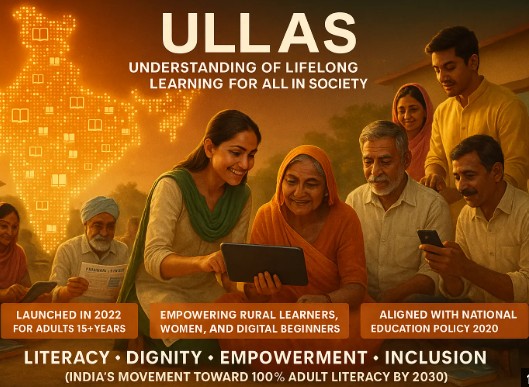
Recognising this shift, the Government of India’s ULLAS (Understanding of Lifelong Learning for All in Society) programme is transforming adult education into a comprehensive lifelong learning mission. Instead of merely teaching adults to read newspapers or sign documents, the initiative focuses on making them confident participants in India’s digital and knowledge-driven economy.
A New Era of Adult Education
The National Education Policy (NEP) 2020 views education as a lifelong journey rather than something limited to childhood. Following this vision, the Ministry of Education launched ULLAS as a nationwide programme for adults aged 15 years and above who either missed formal schooling or need to strengthen essential life skills.
The initiative represents one of India’s biggest shifts in adult education policy, aiming not only to eliminate illiteracy but also to improve employability, financial independence and social participation.
Literacy Today Means Much More Than Reading
Modern literacy has expanded far beyond recognising letters or writing one’s name. Under ULLAS, literacy is viewed as the ability to function effectively in everyday life.
Adults are encouraged to learn:
- Reading with understanding and comprehension
- Writing confidently in daily situations
- Basic mathematics and numeracy
- Digital literacy for smartphones and online services
- Financial literacy for banking and digital payments
- Health, hygiene and legal awareness
- Family welfare and childcare knowledge
- Civic participation and constitutional awareness
This broader understanding ensures that education becomes practical and immediately useful in daily life.
The Five Pillars of ULLAS
Rather than limiting adult education to literacy classes, the programme is built around five interconnected components.
1. Foundational Literacy and Numeracy
Adults learn essential reading, writing and arithmetic skills necessary for everyday activities.
2. Critical Life Skills
Participants receive practical knowledge in:
- Digital literacy
- Financial management
- Legal awareness
- Healthcare
- Family welfare
- Child education
These skills enable citizens to make informed personal and financial decisions.
3. Basic Education
Learners who wish to continue their education can pursue equivalency programmes aligned with primary, middle and secondary school levels.
4. Vocational Skills
The programme promotes employability by encouraging skill development linked to local economic opportunities, helping adults improve their income prospects.
5. Continuing Education
Education does not stop after literacy certification. Adults can continue learning through courses in arts, science, culture, technology, sports and community development, encouraging lifelong learning.
Technology is Becoming the New Classroom
One of the biggest innovations under ULLAS is the integration of digital technology into adult education.
Learners can access educational resources through the DIKSHA platform and dedicated digital tools in multiple Indian languages. Volunteers, teachers and community members help guide learners while allowing flexibility through online and offline learning.
This hybrid approach enables adult learners in both urban and rural India to continue learning according to their own schedules.
Volunteerism Powers the Mission
Unlike conventional education programmes that rely solely on professional teachers, ULLAS places strong emphasis on community participation.
Teachers, college students, retired professionals, government employees and educated citizens are encouraged to become volunteer instructors.
This volunteer-driven model reduces implementation costs while strengthening community ownership of literacy campaigns, making education a shared social responsibility rather than only a government initiative.
Why Digital Literacy Has Become Essential
India’s rapid digital transformation has changed how citizens access almost every public service.
Today, adults increasingly need digital skills to:
- Use online banking and UPI payments
- Access government welfare schemes
- Book healthcare appointments
- Apply for jobs
- Complete online documentation
- Use e-governance services
- Communicate through digital platforms
Without these skills, many adults remain excluded despite being able to read and write.
ULLAS addresses this challenge by integrating digital literacy into the core curriculum rather than treating it as an optional subject.
Supporting Women’s Empowerment
Adult literacy programmes have historically played a significant role in improving women’s social and economic participation.
Through ULLAS, women gain access to:
- Financial independence
- Health awareness
- Digital banking
- Government welfare information
- Entrepreneurial opportunities
- Continued education
Research consistently shows that educating women positively influences children’s education, family health and community development, multiplying the long-term impact of literacy initiatives.
Progress Towards a Fully Literate India
Several states and Union Territories have reported major improvements in adult literacy through community participation under the ULLAS framework. The programme aligns with India’s broader goal of achieving universal literacy while supporting the Sustainable Development Goals related to quality education and inclusive growth. Recent milestones achieved by states demonstrate how volunteer-led campaigns and technology-enabled learning can accelerate literacy outcomes.
Challenges That Still Need Attention
Despite encouraging progress, several issues continue to require focused efforts:
- Identifying unreached adult learners
- Bridging the digital divide in remote areas
- Increasing awareness among eligible beneficiaries
- Sustaining volunteer participation
- Providing multilingual learning resources
- Ensuring regular assessment and certification
- Encouraging lifelong learning beyond basic literacy
Addressing these challenges will determine how effectively India can achieve universal functional literacy over the coming years.
Why ULLAS Matters for India’s Future
India is moving toward a knowledge-based economy where education is increasingly linked with employability, entrepreneurship and digital participation.
ULLAS reflects a significant policy shift—from treating literacy as the ability to read and write to recognising it as the foundation for active citizenship, financial inclusion, technological participation and lifelong learning.
As artificial intelligence, digital governance and skill-based employment continue to reshape society, adult education will play an equally important role alongside school education.
By empowering millions of adults with practical knowledge and confidence, ULLAS has the potential to transform families, communities and the nation’s workforce—making literacy not just an educational achievement but a pathway to inclusive development.