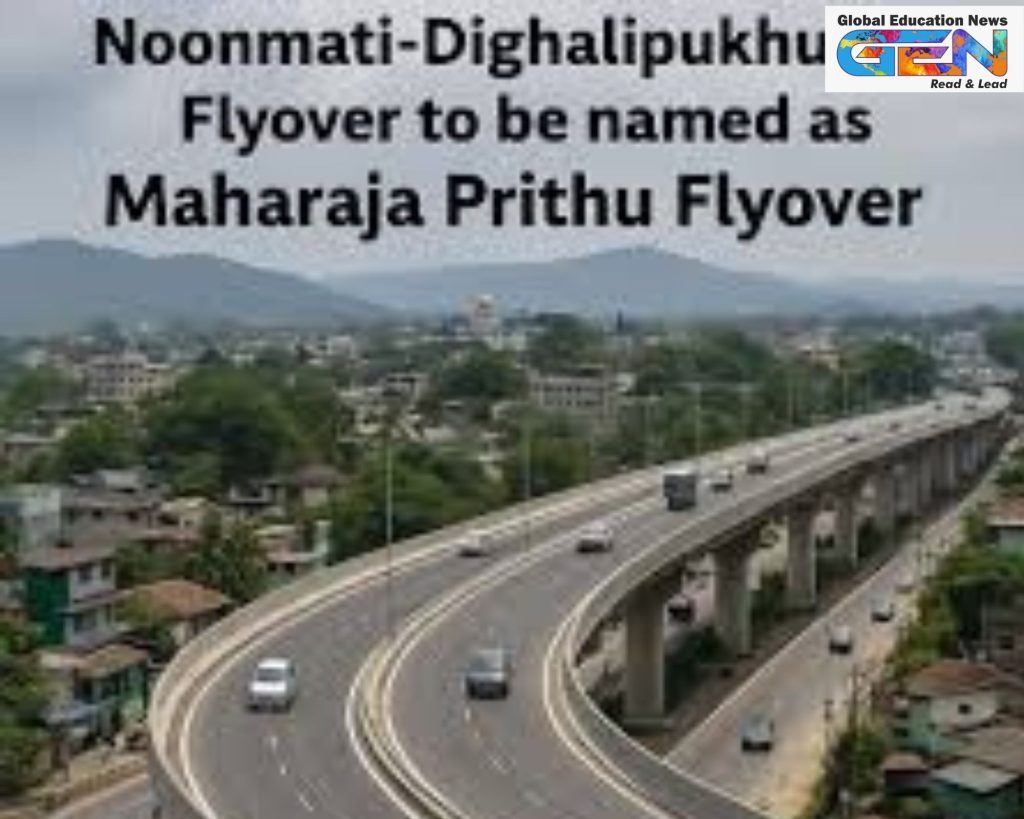
In a significant move to honor Assam’s historical legacy, the Assam Cabinet recently named the state’s longest flyover on Gopinath Bordoloi (GNB) Road in Guwahati the Maharaj Prithu Flyover on August 27, 2025. This decision, led by Chief Minister Himanta Biswa Sarma, celebrates Maharaja Prithu, a 13th-century ruler of the Kamarupa kingdom, credited with repelling the Turko-Afghan invasion led by Bakhtiyar Khilji in 1206 CE. The recognition elevates Prithu alongside Assam’s revered hero Lachit Borphukan, signaling a renewed focus on Assam’s role as a defender of Indian civilization.
- Key Points:
- Guwahati’s GNB Flyover named after King Prithu to honor his legacy.
- Chief Minister Sarma highlights Prithu’s victory as a defense of Bharat’s soul.
- Initiative aligns with efforts to promote Assam’s historical figures nationally.
Historical Context: Prithu’s Defiance in 1206 CE
King Prithu, also known as Visvasundaradeva or Prithu Rae, ruled the Kamarupa kingdom (modern-day Assam) from approximately 1185 to 1228 CE. His reign is most notable for thwarting Bakhtiyar Khilji, a Turko-Afghan general infamous for sacking Nalanda University and plundering Bengal. In 1206 CE, Khilji, leading a massive army of 12,000 cavalry and 20,000 infantry, aimed to invade Tibet via Kamarupa but was decisively defeated by Prithu’s forces near the Silassako stone bridge in North Guwahati.
- Key Points:
- Prithu led a multi-ethnic coalition of Bodo, Koch Rajbongshi, and Keot tribes.
- Employed a scorched earth policy to starve Khilji’s army of resources.
- Ambushed Khilji’s retreating forces, leading to a catastrophic defeat.
The Battle That Shaped Assam’s Legacy
Prithu’s victory in 1206 CE is recorded in the Tabaqat-i-Nasiri, a Persian chronicle, and the Kanai Boroxiboa rock inscription in North Guwahati, which marks the site of the battle. Using guerrilla warfare and strategic positioning on hilltops, Prithu’s coalition decimated Khilji’s army, preventing further incursions into Kamarupa. This victory is celebrated as one of India’s first major triumphs against Islamic invaders, avenging the destruction of Nalanda and other cultural centers.
- Key Points:
- Battle site near Silassako stone bridge, commemorated by an 817-year-old inscription.
- Prithu’s tactics included guerrilla warfare and strategic resource denial.
- Victory halted Khilji’s expansion, protecting Assam’s cultural heritage.
Later Invasions and Prithu’s End
Prithu faced two more invasions: one in 1226 CE by Ghiyasuddin Iwaj Shah, which he repelled, and another in 1228 CE by Nasiruddin Mahmud, son of Sultan Iltutmish. The 1228 invasion proved fatal, with Prithu facing a conspiracy and assassination. Refusing to surrender, he reportedly drowned himself in Maharajar Dighi, a tank in Bhitargarh, Rangpur (now Bangladesh), along with his guards, showcasing his unwavering commitment to his people.
- Key Points:
- Successfully repelled Ghiyasuddin’s invasion in 1226 CE.
- Defeated and killed in 1228 CE by Nasiruddin Mahmud’s forces.
- Chose death over submission, symbolizing his valor and loyalty.
Historical Debate: King or Chieftain?
Despite his celebrated status, Prithu’s identity remains debated. The Persian term ‘rae’ in Tabaqat-i-Nasiri suggests he may have been a local chieftain rather than a king, possibly rising from humble origins after the fall of the Pala Dynasty. The lack of indigenous records from the 13th century, coupled with political fragmentation in Assam, complicates efforts to establish his status. Some historians, like N.K. Bhattasali, argue that Prithu may have been a ruler from Awadh, not Kamarupa, due to misinterpretations in historical texts.
- Key Points:
- Persian texts describe Prithu as ‘rae,’ indicating a possible chieftain status.
- No contemporary indigenous records confirm his reign or title.
- Historians call for more archaeological research to clarify Prithu’s identity.
Sources and Evidence
Evidence of Prithu’s legacy includes the Kanai Boroxiboa rock inscription in North Guwahati and references in Tabaqat-i-Nasiri. Oral traditions, 19th-century accounts by Francis Buchanan-Hamilton, and gazetteers mention fortifications in Jalpaiguri and Rangpur, linked to Prithu. However, limited archaeological findings and the absence of detailed local records pose challenges to constructing a definitive narrative.
- Key Points:
- Primary evidence from rock inscriptions and Persian chronicles.
- Oral traditions link Prithu to forts and a stone bridge in Assam.
- Lack of comprehensive records fuels ongoing historical debates.
Recent Developments and RSS Efforts
The resurgence of Prithu’s legacy is driven by Raktim Patar, a historian affiliated with the RSS-backed Akhil Bhartiya Itihas Sankalan Yojana (ABISY). His 2021 book, Maharaja Prithu: The Unsung Warrior King Who Annihilated Bakhtiyar Khalji, has sparked renewed interest. The Bharatiya Itihas Sankalan Samiti (BISS) and other organizations have organized seminars, such as the Mahavijay Divas on March 28, to commemorate Prithu’s victory. These efforts align with broader initiatives to integrate Assam’s history into national narratives.
- Key Points:
- Raktim Patar’s book and RSS seminars elevate Prithu’s historical profile.
- Mahavijay Divas marks the 1206 CE victory as an annual event.
- Assam government’s flyover naming reinforces Prithu’s cultural significance.
Cultural and Political Significance
Prithu’s story underscores Assam’s role as a frontier region resisting early Islamic incursions, complementing the later victories of the Ahom Dynasty under Lachit Borphukan. Chief Minister Sarma has framed Prithu’s victory as a defense of Bharat’s soul, highlighting Assam’s historical resilience against 18 invasions between 1205 and 1682 CE. The naming of the Maharaj Prithu Flyover reflects efforts to foster cultural pride and integrate regional heroes into India’s broader historical narrative.
- Key Points:
- Prithu’s victory symbolizes Assam’s resistance to external threats.
- Aligns with efforts to promote regional heroes like Lachit Borphukan.
- Strengthens Assam’s cultural identity within India’s historical framework.