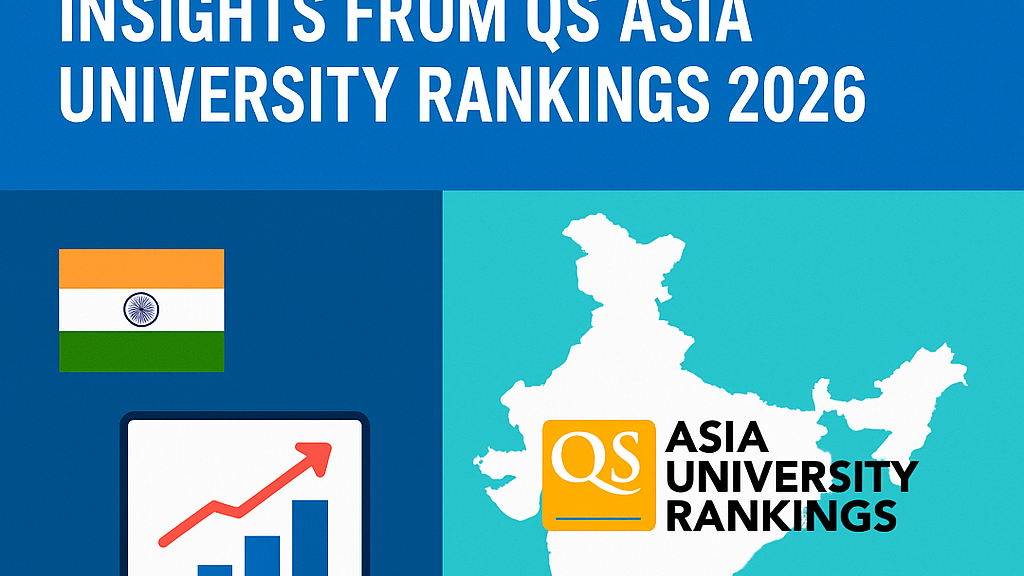
The latest Asia University Rankings 2026, released by Times Higher Education, highlight a clear trend in the continent’s higher education landscape—China continues to dominate, while India, despite strong representation, is yet to break into the top tier.
The rankings, which evaluate universities based on teaching, research, knowledge transfer, and international outlook, include 929 institutions from 36 countries, making it one of the most comprehensive assessments of Asian universities.
China Retains Leadership
At the top of the rankings:
- Tsinghua University secures Rank 1 for the eighth consecutive year
- Peking University holds the second position
- China occupies five of the top 10 spots, underlining its growing academic and research dominance
Other countries like Singapore, Japan, and Hong Kong also feature in the top 10, but China’s leadership remains unmatched.
India’s Performance: Strong Presence, Limited Breakthrough
India has significantly increased its participation in the rankings, but challenges remain:
- Over 100+ Indian institutions featured, reflecting scale and growth
- However, no Indian university is in the top 40
- Indian Institute of Science (IISc) remains India’s top-ranked institution
Most Indian universities are placed in mid-tier rankings, indicating visibility but limited global competitiveness at the highest level.
Key Highlights of the Rankings
- 929 universities ranked across Asia
- China leads with the strongest research ecosystem
- Southeast Asia (especially Malaysia) shows rapid improvement
- New countries like Yemen enter the rankings for the first time
The rankings are based on 18 performance indicators, covering teaching quality, research output, citations, industry income, and international outlook.
Why India Lags Behind
Despite its scale, India faces structural challenges:
1. 🔬 Research Output & Funding
- Lower investment in research compared to global leaders
2. 🌍 Internationalisation
- Limited foreign faculty and student participation
3. 🏫 Institutional Concentration
- Performance concentrated in a few elite institutions like IISc and IITs
4. 📈 Global Competitiveness Gap
- Difficulty competing with China’s heavily funded and globally integrated universities
Asia’s Changing Education Landscape
The rankings reflect a broader shift:
- Asia is emerging as a global education powerhouse
- Countries like China are investing heavily in research and innovation
- Universities are focusing on industry collaboration and global partnerships
This has intensified competition across the region.
What This Means for India
India’s growing representation shows positive momentum, but the absence from top-tier rankings signals the need for:
- Increased research funding and infrastructure
- Greater global collaboration and exchange programmes
- Policy focus on building world-class universities