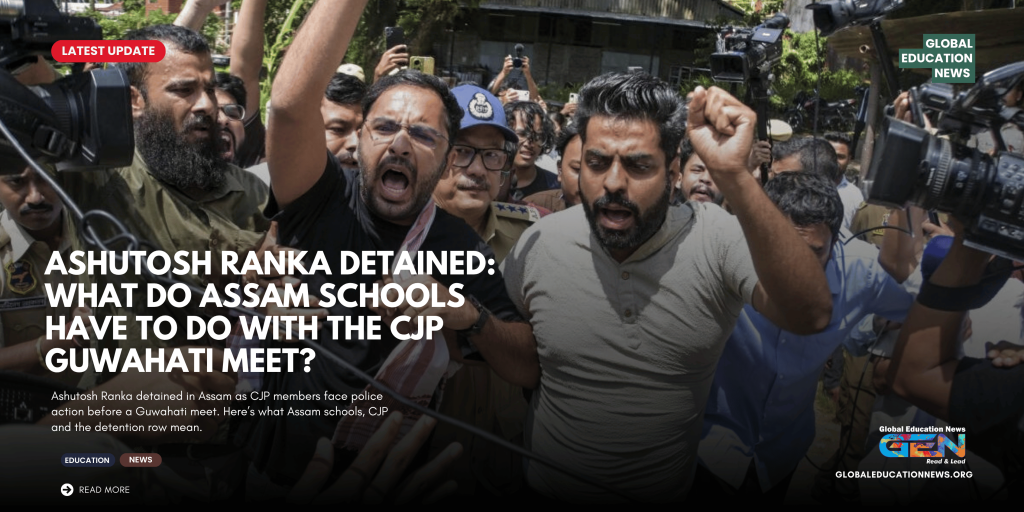
Guwahati, Assam — A planned political gathering in Guwahati turned into a confrontation with the police on Sunday after Assam Police detained Cockroach Janta Party (CJP) co-convenor Ashutosh Ranka and several members of his team shortly before the organisation’s first regional volunteers’ meeting in the state.
Reports differ on the exact number detained. The Times of India reported that 35 CJP members were taken to the 10th Assam Police Battalion campus in Kahilipara, while Northeast Now and other reports put the figure at more than 40.
The group was later released after more than 12 hours in custody, according to Northeast Now and other reports.
The episode has since drawn attention not only because of the detention itself, but because of what CJP leaders said they intended to discuss in Assam — including the condition of government schools, flooding, indigenous rights and other public issues.
Ranka alleged that Chief Minister Himanta Biswa Sarma was concerned about the organisation highlighting the condition of schools in Assam. That allegation was made by Ranka and has not been independently established.
Assam Police Detain CJP Members Before Guwahati Meeting
The CJP meeting was initially scheduled for 10 a.m. at Assam Shree Parshuram Seva Sadan on Kharga Choudhury Road in Athgaon.
Organisers later shifted the proposed gathering to Chowdhury Tilla, opposite the Assam Secretariat in Dispur, after alleging that pressure had been exerted on the original venue. Police subsequently prevented access to the meeting location and detained members of the organisation, according to reports and CJP’s account.
Among those detained were Ranka, CJP’s East and Northeast in-charge Ankit Bhardwaj, joint secretary Premakash Golu and Assam coordinator Sheikh Sahiluddin Shah.
CJP had planned to bring together volunteers from across the Northeast for the meeting.
The event never proceeded as planned.
What CJP Leaders Alleged
CJP leaders described the police action as an attempt to prevent their organisation from conducting its programme and raising questions about issues in Assam.
Ranka specifically linked the confrontation to the group’s proposed campaign around government schools, alleged man-made flooding and questions concerning land, forests and water in Kaziranga. India Today reported similar remarks from Ranka following his detention.
The claims remain allegations by CJP. The available reports did not include a detailed public explanation from Assam Police setting out the grounds for each detention.
That distinction matters. The political claims surrounding the incident should not be treated as established facts simply because they were made during the confrontation.
Why Schools Became a Major Part of the Assam Dispute
The reference to schools gives the episode a wider public-interest dimension.
Ranka told reporters that CJP wanted to highlight what he described as the reality of government schools in Assam. Other reports similarly identified school conditions as one of the subjects the organisation planned to raise.
For readers following Education News Worldwide, the Assam episode illustrates how school infrastructure and public education can become part of a much larger political conversation. Questions about classrooms, teachers, facilities and access are not confined to education policy debates; they can quickly become questions about governance and public accountability.
But the specific claims made by CJP about school conditions require independent verification before they can be treated as evidence of the state of Assam’s entire school system.
What Happened Inside the Police Facility?
The detained CJP members were taken to the 10th Assam Police Battalion campus in Kahilipara, according to multiple reports.
During the detention, CJP said 35 members began an indefinite hunger strike to demand their release. The reported participants included Ranka, Bhardwaj, Golu and Shah.
The situation continued for much of Sunday.
Later that night, reports said the detainees were released. Ranka subsequently said the detention had ended and that he wanted police to take the group back to the location where they had originally been picked up.
India Today Northeast reported that the CJP Assam unit said the leaders were released after authorities accepted the demands raised by the party, although the communication did not specify those demands in detail.
Why the Detention Figure Is Unclear
One detail has emerged differently across news reports: the number of people detained.
The Times of India reported 35 CJP members in its follow-up report.
Northeast Now reported more than 40 CJP workers, while also saying that at least 20 other volunteers who had arrived in Dispur were detained.
Hindustan Times initially reported that more than 30 workers had been detained.
The safest description, therefore, is that dozens of CJP members and volunteers were detained, with reports differing on the precise number.
That discrepancy is worth noting because the incident developed rapidly and different outlets appear to have counted different groups of detainees.
Who Is Ashutosh Ranka and Why Was He in Assam?
Ranka is a national spokesperson and co-convenor of the Cockroach Janta Party. He had travelled to Assam to oversee preparations for the organisation’s first regional volunteers’ meeting in Guwahati.
The proposed meeting was part of CJP’s broader effort to build its presence in Assam and the Northeast. NDTV reported that the programme was connected to the organisation’s ongoing outreach activities in the region.
The detention also came shortly after CJP leaders held discussions with regional political figures, including representatives of Raijor Dal and Assam Jatiya Parishad. The Times of India reported that those discussions covered issues including Assam’s recent floods and CJP’s plans to expand its activities in the state.
What Assam Police Has Said
The central unanswered question is the official reason for the detentions.
Reports available after the incident did not provide a detailed public statement from Assam Police explaining the grounds on which each CJP member was detained. A subsequent report quoted Ranka alleging that officers told him they were acting on orders “from the top”; that allegation has not been independently established.
That leaves an important gap in the public record.
CJP has characterised the action as an attempt to stop its meeting. Police action, however, can only be properly assessed once the authorities’ stated legal and administrative grounds are established.
The Larger Political Question in Assam
The Guwahati incident arrives as CJP attempts to establish a foothold in Assam and use local issues to expand its campaign.
The organisation has said it wants to raise questions around government schools, flooding, indigenous rights, land and other public concerns. Its leaders have also used the detention to intensify their criticism of the Assam government.
For the state government, the immediate episode has been about a disrupted gathering and police action. For CJP, it has become part of a wider campaign narrative.
Those are competing interpretations of the same event.
What is established is simpler: a CJP meeting did not take place as planned, dozens of its members were detained, senior leaders including Ashutosh Ranka were among those held, a hunger strike followed, and the detainees were later released.
The more consequential questions — why the detentions were ordered, whether the meeting lacked required permission, and whether the allegations concerning Assam’s schools influenced the action — require further official clarification.
For now, the confrontation has shifted attention from a small regional volunteer gathering to a much larger debate over political activity, policing and the issues CJP says it wants to put before Assam’s public.
And at the heart of that debate is a question that reaches beyond party politics: what happens when questions about the condition of schools become questions about who gets to raise them?