Date: October 19, 2026
Place: New Delhi
World News: Young Conservationists, Environmental Awareness and Student Inspiration
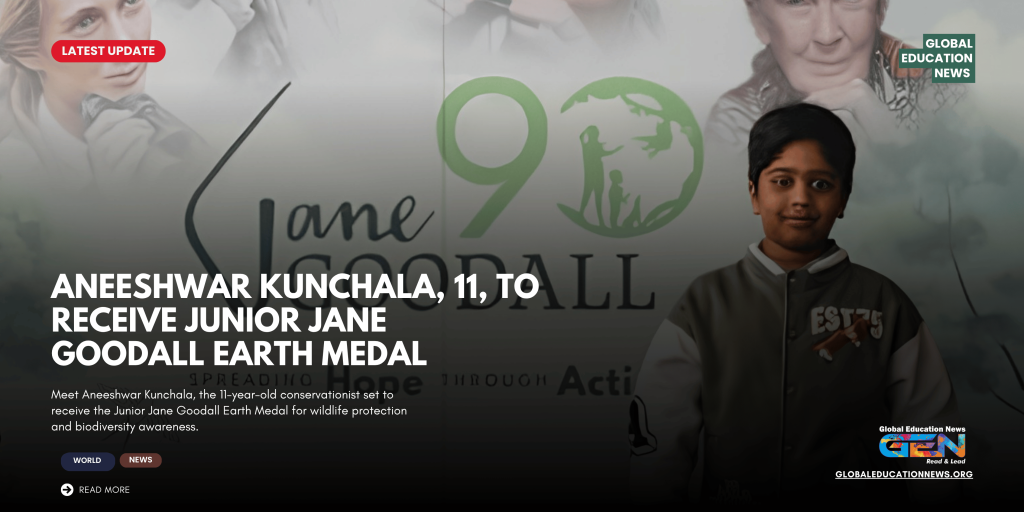
New Delhi, Education news: An 11-year-old wildlife presenter with Indian roots is gaining international recognition for his efforts to protect animals and promote biodiversity. Aneeshwar Kunchala, who lives in the United Kingdom and has family roots in Andhra Pradesh, is set to receive the Junior Jane Goodall Earth Medal for his work encouraging children to care for wildlife and the natural world.
His journey began when he was just four years old. During a school lesson in November 2019, his teacher showed the class a picture of a whale that had died after ingesting plastic. The incident left a lasting impression on him and helped shape his interest in wildlife conservation.
Since then, Kunchala has used documentaries, educational videos, writing, art and public speaking to explain environmental challenges to young audiences. His story highlights how an early interest in nature can grow into a wider effort to educate others and inspire environmental responsibility.
Who Is Aneeshwar Kunchala, the 11-Year-Old Wildlife Conservationist?
Aneeshwar Kunchala is a young wildlife presenter, documentary maker, author and environmental communicator. He uses storytelling and educational projects to encourage children to learn about animals, biodiversity and the importance of protecting natural habitats.
He began making wildlife videos in 2020, working with his father on a film about a baby robin in their garden. The project, titled Regee the Robin, became an early step in his efforts to share his interest in wildlife with a wider audience.
His work later expanded into television documentaries, public speaking, poetry, painting and environmental education. Through these activities, he has encouraged young people to explore nature and consider how everyday actions can affect wildlife.
How Did a Whale’s Death Inspire His Conservation Journey?
Kunchala’s interest in protecting wildlife began after he learnt about a whale that had died because of plastic pollution.
The experience helped him understand that discarded plastic can harm animals and threaten marine ecosystems. Rather than treating the incident as a single upsetting story, he began exploring ways to educate others about wildlife and the environment.
His early work developed into wildlife videos and educational projects that explain environmental problems in ways children can understand.
His journey also highlights the importance of introducing environmental awareness at a young age. Schools, families and community groups can help children develop a connection with nature through wildlife observation, nature projects and responsible waste management.
Junior Jane Goodall Earth Medal: Why Is Aneeshwar Being Recognised?
The Junior Jane Goodall Earth Medal recognises young people whose work reflects a commitment to biodiversity, wildlife conservation and environmental awareness.
The medal is named after renowned primatologist and conservationist Jane Goodall, who devoted decades to studying chimpanzees and promoting the protection of animals and their habitats.
Kunchala’s selection recognises his efforts to communicate environmental issues to younger audiences. Through documentaries, writing and public appearances, he encourages children to learn about the natural world and take an active interest in protecting it.
The recognition was announced by STARMUS, an international festival bringing together science, space exploration, technology, music and the arts. The medal is part of its effort to recognise young changemakers who help bring scientific and environmental ideas to the public.
From Wildlife Videos to Guinness World Records
Kunchala has achieved recognition beyond his conservation activities. His work in television, writing and wildlife communication has earned him several distinctions.
| Achievement | Key detail |
|---|---|
| Wildlife documentary | Began making wildlife videos in 2020 |
| Television | Presented COP27: Six Ways to Save Our Planet in 2022 |
| Guinness World Records | Holds records linked to documentary presenting, newspaper writing and identifying animal sounds |
| Animal-sound record | Identified 28 animal sounds in one minute in January 2025 |
| The Diana Award | Received in 2024 for work involving children and wildlife conservation |
| Book | Published Adventures of a Young Naturalist: Arctic Expedition in 2024 |
| Environmental role | Became the Kennedy Center’s first Youth Ambassador for Arts and the Environment in 2024 |
These achievements demonstrate how Kunchala has combined an interest in wildlife with communication skills to reach audiences beyond his immediate community.
What Can Students Learn From Aneeshwar Kunchala’s Story?
Kunchala’s journey offers lessons for students interested in science, nature, communication and environmental protection.
1. Start with an interest
Students do not need to wait until they are older to explore a subject. Learning about birds, insects, trees or local ecosystems can be the beginning of a lasting interest.
2. Turn learning into communication
Writing an article, preparing a school presentation, making an educational poster or creating a short documentary can help students share what they learn with others.
3. Understand environmental problems
Issues such as plastic pollution, habitat loss and declining biodiversity affect wildlife around the world. Learning about these challenges helps students understand the connection between human activity and the natural environment.
4. Take practical action
Students can contribute through responsible waste disposal, reducing unnecessary plastic use, joining supervised community clean-ups and participating in school nature projects.
5. Explore future careers
An interest in wildlife can lead to further study in environmental science, zoology, ecology, marine biology, conservation, science communication or documentary filmmaking.
These pathways require different qualifications and skills, but they show how environmental interests can connect with education and future career opportunities.
What Is Aneeshwar Kunchala’s Connection With India?
Although Kunchala lives in the United Kingdom, he has family roots in Andhra Pradesh and has explored wildlife habitats in southern India.
In December 2023, he visited Koundinya Forest and Nelapattu Nature Reserve, where he learnt more about the region’s wildlife. His experiences connect his conservation work with India’s biodiversity and the importance of protecting local habitats.
His story may also encourage Indian students to explore the wildlife and ecosystems in their own regions, from wetlands and forests to coastal habitats and urban biodiversity.
Frequently Asked Questions About Aneeshwar Kunchala
1. Who is Aneeshwar Kunchala?
Aneeshwar Kunchala is an 11-year-old wildlife presenter and conservationist who lives in the UK and has family roots in Andhra Pradesh, India. He promotes wildlife conservation and biodiversity through documentaries, writing, art and public speaking.
2. Why is Aneeshwar Kunchala receiving the Junior Jane Goodall Earth Medal?
He is set to receive the medal in recognition of his work promoting wildlife conservation, biodiversity and environmental awareness among young people.
3. What inspired Aneeshwar Kunchala to protect wildlife?
At four years old, he saw a picture of a whale that had died after ingesting plastic. The experience inspired his interest in raising awareness about plastic pollution and protecting animals.
4. What are Aneeshwar Kunchala’s major achievements?
His achievements include wildlife documentaries, television presenting, several Guinness World Records, the Diana Award and a book about naturalist adventures. He has also served as a youth ambassador for arts and the environment.
5. What can students learn from his journey?
Students can learn that curiosity, consistent effort and communication can help them share knowledge and encourage positive action. They can begin by learning about local wildlife and participating in school or community environmental projects.
6. Which careers are connected with wildlife conservation?
Relevant fields include environmental science, zoology, ecology, marine biology, wildlife research, conservation management and science communication. The qualifications required depend on the chosen career.
A Young Voice for Wildlife and the Environment
Aneeshwar Kunchala’s journey shows how an early experience can inspire a sustained interest in protecting nature. From learning about a whale affected by plastic pollution to sharing wildlife stories with international audiences, he has used education and communication to encourage others to care about biodiversity.
For students, his story is a reminder that environmental learning can begin with simple questions about the world around them. With curiosity, knowledge and responsible action, young people can contribute to a greater understanding of wildlife and the need to protect natural habitats.
Global Education News will continue to highlight young achievers, student inspiration and developments in science, education and environmental awareness.