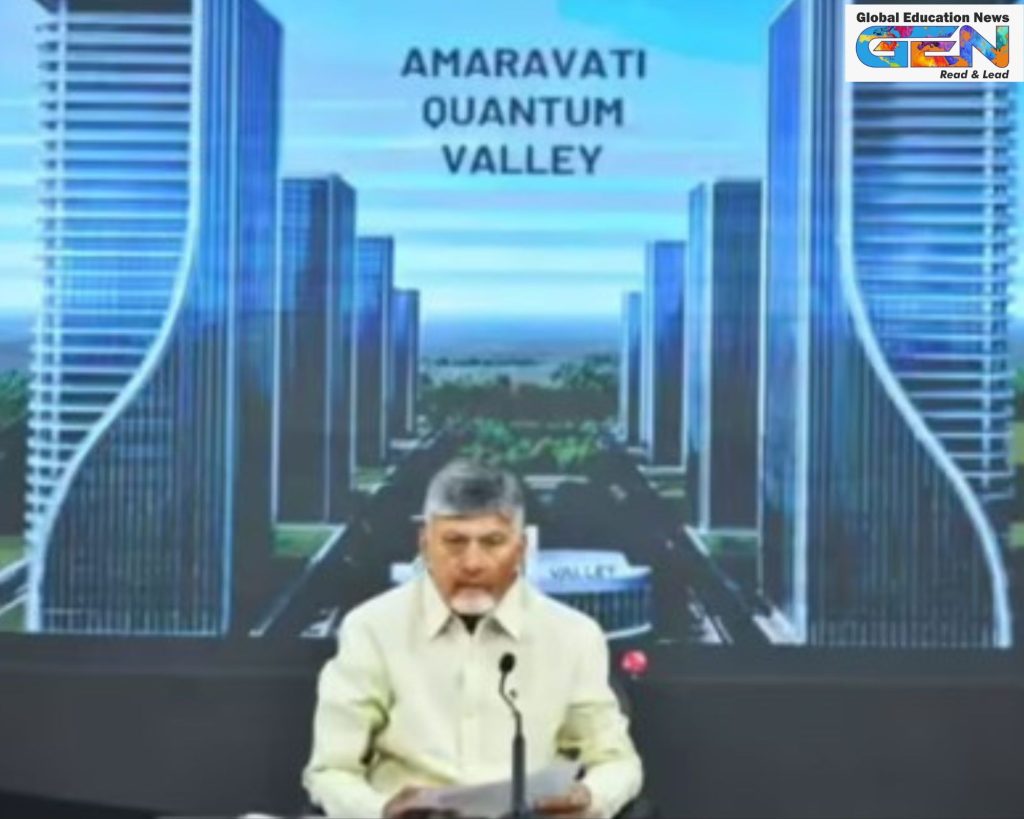
As of December 25, 2025, Andhra Pradesh is poised to redefine STEM education with the introduction of quantum technology courses in schools—a visionary move announced by Chief Minister N. Chandrababu Naidu during a high-level meeting on December 23. This initiative isn’t just about adding buzzwords to curricula; it’s a strategic pivot to cultivate a quantum-savvy workforce amid India’s National Quantum Mission (NQM). By targeting early exposure for Classes 7-9 and scaling to over 50,000 tech students, the plan aligns with global trends where nations like the US and China invest billions in quantum talent pipelines. This article dissects the announcement’s core components, implementation roadmap, collaborative ecosystem, and long-term implications, highlighting how Andhra Pradesh could emerge as a frontrunner in Asia’s quantum race.
The Genesis: Naidu’s Renewed Vision for a Knowledge-Driven Economy
Rooted in Naidu’s long-standing tech evangelism—recall his role in birthing Hyderabad’s HITEC City in the 1990s—this announcement builds on his 2017 pledge of a Rs 100 crore reward for the state’s first Nobel laureate, now explicitly tied to quantum breakthroughs. Speaking at the “Quantum Talk” session, Naidu evoked a “Silicon Valley to Quantum Valley” narrative, urging youth to “aim for a big vision” rather than incremental gains.
- Core Motivation: With quantum computing poised to revolutionize sectors like green energy, personalized medicine, and agriculture, AP aims to preempt skill gaps. Naidu emphasized, “IT and AI have transformed our lives; the next breakthrough will be quantum’s speed and efficiency,” positioning the state to capture India’s first-mover advantage.
- Inclusivity Focus: Every student, from government to private schools, will gain basic quantum exposure, addressing urban-rural divides where only 40% of rural AP schools currently have functional computer labs.
- Launch Momentum: The world’s largest quantum skilling program garnered 50,000+ registrations in just 10 days, with 51% women participants—a nod to gender equity in STEM.
This isn’t isolated ambition; it syncs with NQM’s Rs 6,000 crore outlay, but AP’s school-centric approach differentiates it from top-down federal efforts.
Course Framework: From Awareness to Advanced Skilling
The quantum education rollout emphasizes phased, accessible learning, blending awareness with hands-on training to demystify complex concepts like qubits and superposition for young minds.
- School-Level Integration: Starting with Classes 7-9, quantum awareness modules will introduce foundational ideas via interactive sessions, aiming to spark curiosity without overwhelming core academics.
- Curriculum Timeline: A comprehensive quantum skill development syllabus must be finalized by January 2026, incorporating NPTEL resources for self-paced modules.
- Higher Ed Scaling: Over 50,000 tech students will receive structured training, extending to virtual lectures and certifications, with applications in real-world scenarios like quantum-optimized farming algorithms.
- AI Synergy: Parallel four-phase AI orientation over two years (from 2026), delivered digitally in Telugu, English, and Hindi, to foster hybrid quantum-AI expertise.
Analytically, this modular design mirrors successful pilots in Singapore’s quantum curriculum, potentially boosting AP student retention in STEM by 20-30%, per regional education benchmarks.
| Component | Target Audience | Duration/Timeline | Delivery Mode |
|---|---|---|---|
| Quantum Awareness | Classes 7-9 | Phased rollout, 2026 onward | Classroom sessions + digital tools |
| Skill Training | 50,000+ tech students | Ongoing from Jan 2026 | NPTEL platform, virtual lectures |
| AI Orientation | All school students | 4 phases over 2 years | Multilingual digital platforms |
| Curriculum Design | Educators & developers | Completion by Jan 2026 | Collaborative workshops |
Implementation Roadmap: Infrastructure, Events, and Milestones
Execution hinges on swift infrastructure upgrades and stakeholder buy-in, with Naidu directing phased computer lab setups in schools—coordinated with central funding to cover 5,000+ institutions.
- Key Milestones: Student Partnership Summit by late January 2026, where innovators showcase projects, fostering entrepreneurial ecosystems akin to global hackathons.
- Tech Backbone: Leverage NPTEL for skill upgrades and expand true 5G with BSNL for seamless digital access, targeting 90% rural connectivity by mid-2026.
- Monitoring Mechanism: Monthly reviews by the ITE&C Department to track enrollment and outcomes, with adaptive tweaks based on pilot feedback.
Challenges loom—teacher training lags, with only 25% of AP educators versed in advanced tech—but Naidu’s directive for IIT-led workshops could bridge this, drawing from IIT Madras’s proven MOOC models.
Collaborative Ecosystem: Powering the Quantum Push
No state-level quantum leap happens in silos; AP’s strategy thrives on elite partnerships, amplifying resources and expertise.
- Academic Anchors: IIT Madras presented the AI action plan, while IIT Tirupati focuses on quantum research integration.
- Industry Titans: IBM installs a 156-qubit Quantum System Two at Amaravati Quantum Valley (AQV)—India’s first dedicated quantum hub on 50 acres— with TCS offering hybrid solutions and L&T managing infra.
- Global Ties: WISER and Qubitech lead skilling, aligning with NQM; experts like IIT Madras Director Prof. V. Kamakoti joined Naidu’s session.
- Ecosystem Hubs: AQV will host startups, MNCs, and labs, spawning 1,000+ jobs by 2027 and echoing Naidu’s vision: “Produce quantum computers in Amaravati within two years.”
This network not only accelerates rollout but positions AP as a quantum magnet, potentially attracting Rs 5,000 crore in investments, per ITE&C estimates.
Implications and Benefits: Forging a Future-Proof Workforce
Beyond buzz, this initiative promises tangible socioeconomic dividends, transforming AP from an agrarian base to a deep-tech powerhouse.
- Economic Catalysts: High-paying quantum jobs (average Rs 15-20 lakh starting salary) for Telugu youth, building on their Silicon Valley diaspora (2.5 lakh professionals, 1,200 startups).
- Innovation Surge: Summit-driven projects could yield patents in quantum-agri apps, cutting crop losses by 15% via predictive modeling.
- Equity Gains: Rural inclusion via multilingual tools narrows the digital divide, empowering 51% female registrants to lead in a field where women hold just 20% global roles.
- National Edge: AP’s proactive skilling outpaces peers like Karnataka’s quantum labs, potentially contributing 10% to India’s NQM talent pool by 2030.
Critically, success metrics—enrollment rates, skill certification pass-outs—will gauge ROI, with risks like funding delays mitigated by Naidu’s track record in public-private synergies.