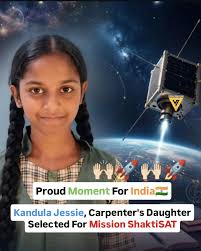
In an inspiring story of determination, talent, and ambition, 14-year-old Kandula Jessie, a Class 10 student from a government school in Andhra Pradesh, has earned a place in Mission ShakthiSAT, the world’s first global all-girls lunar CubeSat mission. The daughter of a carpenter from Dhavaleswaram in East Godavari district, Jessie has emerged as one of India’s brightest young STEM talents after being selected from nearly 12,000 applicants across 108 countries. She is among just 20 students from India chosen for this prestigious international programme and the only participant from Andhra Pradesh.
Her achievement is not just a personal milestone but also a powerful reminder that talent can flourish anywhere when opportunities meet determination. It highlights the growing role of government schools, STEM education, and innovation programmes in nurturing future scientists and engineers.
Key Highlights
- Kandula Jessie, a 14-year-old Class 10 student from Andhra Pradesh, has been selected for Mission ShakthiSAT, the world’s first global all-girls lunar CubeSat mission.
- She is one of 20 Indian participants selected from nearly 12,000 applicants representing 108 countries.
- Jessie studies at a government school and is the daughter of a carpenter, making her achievement even more remarkable.
- The mission aims to inspire girls worldwide to pursue careers in science, technology, engineering, and mathematics (STEM) through hands-on satellite development.
- Participants will receive training in satellite engineering, mission planning, and space science before contributing to a lunar CubeSat mission.
Who Is Kandula Jessie?
Kandula Jessie is a Class 10 student studying at Zilla Parishad Girls High School in Dhavaleswaram, Andhra Pradesh. Coming from a modest family, she has consistently shown exceptional interest in science and technology.
Her father works as a carpenter, and despite financial challenges, Jessie’s passion for learning and participation in science and innovation activities helped her stand out on the global stage. Her journey reflects the growing impact of school innovation labs and STEM initiatives in government schools.
What Is Mission ShakthiSAT?
Mission ShakthiSAT is the world’s first global all-girls lunar CubeSat programme, designed to encourage young women to actively participate in space science and satellite technology.
Unlike traditional classroom learning, the programme offers participants practical exposure to:
- CubeSat design and development
- Space engineering fundamentals
- Satellite communication systems
- Mission planning and operations
- Space research and innovation
- Team-based international collaboration
The mission seeks to increase female representation in the global space sector by providing schoolgirls with real-world experience in aerospace technologies.
A Selection Against Global Competition
Jessie’s selection is particularly significant because of the intense competition.
According to programme organisers:
- Nearly 12,000 girls applied.
- Applicants came from 108 countries.
- Only a small group was selected globally.
- India secured 20 places, with Jessie representing Andhra Pradesh.
Her achievement demonstrates that students from government schools can compete successfully with peers from across the world when provided with the right opportunities.
Why This Achievement Matters
Breaking Social Barriers
Jessie’s success challenges long-standing stereotypes about who can pursue careers in science and space exploration.
Her story sends a strong message that economic background need not limit academic or scientific aspirations.
Inspiring Girls in STEM
Globally, women remain underrepresented in many STEM careers.
Initiatives like Mission ShakthiSAT encourage girls to develop confidence in:
- Space science
- Artificial intelligence
- Robotics
- Engineering
- Coding
- Advanced technologies
By providing hands-on experience, such programmes help bridge the gender gap in scientific fields.
Strengthening Government School Education
Jessie’s journey also reflects the positive impact of science clubs, innovation labs, and experiential learning opportunities increasingly available in government schools.
As states invest more in STEM education, students from rural and economically weaker backgrounds are gaining access to opportunities that were once limited to elite institutions.
India’s Growing Space Ecosystem
Jessie’s selection comes at a time when India’s space sector is expanding rapidly.
Recent milestones include:
- The success of Chandrayaan-3, which achieved a historic soft landing near the Moon’s south pole.
- Progress on the Gaganyaan human spaceflight programme.
- Growing participation of private space startups.
- Increased focus on student satellite missions and innovation.
These developments have inspired a new generation of students to pursue careers in aerospace, astronomy, engineering, and scientific research.