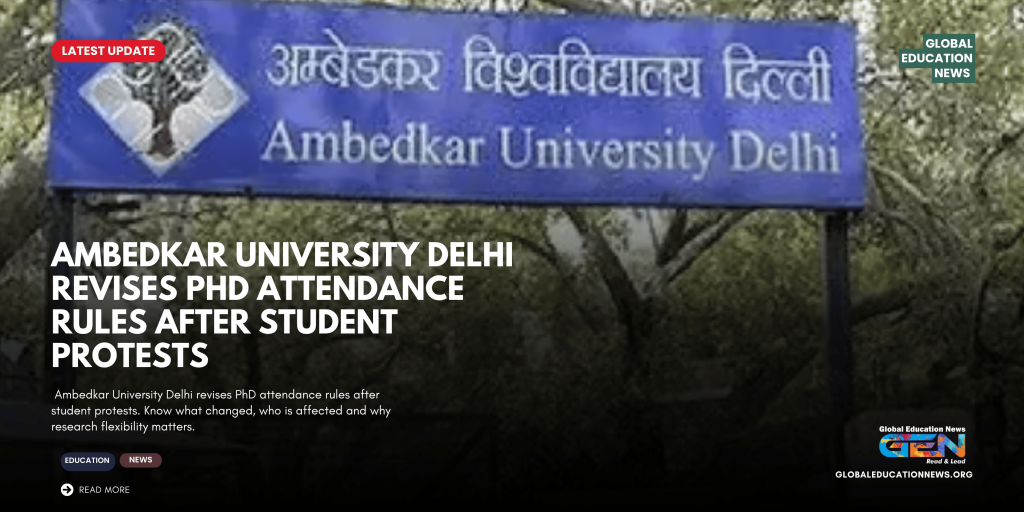
October 5, 2026 | New Delhi | Education News: Ambedkar University Delhi has revised its PhD attendance rules for full-time research scholars receiving fellowships after students raised concerns over the university’s earlier attendance requirements. The revision follows criticism of the July notification, which had sparked debate over whether strict attendance conditions could limit the flexibility researchers need for fieldwork, academic travel, laboratory work and other research-related activities.
The development puts PhD attendance rules, research scholar rights and university academic regulations back in focus. It also raises a wider question for India’s higher-education system: How should universities balance accountability for fellowship-funded scholars with the flexible working arrangements often required for doctoral research?
The Ambedkar University Delhi case is particularly significant because the university’s revision came after student concerns, making it an example of how student feedback can influence academic policy.
What Changed in Ambedkar University Delhi’s PhD Attendance Rules?
Ambedkar University Delhi has revised the attendance guidelines applicable to full-time PhD scholars receiving fellowships.
The earlier July notification had generated concern among students who argued that a rigid attendance framework could interfere with the nature of doctoral research.
PhD research is not always conducted inside a classroom or university department. Depending on the discipline, scholars may need to spend extended periods conducting fieldwork, visiting archives, working in laboratories, collecting data, attending conferences or collaborating with researchers elsewhere.
The revised guidelines therefore address a key tension between institutional attendance monitoring and the practical requirements of research.
Why Did Ambedkar University Delhi Students Protest the Earlier Rules?
The controversy centred on concerns that the earlier attendance requirements could reduce the academic flexibility available to doctoral researchers.
Unlike undergraduate or conventional classroom-based postgraduate programmes, PhD programmes involve independent research.
A research scholar’s work may involve activities away from the university campus, sometimes for extended periods.
Students therefore questioned whether a uniform attendance requirement could adequately account for different research disciplines and circumstances.
The issue became particularly sensitive for scholars receiving fellowships because attendance requirements can potentially intersect with the conditions attached to financial support.
How Do PhD Attendance Rules Affect Research Scholars?
Attendance policies can have several consequences for PhD scholars.
They may influence:
- access to fellowships;
- academic registration;
- research progress;
- departmental requirements;
- participation in university activities;
- fieldwork and research travel;
- laboratory or institutional access.
For a researcher, however, being physically absent from campus does not necessarily mean being academically inactive.
A doctoral scholar conducting field research, analysing data at another location or accessing an archive may be actively progressing with their thesis while not being physically present at the university.
That is why attendance rules for PhD programmes can require a different approach from attendance requirements for conventional classroom courses.
What Is the Difference Between PhD Attendance and Classroom Attendance?
This distinction is at the heart of the Ambedkar University Delhi discussion.
In a classroom programme, attendance generally measures participation in scheduled teaching.
A PhD is primarily a research programme. Its work can extend across multiple locations and activities.
For example, a doctoral researcher may need to:
conduct fieldwork → collect data → interview participants → access external archives → attend conferences → work with research collaborators → analyse findings.
Some of these activities may happen outside the university campus.
That makes the design of a doctoral attendance policy considerably more complicated than simply counting days physically spent on campus.
Why Are Fellowship-Linked Attendance Rules Important?
The issue becomes more significant when attendance requirements are connected to fellowships.
Research fellowships provide financial support to scholars while they pursue doctoral research. Students receiving such support may therefore be particularly concerned about regulations that could affect their eligibility or continuation.
A fellowship framework needs accountability, but research scholars also require sufficient flexibility to undertake legitimate academic work.
The Ambedkar University Delhi revision highlights this balance between institutional oversight and research autonomy.
How Did Student Feedback Influence the University Policy?
The sequence of events is significant.
The university issued its earlier attendance notification in July.
Students subsequently raised concerns about its implications for doctoral research.
Following the criticism and student feedback, the university revised the guidelines.
That makes the episode noteworthy beyond the specific attendance rule.
It demonstrates how consultation with students can become part of the policy-making process within higher education.
For research scholars, it also shows why student representation and communication with university authorities can matter when new academic regulations are introduced.
What Does the Ambedkar University Delhi Case Mean for PhD Scholars?
The immediate relevance is for full-time PhD scholars receiving fellowships at the university.
But the wider debate extends across India’s research ecosystem.
Universities have to establish mechanisms for monitoring academic progress while recognising that doctoral research is often unpredictable and discipline-specific.
A researcher conducting fieldwork in another state, an experimental scientist working in a laboratory or a humanities scholar spending weeks in an archive may all have very different research schedules.
A single attendance model may therefore not capture the full range of doctoral work.
Can Universities Require PhD Scholars to Maintain Attendance?
Universities can establish academic and administrative requirements for doctoral programmes, but the exact rules depend on the institution’s regulations and applicable higher-education frameworks.
The key question is how attendance is defined and what exceptions or research-related provisions are available.
A PhD attendance policy can be designed around academic engagement and research progress rather than treating doctoral scholars exactly like students attending conventional lectures.
The Ambedkar University Delhi revision brings this distinction into sharper focus.
Why Is Research Flexibility Important for PhD Students?
Doctoral research can require activities that cannot always be scheduled around fixed campus hours.
Depending on the subject, researchers may need to undertake:
- field surveys;
- interviews;
- laboratory experiments;
- archival research;
- data collection;
- academic conferences;
- research collaborations;
- internships or external research projects;
- visits to specialised facilities.
Research flexibility does not mean the absence of accountability.
Instead, universities can assess progress through research proposals, reviews, supervisor evaluations, coursework requirements, publications where applicable and progress reports alongside appropriate attendance or engagement requirements.
What Does This Mean for Fellowships and Research Funding?
The relationship between attendance, fellowship eligibility and research progress remains an important issue for doctoral scholars.
Students receiving fellowships need clarity about the circumstances under which their financial support can be affected.
Universities also need transparent procedures so scholars understand:
- what counts as attendance;
- what constitutes authorised research-related absence;
- who can approve such absence;
- how fieldwork is recorded;
- what happens during academic travel;
- how fellowship conditions interact with university rules.
Clearer rules can reduce uncertainty for both students and administrators.
Ambedkar University Delhi PhD Attendance Rules: Key Facts
| Key point | Details |
|---|---|
| University | Ambedkar University Delhi |
| Issue | PhD attendance requirements |
| Students affected | Full-time PhD research scholars receiving fellowships |
| Earlier notification | Issued in July |
| Student response | Concerns and criticism over attendance requirements |
| Main concern | Potential impact on research flexibility |
| Latest development | Attendance guidelines revised |
| Broader issue | Balancing academic accountability with doctoral research flexibility |
| Why it matters | Demonstrates the potential role of student feedback in university policy |
FAQs: Ambedkar University Delhi PhD Attendance Rules
What happened at Ambedkar University Delhi?
Ambedkar University Delhi revised attendance guidelines for full-time PhD scholars receiving fellowships after students raised concerns about the earlier rules.
Why were students concerned about the PhD attendance rules?
Students were concerned that strict attendance requirements could restrict the flexibility required for doctoral research, including fieldwork and other academic activities outside the university campus.
Who is affected by the revised attendance rules?
The revision concerns full-time PhD research scholars receiving fellowships at Ambedkar University Delhi.
When were the earlier attendance guidelines issued?
The earlier notification was issued in July 2026 and subsequently became the subject of student criticism.
Why is attendance complicated for PhD scholars?
Doctoral research often involves activities outside the university, including fieldwork, laboratory work, archival research, conferences and data collection. Physical absence from campus therefore does not necessarily indicate a lack of academic work.
What does the revision mean for research scholars?
The revision provides a changed framework for attendance requirements following student concerns. Scholars should refer to the university’s latest applicable guidelines for the precise requirements affecting their programme and fellowship.
Can PhD attendance rules affect fellowships?
Depending on the applicable university and fellowship regulations, attendance and academic compliance requirements can be relevant to fellowship administration. Scholars should check the specific conditions governing their fellowship.
Why is the Ambedkar University Delhi decision significant?
The episode highlights the challenge universities face in balancing administrative accountability with the flexibility required for independent doctoral research. It also demonstrates how student feedback can influence university policy.
What Happens Next for PhD Attendance Policies?
The Ambedkar University Delhi case could add to a wider discussion about how Indian universities regulate doctoral research.
As PhD programmes expand, universities will need systems that can demonstrate academic engagement without treating research scholars as though they are following conventional classroom timetables.
The key issue is not simply how many days a researcher is physically present on campus. It is whether the scholar is making meaningful academic progress while meeting transparent institutional and fellowship requirements.
For research scholars, the latest revision provides a reminder that university regulations can evolve when students raise concerns and institutions review how policies work in practice.
Global Education News will continue tracking PhD regulations, research fellowships, university policy changes, student concerns and developments shaping India’s higher-education system.