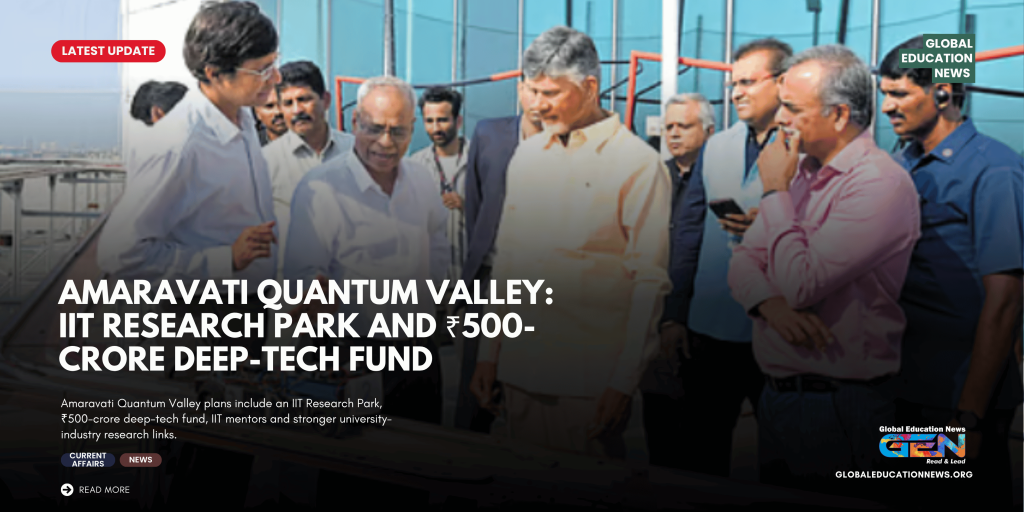
October 6, 2026 | Amaravati | Education News: Andhra Pradesh is stepping up its ambition to build Amaravati Quantum Valley as a major centre for quantum technology, higher education, research and deep-tech entrepreneurship, with plans for an IIT Research Park, a proposed ₹500-crore PanIIT Amaravati Deep Tech Venture Fund and a wider partnership with the IIT alumni network.
The announcements were made around the PanIIT Andhra Pradesh Summit 2026, where Chief Minister N Chandrababu Naidu called for greater participation from the country’s approximately five-lakh-strong IIT alumni network in research, technology transfer, startups and education. The state and PanIIT also outlined a permanent council, university-industry partnerships, startup mentoring and technology-transfer initiatives.
The latest proposals build on an existing quantum-technology push in Amaravati. Earlier in February 2026, the Centre and Andhra Pradesh marked the foundation of the Amaravati Quantum Valley, alongside initiatives involving quantum cloud services, an IBM-TCS Quantum Innovation Centre, a Quantum Talent Hub and industry partnerships.
What Is Amaravati Quantum Valley and Why Is Andhra Pradesh Building It?
The Amaravati Quantum Valley is being developed as an ecosystem rather than a single university or laboratory. Its broader objective is to connect quantum computing, artificial intelligence, advanced research, higher education, startups and industry in one regional technology ecosystem.
The February foundation event already brought together the central government, Andhra Pradesh, academic institutions and technology companies around quantum research and infrastructure. The latest PanIIT proposals add another layer: using the IIT ecosystem to connect research with commercialisation, entrepreneurship and workforce development.
The strategy is significant for higher education because it potentially creates a pathway from university research to laboratories, startups and industry applications.
What Did Andhra Pradesh Announce at the PanIIT Summit?
The latest package includes several connected initiatives rather than a single project.
| Initiative | What has been announced | Expected role |
|---|---|---|
| Amaravati Quantum Valley | State-led quantum technology ecosystem | Research, technology and innovation |
| IIT Research Park | Planned in Amaravati | Industry-academia research and technology development |
| PanIIT Amaravati Deep Tech Venture Fund | Proposed ₹500 crore fund | Support for deep-tech startups and investment |
| PanIIT Amaravati Council | Permanent council proposed | Coordinate research, startups and technology initiatives |
| Industry Chairs | 10 chairs planned in universities/institutions | Research and skill development |
| IIT mentor network | 100 global mentors proposed | Startup and entrepreneurship guidance |
| University collaboration | IITs expected to mentor state universities | Centres of Excellence and academic development |
| Student exchange | Programme proposed | Academic and institutional collaboration |
The ₹500-crore fund and IIT Research Park are therefore announced/planned initiatives, rather than evidence that a fully operational fund or research park is already functioning.
How Will the IIT Research Park Support Amaravati’s Deep-Tech Ambition?
The proposed IIT Research Park in Amaravati is intended to strengthen the connection between academic research and real-world technology development.
According to the summit announcements, IITs would also mentor Andhra Pradesh’s state universities and support the creation of Centres of Excellence. The broader PanIIT framework includes technology transfer from IITs and industry-linked research initiatives.
A research-park model can potentially provide a bridge between:
University → Research laboratory → Technology transfer → Startup → Industry
That connection matters particularly for deep-tech fields, where moving from an academic discovery to a commercially viable product can require specialised laboratories, experienced mentors, patient capital and industry partnerships.
The proposed Amaravati model is therefore aimed at more than startup incubation; it seeks to build an institutional pipeline connecting higher education, research and economic activity.
What Is the ₹500-Crore Deep-Tech Venture Fund?
The proposed PanIIT Amaravati Deep Tech Venture Fund is a ₹500-crore funding initiative intended to promote deep-tech startups, innovation and investment in Andhra Pradesh.
Deep-tech companies generally operate in areas requiring substantial research and development before products can reach the market. Quantum technology, semiconductors, aerospace, defence, advanced manufacturing and certain healthcare technologies are examples of areas covered by the wider Andhra Pradesh technology strategy.
The fund is expected to address one of the major challenges faced by such companies: access to capital during long development cycles.
However, the precise funding structure and deployment status should be distinguished from the announcement itself. Reporting on the summit indicates that the fund is proposed, with participation from the IIT alumni network, industry and investors being part of the broader model.
Why Is the IIT Alumni Network Important to the Plan?
The IIT alumni network is central to the new Amaravati strategy.
Naidu appealed to approximately five lakh IIT graduates to contribute ideas, technology expertise and entrepreneurial experience. The PanIIT-Andhra Pradesh partnership includes a proposed network of 100 global IIT mentors for startups and aspiring entrepreneurs.
The proposed role of IIT alumni extends beyond financial support. The partnership is designed to provide access to:
- Research expertise
- Startup mentoring
- Industry connections
- Technology-transfer opportunities
- Entrepreneurship experience
- Global professional networks
- Curriculum and academic guidance
The state has also proposed 10 industry chairs at universities and educational institutions to strengthen research and skills development.
How Could Amaravati Quantum Valley Affect Higher Education?
The initiative could influence higher education in Andhra Pradesh in several ways if the announced programmes are implemented.
1. More quantum technology research
Universities could gain greater exposure to quantum computing, quantum communication, cybersecurity and related research areas.
2. Stronger industry-academia links
Industry chairs, research partnerships and a proposed research park could create more opportunities for students and researchers to work on practical technology problems.
3. Greater startup opportunities
The proposed deep-tech fund and mentor network could give university researchers and student entrepreneurs additional routes towards commercialising ideas.
4. New Centres of Excellence
IIT mentorship and proposed university-level Centres of Excellence could strengthen institutional capacity in emerging technology fields.
5. Technology-transfer opportunities
The PanIIT framework specifically includes technology transfer, potentially helping research move beyond academic publications towards products and services.
Is Amaravati Already a Quantum Technology Hub?
Amaravati’s quantum ecosystem is already supported by several announced national, academic and industry initiatives, but it would be inaccurate to describe every component of the larger vision as fully operational.
In February 2026, the Ministry of Science and Technology reported the foundation ceremony of Amaravati Quantum Valley and announced initiatives including IBM and TCS Quantum Cloud Services, an IBM-TCS Quantum Innovation Centre, a Quantum Talent Hub, an SRM University Quantum Reference Facility and a Quantum-Safe Applications initiative.
A separate February 2026 MoU between NIELIT and the Andhra Pradesh government proposed a dedicated Quantum and AI university campus in Amaravati, with plans covering undergraduate, postgraduate and PhD education, advanced laboratories, Centres of Excellence and deep-tech incubation.
These initiatives show that the Quantum Valley concept predates the latest PanIIT announcements.
What Is the Role of Students and Universities?
The education component is broader than postgraduate research.
At the PanIIT summit, Naidu announced plans to introduce AI and entrepreneurship skills from Class 6 onwards in Andhra Pradesh, alongside student-exchange initiatives and stronger links between universities, industry and technology institutions.
For higher education, the proposed ecosystem could eventually create opportunities across:
- Quantum computing
- Artificial intelligence
- Semiconductors
- Aerospace
- Defence technology
- Space technology
- Advanced manufacturing
- Healthcare technology
- Agritech
The potential benefit for students will depend on how quickly the proposed infrastructure, courses, laboratories, research partnerships and funding mechanisms are converted into functioning programmes.
What Happens Next for Amaravati Quantum Valley?
The immediate focus will be on converting the announcements into institutions, infrastructure and investment mechanisms.
Among the future milestones reported from the summit is a target for the first quantum computer to begin functioning in Amaravati in February 2027. The exact date has been reported differently across accounts, so it should be treated as a stated target rather than a completed or guaranteed milestone.
The bigger test will be whether the proposed ecosystem can consistently connect:
research + talent + infrastructure + funding + startups + industry.
That will determine whether Amaravati’s Quantum Valley ambition develops into a functioning deep-tech ecosystem rather than remaining a collection of announcements and partnerships.
Amaravati Quantum Valley: What Is Confirmed and What Is Planned?
| Area | Current position |
|---|---|
| Amaravati Quantum Valley | Established as a broader state quantum-technology initiative with foundation activity reported in February 2026 |
| ₹500-crore deep-tech fund | Proposed/announced at the PanIIT summit |
| IIT Research Park | Planned/announced |
| PanIIT Amaravati Council | Proposed as a permanent institutional mechanism |
| 100 IIT mentors | Proposed startup-support network |
| 10 Industry Chairs | Proposed for universities/institutions |
| Quantum & AI university campus | MoU announced between NIELIT and Andhra Pradesh |
| First quantum computer target | Announced for February 2027; future milestone |
| AI and entrepreneurship from Class 6 | Announced education plan; implementation details remain to be established |
Amaravati Quantum Valley FAQs
What is Amaravati Quantum Valley?
Amaravati Quantum Valley is Andhra Pradesh’s initiative to build a technology ecosystem focused on quantum computing, research, education, innovation and deep-tech development in Amaravati.
What is the ₹500-crore Amaravati fund?
The proposed PanIIT Amaravati Deep Tech Venture Fund is a ₹500-crore initiative announced to support deep-tech startups, innovation and investment in Andhra Pradesh.
Will Amaravati get an IIT Research Park?
An IIT Research Park in Amaravati has been announced as a planned initiative. It is intended to strengthen research, technology development and industry-academia collaboration.
How will IITs be involved in Amaravati?
The announced framework includes IIT mentorship for state universities, Centres of Excellence, technology transfer, industry chairs and a global network of IIT mentors for startups.
Is there already a quantum university planned in Amaravati?
Yes. In February 2026, NIELIT and the Andhra Pradesh government signed an MoU for a dedicated Quantum and AI-focused university campus in Amaravati, covering education, research laboratories, Centres of Excellence and deep-tech incubation.
When is the first quantum computer expected in Amaravati?
The Andhra Pradesh government has announced a target for the first quantum computer to begin functioning in Amaravati in February 2027. This remains a future target, not an achieved milestone.
Why the Amaravati Plan Matters for India’s Deep-Tech Education
The significance of the Amaravati Quantum Valley proposal lies in its attempt to bring several parts of the innovation chain together: universities, IIT alumni, research institutions, technology companies, startups, investors and government.
If the proposed IIT Research Park, ₹500-crore deep-tech fund, university partnerships and Centres of Excellence are implemented effectively, they could create new pathways for students and researchers to move from classroom learning to advanced research and eventually commercial technology.
For Andhra Pradesh, the next phase will be less about announcing individual projects and more about building the institutional capacity, talent pipeline and research-to-market connections needed to sustain them.
Global Education News will continue tracking the development of Amaravati Quantum Valley, higher-education research infrastructure and India’s expanding deep-tech education ecosystem.