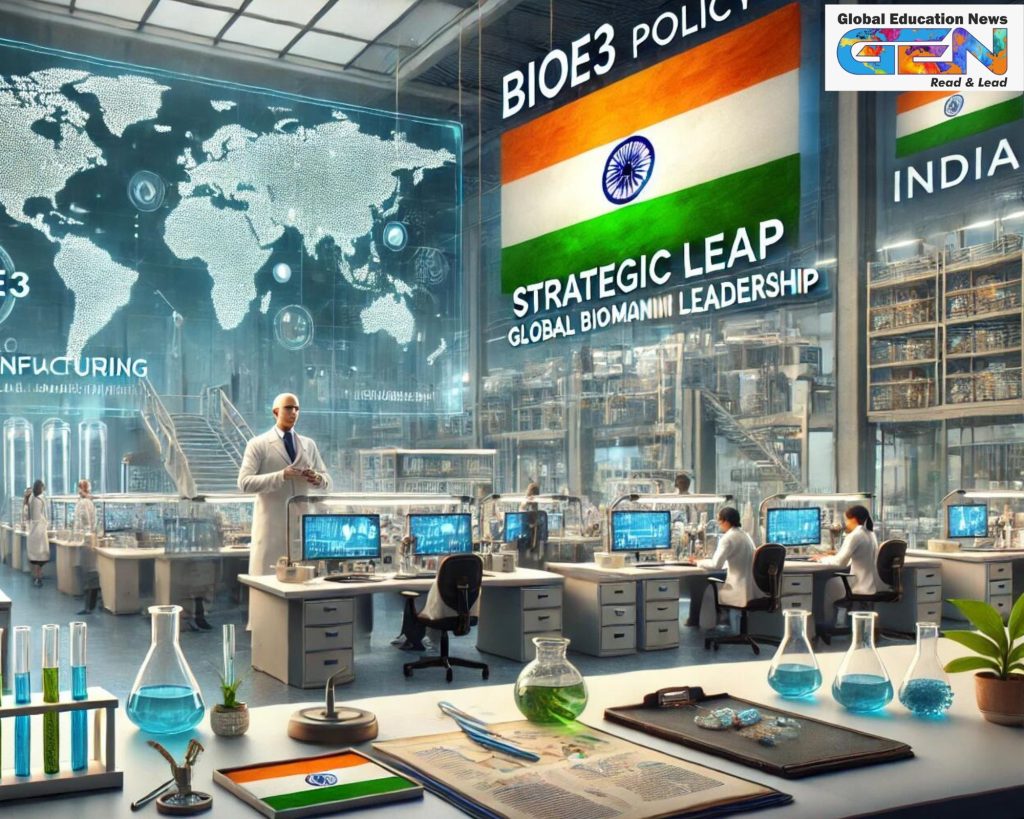
The Biotechnology for Economy, Environment, and Employment (BioE3) Policy, launched by the Union Ministry of Science and Technology on August 27, 2024, is a transformative framework designed to advance high-performance biomanufacturing in India. By establishing 16 biomanufacturing hubs across the country, the policy seeks to strengthen India’s bioeconomy, which grew from $10 billion in 2014 to $151 billion in 2023, contributing 4.25% to India’s GDP as of December 2023. The BioE3 Policy aligns with India’s vision of Atmanirbhar Bharat (self-reliance) and the Lifestyle for Environment (LiFE) initiative, emphasizing green growth and sustainability through the utilization of renewable biological resources.
Context: India’s Bioeconomy and Import Dependence
India’s bioeconomy leverages renewable biological resources—from plants, animals, microorganisms, and organic waste—to produce food, feed, energy, and bio-based products. Despite significant growth, with 8,531 biotech startups in 2023 (up from 50 in 2014), India remains heavily reliant on imports for critical components such as:
- Active Pharmaceutical Ingredients (APIs),
- Fermentation-based drugs,
- Enzymes for biofuels, and
- Biofertilizer reagents.
The Covid-19 pandemic exposed vulnerabilities in global supply chains, prompting the government to accelerate domestic manufacturing through initiatives like the Production Linked Incentive (PLI) scheme. The BioE3 Policy builds on these efforts, aiming to reduce import dependence and establish India as a global leader in biomanufacturing.
Objectives of the BioE3 Policy
The BioE3 Policy outlines a comprehensive framework to foster high-performance biomanufacturing across diverse sectors, with three core objectives:
- Economic Growth: Expand the bioeconomy to $300 billion by 2030, creating jobs and reducing reliance on imported biotech products.
- Environmental Sustainability: Promote green growth by utilizing renewable resources and advancing technologies like carbon capture and biofuels, aligning with the LiFE initiative.
- Employment Generation: Support startups and MSMEs through shared infrastructure, fostering innovation and job creation in tier-1 and tier-2 cities.
The policy aligns with India’s Atmanirbhar Bharat vision by prioritizing domestic production of critical biotech products, enhancing self-reliance in sectors like healthcare, agriculture, and energy.
Key Features of the BioE3 Policy
The BioE3 Policy introduces several strategic components to transform India’s biomanufacturing landscape:
1. Biomanufacturing Hubs
- Scale and Scope: The policy envisions establishing 16 biomanufacturing hubs across India, each equipped with large fermenters (500–1,000 liters) to support scalable production.
- Focus Areas:
- Fermentation-based medicines: Producing APIs and biotherapeutics to reduce import dependence.
- Biofuels: Developing enzymes and technologies for sustainable energy solutions.
- Bioproteins: Creating alternative proteins for food and feed.
- Carbon capture technologies: Supporting environmental sustainability.
- Novel monoclonal antibody treatments: Advancing precision healthcare.
- Support for Startups and MSMEs: The hubs will pool resources, reducing the capital burden for startups and micro, small, and medium enterprises (MSMEs), enabling them to scale innovations efficiently.
2. Product Focus
- The government has identified approximately 1,000 critical products needed for domestic production, including APIs, enzymes, and biofertilizers, to address supply chain vulnerabilities exposed during the Covid-19 pandemic.
- These products will be prioritized in the biomanufacturing hubs, ensuring alignment with national healthcare and agricultural needs.
3. Alignment with Green Growth and LiFE
- The policy promotes a circular bioeconomy, utilizing organic waste and renewable resources to minimize environmental impact.
- It supports the Lifestyle for Environment (LiFE) initiative, encouraging collective action for sustainability through biomanufacturing innovations like biofuels and carbon capture.
Significance for India’s Bioeconomy
The BioE3 Policy is a pivotal step toward achieving India’s bioeconomy and sustainability goals:
- Economic Impact: With the bioeconomy already at $151 billion in 2023, the policy’s focus on 16 biomanufacturing hubs could drive it to $300 billion by 2030, creating millions of jobs, particularly in tier-2 cities.
- Self-Reliance: By reducing dependence on imported APIs and enzymes, the policy strengthens India’s position in global biotech markets, complementing initiatives like the PLI scheme.
- Sustainability: Technologies like carbon capture and biofuels align with India’s net-zero by 2070 commitment, supporting global sustainability goals under the LiFE initiative.
- Startup Ecosystem: The growth of 8,531 biotech startups in 2023 highlights India’s innovation potential, which the policy amplifies through shared infrastructure and funding.
Challenges and Opportunities
- Challenges:
- Infrastructure Gaps: Establishing 16 biomanufacturing hubs requires significant investment in large fermenters and skilled manpower, particularly in tier-2 cities.
- Global Competition: India must compete with biotech leaders like the US and China, necessitating robust intellectual property rights (IPR) models and innovation incentives.
- Skilling Needs: The policy demands a workforce trained in synthetic biology and bioprocess engineering, requiring alignment with educational initiatives like NEP 2020.
- Opportunities:
- Resource Sharing: The hubs’ cost-sharing model reduces barriers for startups and MSMEs, fostering innovation in biotherapeutics and biofuels.
- Regional Development: By prioritizing tier-2 cities, the policy promotes equitable growth, aligning with initiatives like Beyond Bengaluru and Belagavi’s tech ecosystem.
- Global Leadership: The policy positions India to capture a share of the $1 trillion global bioeconomy, leveraging its 8,531 biotech startups and growing talent pool.