Date: November 25, 2026
Place: New Delhi
Education News: Delhi University, NEP 2020 and Postgraduate Admissions
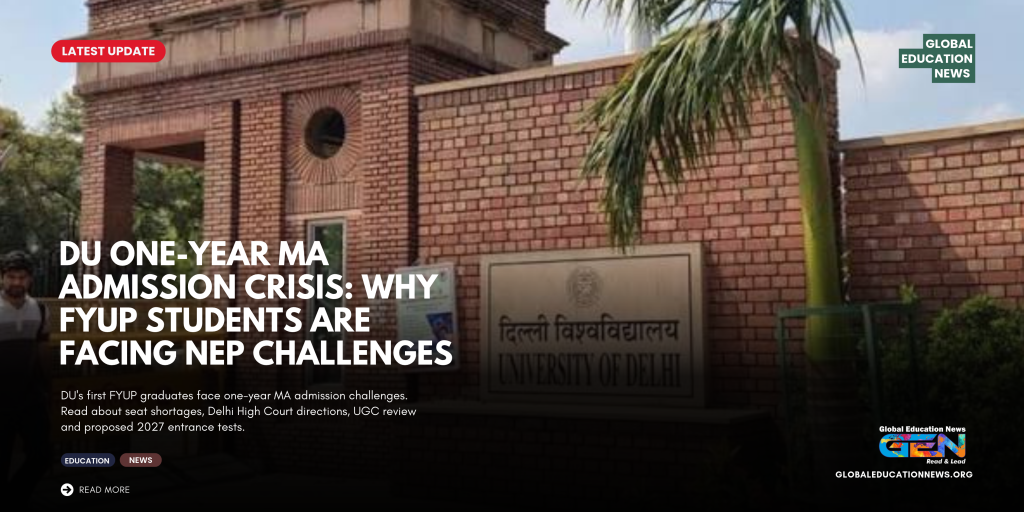
New Delhi, Education News: Delhi University’s (DU) ambitious transition to a four-year undergraduate programme and a one-year postgraduate degree pathway under the National Education Policy (NEP) 2020 is facing a major implementation challenge. Students from the university’s first Four-Year Undergraduate Programme (FYUP) batch, which completed its fourth year in 2026, are struggling to secure admission to the newly introduced one-year master’s programmes.
The new academic structure was intended to provide greater flexibility and create a shorter postgraduate route for students completing a four-year bachelor’s degree. However, the first admission cycle has exposed several concerns, including limited seats, admission-priority criteria, infrastructure constraints and uncertainty about academic progression.
The matter has reached the Delhi High Court. The court has asked the University Grants Commission (UGC) to examine the students’ grievances and explore whether they can be accommodated in one-year postgraduate programmes at other universities and colleges, wherever feasible.
The developments have raised an important question for India’s higher-education system: can universities successfully implement a new undergraduate structure without preparing sufficient postgraduate seats, faculty and admission arrangements for the students who complete it?
What Is the Problem With DU’s One-Year MA Admission Under NEP 2020?
Delhi University introduced its four-year undergraduate structure under the Undergraduate Curriculum Framework (UGCF) 2022 in the 2022–23 academic session.
Students who continued into the fourth year expected to complete the additional undergraduate requirements and become eligible for a one-year master’s programme, in line with the postgraduate pathway envisaged under NEP 2020.
However, the first admission cycle in 2026–27 created difficulties.
According to figures reported during the admission controversy, approximately 23,000 students continued into the fourth year, while around 14,000 subsequently applied for the one-year postgraduate programmes.
The number of available seats was significantly lower than the number of interested applicants. The admission criteria also gave preference to certain categories of four-year graduates, creating further competition.
As a result, students questioned whether the admission process adequately reflected the expectations created when the four-year undergraduate programme was introduced.
How Many Students Applied for DU’s One-Year Postgraduate Courses?
The difference between the number of students completing the fourth year and the number of available postgraduate seats has become one of the central issues.
| Particular | Reported figure |
|---|---|
| Students who continued into the fourth undergraduate year | Approximately 23,000 |
| Students who applied for one-year postgraduate courses | Approximately 14,000 |
| Initial one-year PG seat intake reported | 1,063 |
| Revised regular PG intake reported | 2,807 |
| Revised School of Open Learning (SOL) intake reported | 3,340 |
Note: These figures refer to different stages of the admission process and should not be treated as a single final admission count. Regular and SOL seats are separate categories.
Even after the university increased the intake, concerns remained about the availability of regular postgraduate seats and the number of applicants who could not secure their preferred admission.
The situation has highlighted the importance of matching undergraduate expansion with postgraduate capacity.
Why Are Students Challenging DU’s One-Year MA Admission Rules?
Seat availability is not the only issue. Students have also questioned the admission-priority system used for the one-year postgraduate programmes.
DU introduced a merit-based selection mechanism using undergraduate CGPA, together with programme-specific priority categories.
Under the reported framework, students with a four-year Bachelor’s Honours degree, including Honours with Research or Entrepreneurship, were placed in the first priority category (P1).
Students with a four-year multidisciplinary undergraduate degree with a Major in the relevant subject were placed in the second priority category (P2).
This meant that candidates in the first category were considered before candidates in the second category, even where a student in the latter category had a higher CGPA.
Students argued that the system disadvantaged some multidisciplinary graduates who had completed four years of undergraduate study and fulfilled the relevant subject requirements.
They also questioned whether the admission priorities had been communicated clearly and early enough for students to make informed academic decisions.
What Is the Difference Between P1 and P2 Admission Categories?
| Category | Degree background | Admission priority |
|---|---|---|
| P1 | Four-year Bachelor’s Honours degree, including eligible Honours with Research or Entrepreneurship | First priority |
| P2 | Four-year multidisciplinary bachelor’s degree with a Major in the relevant subject | Considered after P1 candidates, subject to available seats |
The priority system became a major point of disagreement because students believed that completing the fourth year should provide a clearer and more predictable pathway to postgraduate education.
What Did the Delhi High Court Say About DU’s Admission Dispute?
The Delhi High Court heard petitions filed by students challenging the admission criteria for the one-year postgraduate programmes.
In its order dated November 20, 2026, the court acknowledged that students had continued with the fourth year of their undergraduate studies with a genuine expectation that the new academic structure would facilitate progression to a one-year master’s degree.
However, the court declined to direct Delhi University to create additional seats or grant admission to the petitioners.
The court observed that increasing postgraduate intake would involve several academic and administrative considerations, including:
- Approved or sanctioned seat capacity.
- Availability of qualified teaching staff.
- Classroom and other infrastructure.
- Academic requirements of individual programmes.
- Institutional resources.
The court also did not undertake to compare the academic content and rigour of different four-year undergraduate degree structures, leaving such academic assessments to the appropriate university and regulatory authorities.
What Did the Court Direct the UGC to Do?
Although the court did not order DU to increase its seats, it directed the UGC to examine the students’ representations.
The commission has been asked to explore whether one-year postgraduate seats are available at other universities and colleges and whether the affected students can be accommodated wherever feasible.
The UGC was directed to complete this exercise within three weeks of the November 20 order.
Importantly, this direction does not guarantee admission to every student who has filed a grievance. Any possible accommodation will depend on available seats, eligibility conditions and the applicable admission rules.
Why Has NEP 2020 Implementation Become a Challenge at Delhi University?
The DU admission controversy highlights a wider issue in education policy implementation: introducing a new degree structure is not enough unless universities prepare the entire academic pathway.
The four-year undergraduate programme and one-year postgraduate route are connected. Students need clear information about eligibility, admission priorities, seat availability and academic progression before choosing whether to continue into the fourth year.
Several challenges have emerged.
1. Postgraduate Seats Did Not Match Student Demand
The number of students interested in the one-year master’s route was much higher than the initial seat intake.
This has raised questions about whether postgraduate capacity was adequately assessed when the four-year undergraduate programme was introduced.
2. Admission Rules Created Uncertainty
The priority-based system created different levels of consideration among students who had completed four-year undergraduate programmes.
Students questioned whether their degree structure could affect their postgraduate opportunities despite completing the additional year of study.
3. Infrastructure and Faculty Constraints
Delhi University has pointed to limitations involving teaching staff, classrooms, accommodation and other academic resources.
Increasing the number of seats without providing adequate infrastructure and faculty could affect the quality of postgraduate education.
4. Communication and Planning Gaps
The admission controversy has also raised concerns about the timing and clarity of information given to students.
For major academic reforms, students need to know the eligibility criteria and likely admission pathways well before making decisions about their undergraduate course structure.
5. Different Postgraduate Routes Created Additional Questions
DU’s one-year postgraduate programme operates alongside the existing two-year master’s structure.
The two pathways have different eligibility and admission arrangements. This makes it important for students to understand which route applies to their degree and academic background.
Will Delhi University Introduce an Entrance Exam for One-Year MA Admissions in 2027–28?
Delhi University is considering a change to its admission process for future academic sessions.
The university informed the Delhi High Court that it was examining the possibility of introducing an entrance examination for admission to one-year postgraduate programmes from the 2027–28 academic session.
Under the proposal, admission could be based on entrance-test performance rather than the existing undergraduate CGPA-based priority arrangement.
However, this is still a proposal under consideration. DU has not announced a final entrance-test format, syllabus, eligibility framework or confirmed admission schedule for the 2027–28 one-year postgraduate programmes.
Students should therefore avoid treating the proposed entrance examination as an officially implemented rule.
One-Year MA vs Two-Year MA at DU: What Should Students Know?
Delhi University’s postgraduate admission structure includes different routes depending on the candidate’s undergraduate qualification.
| Feature | One-year PG programme | Two-year PG programme |
|---|---|---|
| Intended academic background | Eligible four-year bachelor’s graduates under NEP from DU | Eligible candidates under the notified two-year PG admission rules |
| Duration | One year | Two years |
| 2026–27 admission route | University-defined eligibility and merit priorities | CUET-PG 2026 and DU’s CSAS(PG) process for regular programmes |
| Academic structure | Postgraduate study following a four-year undergraduate degree | Traditional two-year postgraduate pathway |
| Key consideration | Programme-specific eligibility and available seats | CUET-PG performance and applicable admission requirements |
Students should consult the current admission bulletin because eligibility, programme availability and admission procedures may differ across courses and academic sessions.
What Should Current DU Students Do Now?
Students planning postgraduate education should follow official university announcements rather than relying on assumptions about the one-year master’s pathway.
Some practical points to consider include:
- Check the official DU admission portal for updated postgraduate notices.
- Read the programme-specific eligibility requirements carefully.
- Understand whether the degree qualifies for the one-year or two-year postgraduate route.
- Follow UGC announcements concerning the court-directed review.
- Do not assume that a proposed entrance examination has been finalised for 2027–28.
- Consider other universities and eligible postgraduate options where appropriate.
Students currently enrolled in undergraduate programmes should also follow official academic guidance when deciding whether to pursue a three-year or four-year degree.
What Does the DU Admission Controversy Mean for the Future of NEP 2020?
The situation at Delhi University is important because the university is among the major institutions implementing the NEP’s revised undergraduate and postgraduate framework.
The experience of its first FYUP graduating batch offers lessons for other universities planning similar academic changes.
Successful implementation requires coordination across several stages:
- Undergraduate planning: Students should receive clear information about the academic and career implications of choosing a four-year degree.
- Postgraduate capacity: Universities need to estimate future demand and plan seats accordingly.
- Transparent eligibility: Admission priorities should be published well in advance.
- Faculty and infrastructure: Additional programmes require sufficient teachers, classrooms and academic resources.
- Student communication: Universities should provide timely guidance so students can make informed decisions.
The larger lesson is that education reforms must be planned as complete academic pathways, not as separate changes introduced at different stages.
Frequently Asked Questions (FAQs)
1. Why are DU FYUP students facing problems with one-year MA admissions?
Students from DU’s first four-year undergraduate batch have faced limited postgraduate seats and admission-priority rules that favour certain categories of four-year graduates. This has created uncertainty for students seeking admission to the one-year master’s programmes.
2. What is the one-year master’s programme under NEP 2020?
The NEP framework envisages a one-year master’s pathway for students who complete a four-year undergraduate degree. It is part of a broader effort to make higher education more flexible.
3. How many students applied for DU’s one-year postgraduate programmes?
Approximately 14,000 students reportedly applied for the one-year postgraduate programmes after around 23,000 students continued into the fourth year of DU’s undergraduate structure.
4. What are P1 and P2 categories in DU’s one-year PG admissions?
P1 refers to eligible four-year Bachelor’s Honours graduates, including Honours with Research or Entrepreneurship. P2 refers to eligible four-year multidisciplinary graduates with a Major in the relevant subject. P1 candidates were given priority over P2 candidates under the reported admission framework.
5. What did the Delhi High Court order on November 20, 2026?
The court declined to direct DU to create additional postgraduate seats. It asked the UGC to examine the students’ grievances and explore possible accommodation in one-year postgraduate programmes at other institutions within three weeks.
6. Will the UGC guarantee admission to affected DU students?
No. The court-directed review does not guarantee admission. The UGC has been asked to examine available opportunities and facilitate accommodation wherever feasible, subject to eligibility and seat availability.
7. Will DU conduct an entrance test for one-year MA admissions in 2027–28?
DU has informed the court that it is considering an entrance examination for the 2027–28 academic session. The proposal is not yet a final admission rule.
8. Is CUET-PG required for DU’s one-year postgraduate programmes?
The 2026–27 admission arrangements for DU’s one-year postgraduate programmes used the university’s eligibility and CGPA-based priority framework. Regular two-year postgraduate admissions used CUET-PG 2026 and the university’s CSAS(PG) process. Students should check the relevant admission bulletin for their programme and session.
9. What is the main challenge in implementing NEP 2020 at DU?
The main challenge is aligning the new four-year undergraduate structure with postgraduate seat availability, admission rules, faculty strength, infrastructure and timely communication with students.
Conclusion: DU’s FYUP Experience Highlights the Need for Better NEP Planning
Delhi University’s one-year postgraduate admission controversy has exposed the difficulties of implementing major education reforms without adequately coordinating undergraduate and postgraduate planning.
The four-year undergraduate structure was intended to offer students greater flexibility and a shorter master’s pathway. However, the experience of the first graduating batch shows that students also need sufficient postgraduate seats, transparent admission criteria and timely academic guidance.
The Delhi High Court’s direction to the UGC provides an opportunity to examine the immediate concerns of affected students. At the same time, DU’s consideration of an entrance examination for 2027–28 indicates that the university may review its future admission process.
The broader lesson for India’s higher-education system is clear: a successful education reform must work for students at every stage, from undergraduate admission to postgraduate progression.
Global Education News will continue to follow DU admission developments, UGC decisions, NEP 2020 implementation and changes that affect students pursuing higher education in India.