Date: October 16, 2026
Place: New Delhi, India
Education News: CBSE, School Education, Board Examinations and Attendance Rules
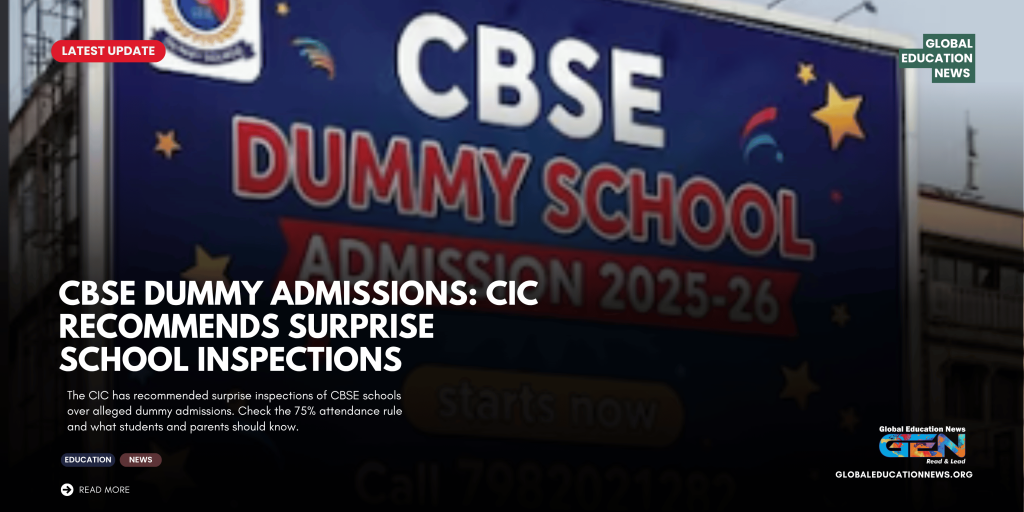
New Delhi, October 16, 2026, Education news: The Central Information Commission (CIC) has recommended surprise inspections of schools affiliated with the Central Board of Secondary Education (CBSE) to investigate alleged dummy admissions and strengthen compliance with mandatory attendance rules.
Information Commissioner Sudha Rani Relangi made the recommendation in an order following a complaint alleging that students were receiving dummy admission certificates despite not attending regular classes. The recommendation invokes Section 25(5) of the Right to Information (RTI) Act, 2005, and calls on CBSE to use its inspection powers to improve monitoring of affiliated schools.
The development has renewed attention on dummy school admissions, attendance requirements for Class 10 and Class 12 board examinations, and the responsibility of schools to ensure that registered students attend classes regularly. The recommendation does not mean that all CBSE schools are under investigation or that surprise inspections have already taken place.
What Has the CIC Recommended for CBSE Schools?
The Central Information Commission has recommended that CBSE conduct surprise inspections at its affiliated schools to check alleged dummy admissions and ensure compliance with school affiliation conditions.
The recommendation followed an RTI-related complaint concerning attendance requirements at private missionary schools in Bhopal, Madhya Pradesh. The applicant sought information about attendance rules, subject selection and prescribed textbooks, and raised concerns about students allegedly obtaining examination results without attending regular classes.
During the proceedings, the commission also questioned the initial handling of the RTI application, which had been returned because of an issue with the application fee payment instrument. The concerned public information officer subsequently agreed to provide a point-by-point response, which CBSE submitted.
The commission’s recommendation highlights the need for effective monitoring so that students appearing for board examinations meet the prescribed conditions.
What Are Dummy Admissions in Schools?
Dummy admission generally refers to an arrangement in which a student is enrolled in a school but does not attend regular classes, often to focus on preparation for competitive examinations.
Such arrangements can undermine the purpose of school education if students receive school enrolment or examination eligibility without meeting attendance and other academic requirements.
However, students who are absent for legitimate reasons, including documented medical circumstances, should not automatically be labelled as dummy candidates. Their cases must be considered under the applicable attendance rules and permitted exemptions.
What Is the CBSE Attendance Rule for Class 10 and Class 12?
CBSE rules generally require students in Classes 9 to 12 to complete at least 75% attendance to be eligible for the relevant examinations, subject to the applicable examination bye-laws.
The board has also directed affiliated schools to maintain attendance records and ensure that students meet the prescribed conditions before their names are submitted for board examinations.
| Key detail | What the rules say |
|---|---|
| Minimum attendance | Generally 75% |
| Relevant classes | Classes 9, 10, 11 and 12 under the applicable rules |
| Practical subjects | Separate attendance requirements may apply to practical work |
| Attendance records | Schools must maintain appropriate records |
| Attendance shortage | Permitted relaxation may be considered in eligible cases |
| Dummy or non-attending candidates | Schools must not sponsor candidates who fail to meet the applicable requirements |
Students and parents should check the current CBSE examination bye-laws and circulars for the rules relevant to their class and academic session.
Why Has CBSE Been Asked to Conduct Surprise Inspections?
Surprise inspections can help determine whether schools are maintaining accurate attendance records and following the conditions attached to their CBSE affiliation.
The recommendation is intended to strengthen accountability and discourage practices in which students remain enrolled on paper without participating in regular classroom learning.
Potential areas of scrutiny include:
- Whether enrolled students attend classes regularly.
- Whether attendance registers accurately reflect student presence.
- Whether schools maintain records for authorised leave and absences.
- Whether students meet the minimum attendance requirement before being sponsored for board examinations.
- Whether schools comply with CBSE affiliation and examination rules.
The commission’s recommendation does not establish that a particular school has violated the rules. Any findings would depend on the relevant inspection and evidence.
Can Students With Low Attendance Be Barred From CBSE Board Exams?
Students who do not meet the required attendance criteria may face difficulties obtaining eligibility to appear for CBSE board examinations.
CBSE’s examination rules provide for consideration of certain attendance-shortage cases, but relaxation is not automatic. The board’s published instructions identify serious circumstances, such as medical emergencies and participation in recognised national or international sports events, as examples of grounds that may be considered when supported by the required documents.
Students who have been absent for legitimate reasons should submit leave applications and supporting records through their schools as required. They should not assume that a shortage of attendance will automatically be excused.
What Action Can CBSE Take Against Schools Violating Attendance Rules?
CBSE’s affiliation bye-laws prohibit affiliated schools from presenting candidates for board examinations if those students have not attended school regularly or do not satisfy the prescribed minimum attendance conditions.
Where violations are established, the board may take action under its applicable affiliation and examination rules. Depending on the circumstances, consequences may affect both the school and the eligibility of the candidates concerned.
The precise action would depend on the evidence, the applicable provisions and the board’s procedures. The CIC’s recommendation for surprise inspections should not be interpreted as a finding of guilt against all affiliated schools.
How Could the Recommendation Affect Students and Parents?
The recommendation may lead to closer scrutiny of attendance records if CBSE implements the suggested inspections.
For students, it reinforces the importance of attending classes and maintaining proper documentation for authorised absences. For parents, it is a reminder to understand the school’s attendance policy and check that their child’s records are accurate.
Students preparing for competitive examinations should also understand that preparation outside school does not automatically remove the obligation to satisfy applicable school attendance requirements.
Schools, meanwhile, must communicate attendance rules clearly and maintain records that can be verified if required.
Frequently Asked Questions (FAQs)
1. What is the latest update on CBSE dummy admissions?
The Central Information Commission has recommended surprise inspections of CBSE-affiliated schools to check alleged dummy admissions and strengthen compliance with attendance rules.
2. Who recommended surprise inspections of CBSE schools?
Information Commissioner Sudha Rani Relangi made the recommendation in a recent CIC order.
3. Have surprise inspections already started across all CBSE schools?
The recommendation calls on CBSE to conduct surprise inspections. It does not establish that inspections have already taken place at every affiliated school.
4. What is the minimum attendance required for CBSE board examinations?
The general requirement is at least 75% attendance, subject to the applicable CBSE examination bye-laws and permitted exceptions.
5. Can a student with low attendance still appear for board examinations?
Some attendance-shortage cases may be considered under CBSE’s rules, but relaxation is not automatic. Students must follow the prescribed procedure and provide the required supporting documents.
6. Why did the CIC raise the issue of dummy admissions?
The recommendation followed an RTI-related complaint alleging that students were receiving dummy admission certificates despite not attending regular classes.
7. Can CBSE take action against schools that enrol non-attending students?
CBSE’s rules prohibit schools from sponsoring candidates who do not meet the applicable attendance requirements. Action may be taken where violations are established under the relevant rules.
8. What should students and parents do if attendance is low?
They should contact the school, check the attendance record, submit valid leave applications and supporting documents, and follow the official procedure for attendance-shortage cases.
9. Does this recommendation mean all dummy admission allegations have been proved?
No. The recommendation addresses concerns raised in a complaint. Specific violations must be established through appropriate verification and procedures.
Conclusion
The CIC’s recommendation for surprise inspections has brought renewed attention to dummy admissions and attendance compliance in CBSE-affiliated schools. The central issue is whether students are receiving genuine classroom education and meeting the conditions required for board examination eligibility.
CBSE’s implementation of the recommendation, along with effective monitoring and fair treatment of students with legitimate absences, will be important in determining its impact. Global Education News will continue tracking school education policy, CBSE rules and developments affecting students, parents and educators.