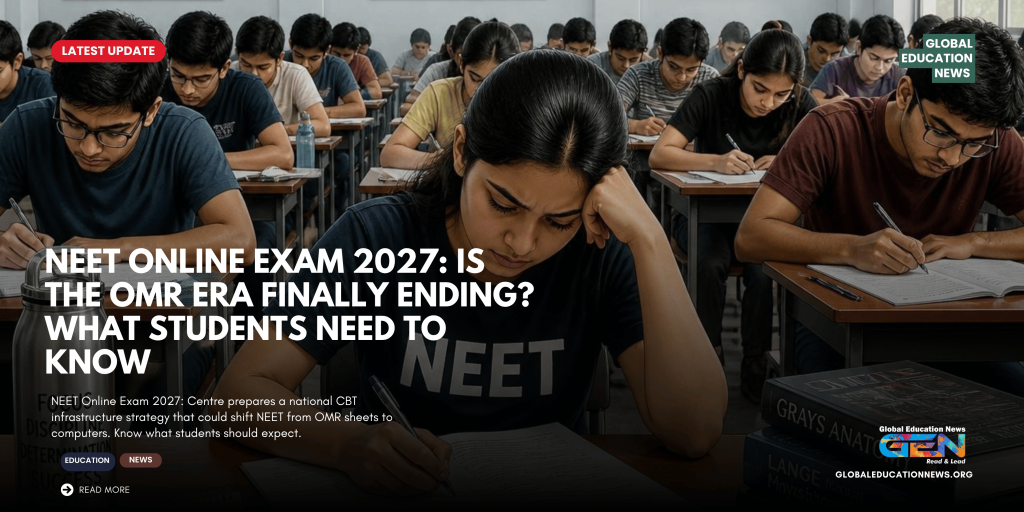
New Delhi — For millions of medical aspirants, the most familiar part of NEET could soon disappear: the OMR sheet.
The Education Ministry is working on a national Computer-Based Testing (CBT) infrastructure strategy aimed at creating the examination-grade network needed to shift NEET-UG from its traditional pen-and-paper format to an online test. The proposal is part of the wider overhaul of India’s examination system and follows the controversies that have intensified scrutiny of the National Testing Agency (NTA).
But the transition is not simply a matter of putting NEET questions on computer screens. The government must first determine where hundreds of thousands of candidates can take the exam, how centres will be standardised, how security will be maintained and how students in rural and low-connectivity districts will be protected from being disadvantaged.
The final architecture is still being worked out.
The government is awaiting recommendations from the Nandan Nilekani-led high-powered task force on examination reforms, with the possible NEET transition also requiring consultation with the Health Ministry and the National Medical Commission.
NEET Online Exam: Why the CBT Infrastructure Is the Real Challenge
NEET is not an ordinary computer-based examination.
The 2026 NEET-UG was conducted in pen-and-paper mode across 551 cities in India and 14 cities abroad, with more than 22.79 lakh registered candidates and over 5,432 examination centres. NTA said more than two lakh personnel were mobilised for the examination.
That scale explains why the proposed NEET online exam 2027 cannot simply copy the infrastructure already used for smaller CBT examinations.
NTA already conducts major examinations such as JEE Main, CUET and UGC-NET in computer-based mode. But NEET’s enormous candidate pool creates a different logistical problem: there must be enough reliable computers, secure networks, trained staff and examination rooms available across the country within a tightly controlled testing window.
The ministry’s proposed strategy is therefore focused on building an examination-grade ecosystem rather than merely changing the question paper’s format.
What the national CBT strategy is expected to address
The framework under consideration focuses on several critical areas:
- More examination centres to reduce geographical gaps.
- Standardised technical specifications for CBT centres.
- Adequate computer capacity and reliable networking.
- Strong examination security and monitoring.
- Accessibility for candidates with different needs.
- Better access for students in rural and low-connectivity areas.
- A scalable system capable of handling very large candidate numbers.
Officials have described the approach as a multi-model sourcing architecture, indicating that the government is examining different ways of creating the required national testing capacity.
From OMR Sheets to Screens: What Could Change for NEET Aspirants?
For students, the most visible change would be straightforward: instead of receiving a question paper and marking answers on an OMR sheet, candidates would answer questions on a computer.
But the consequences could extend beyond the screen.
A CBT-based NEET could alter how examination centres are allocated, how sessions are scheduled and how technical failures are handled. If the examination has to be spread across multiple sessions or days because of infrastructure limitations, questions around comparability between shifts and the method used to ensure fairness would become significant.
Reports in July had indicated that a computer-based NEET could potentially be conducted over several days and across more than 1,000 centres, although those details have not been established as the final examination plan.
For now, students should therefore distinguish between the direction of reform and the final NEET 2027 examination rules.
The latter will depend on official decisions and the eventual information bulletin.
Rural Students and the Digital Divide Are Central to the Plan
The hardest question may not be technological.
It may be geographical.
The government’s own planning recognises that a national CBT system must account for rural candidates, women candidates and students from low-connectivity districts. Officials said these equity implications are being considered as part of the proposed transition.
This matters because a computer-based examination is only as accessible as the infrastructure surrounding it.
A student living close to a large city may have several potential testing centres nearby. A student in a remote district could face a very different situation if adequate computer capacity is unavailable locally.
NTA has previously acknowledged the importance of expanding examination infrastructure. A 2024 parliamentary response noted that CBT centres require technical infrastructure such as computer nodes and networking, while new centres are influenced by candidate numbers and the availability of suitable physical and technical infrastructure.
The new strategy is intended, in part, to close that gap.
Why the NEET Paper Leak Changed the Conversation
The push towards CBT comes amid a broader examination-system overhaul.
The controversy surrounding NEET and examination security has placed greater attention on the vulnerabilities associated with the physical handling of question papers, including printing, storage and transportation.
A digital examination model could remove some of those physical processes. But it would create a different set of responsibilities around computer security, networks, authentication, software and centre-level systems.
That distinction matters.
Moving NEET online is not the same thing as making NEET secure.
The technology must be supported by strong operational controls, independent monitoring and clearly defined contingency procedures.
The NTA has already been expanding technology-based safeguards. Its current tender listings include CBT services, examination monitoring, CCTV, frisking and face-authentication requirements.
NTA Already Has Experience With Large CBT Exams
The proposed NEET shift does not mean India is starting from zero.
NTA has conducted large examinations in CBT mode for years. JEE Main 2026 Session 2, for example, was scheduled in CBT mode across hundreds of centres for more than 11 lakh candidates. NTA also uses computer-based systems for other national examinations.
The difference is scale.
NEET brings together an exceptionally large and geographically dispersed candidate population in one medical entrance examination. The challenge is therefore to make the CBT model sufficiently large, reliable and uniform without creating new barriers for candidates.
That is why the infrastructure question has become as important as the examination-format question.
Nilekani Task Force Report Could Shape the Next Step
The final direction is closely linked to the Nandan Nilekani-led high-powered task force examining India’s public examination system.
The ministry has said that the possible migration of NEET to CBT — including its design, sequencing, infrastructure requirements and equity implications — is being worked out. Recommendations from the task force are still awaited, after which consultations with the Health Ministry and NMC will inform the final decision.
That means reports about an online NEET should currently be read with one distinction in mind:
The government is preparing for the transition, but every operational detail has not yet been finalised.
What NEET Aspirants Should Watch Next
The eventual NTA notification will matter more than speculation about the format.
Students should watch for official information on:
- Whether NEET-UG 2027 will definitively be conducted in CBT mode.
- The number and location of examination centres.
- Whether the exam will be held in one or multiple sessions.
- Rules governing shift-wise examination and scoring, if multiple sessions are used.
- Accessibility arrangements for PwD candidates.
- Computer familiarity or practice facilities, if announced.
- The final examination schedule and detailed information bulletin.
The current NEET-UG 2026 system remains based on pen-and-paper testing; NTA’s official material confirms that format and the scale of the 2026 examination.
The bigger story, however, is no longer whether India can conduct computer-based entrance tests. It already can.
The question is whether the country can build a national CBT infrastructure capable of delivering the same examination experience to students separated by thousands of kilometres, different levels of connectivity and vastly different access to technology.
For NEET aspirants, that infrastructure may ultimately determine what the country’s biggest medical entrance examination looks like from 2027 onward.