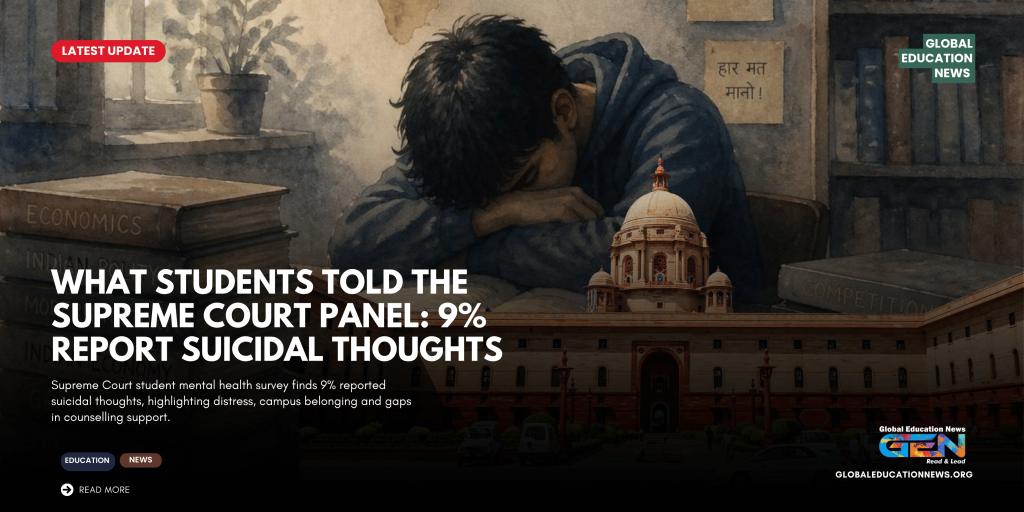
New Delhi, India — A nationwide student mental health survey conducted by the Supreme Court-appointed National Task Force has brought a difficult reality on Indian campuses into sharper focus: 9% of surveyed higher-education students reported experiencing suicidal thoughts often or very often during the previous year, while 15% said they had gone through a prolonged period of severe distress, anxiety or low mood in the preceding six months.
The survey collected responses from more than 2.43 lakh students, with about 67% of respondents belonging to Scheduled Caste, Scheduled Tribe and Other Backward Class communities. It also found that roughly 34% of students felt like outsiders on campus to varying degrees, while only 56% said they trusted their institution’s administration to handle serious issues fairly.
The findings are expected to form part of the final report of the National Task Force (NTF), which was constituted by the Supreme Court to examine student mental health and measures to prevent suicides in higher educational institutions. The final report is expected by October 31.
Student Mental Health Survey Points to a Wider Campus Problem
The headline figure is only one part of the survey.
The responses point towards a broader combination of academic, social and institutional pressures affecting students across different types of higher-education institutions.
About 32% of respondents said their institution did not offer counselling services, while only 56% expressed trust in their administration’s ability to deal fairly with serious concerns.
For policymakers and universities, that shifts the conversation beyond individual distress towards the systems surrounding students.
Feeling Like an Outsider Matters
One of the survey’s striking findings was the extent of students reporting a sense of being outsiders on campus.
About 34% reported feeling like outsiders to some degree. The figure is significant because belonging can shape how students interact with classmates, faculty and institutional support systems.
The task force’s wider work has also examined discrimination and unequal experiences in higher education, including concerns involving caste, gender, academic support and access to institutional resources.
The survey therefore places campus culture alongside academic performance when examining student well-being.
Academic Pressure and Career Anxiety Emerge as Concerns
The task force’s consultations found that student concerns were not confined to examinations.
Students reported problems involving strict attendance requirements, demanding academic schedules and heavy workloads in medical and allied disciplines. Engineering students raised concerns around intense competition, relative grading and placement expectations.
Concerns about academic choices and employment were also reported as recurring sources of worry.
In state universities, students pointed to faculty shortages and inconsistent academic support. In professional courses, respondents raised concerns about practical training, while some research students described problems involving supervisory relationships.
The picture that emerges is therefore more complicated than a simple examination-pressure narrative.
Counselling Access Remains a Major Gap
The survey’s finding that around one-third of respondents reported no counselling service at their institution raises questions about how students can access support when difficulties become overwhelming.
Earlier analysis of the NTF’s work has identified an even broader institutional gap. The Indian Express reported that more than 70% of institutions examined by the task force lacked a full-time mental-health service provider, while fewer than 4% had a formal suicide-risk management protocol.
That distinction matters.
Having a person designated as a counsellor is not necessarily the same as having trained mental-health professionals, confidential support and a clear system for responding to serious concerns.
Why the Survey Results Need Careful Reading
The NTF has cautioned that the current survey should not be treated as a nationally representative picture of every higher-education student.
A senior official cited in the reporting said responses to several questions, including open-ended responses, were still being analysed and that the non-representative nature of the sample meant the findings should be regarded as preliminary and tentative.
The task force has also conducted institutional visits and stakeholder consultations.
So the survey is best understood as an important signal from a large student sample—not as a precise estimate of the mental-health experience of every student in India.
What the Supreme Court Task Force Is Looking At
The NTF was constituted in March 2025 to examine student mental health and the circumstances surrounding student suicides in higher-education institutions.
The panel is headed by former Supreme Court judge Justice S. Ravindra Bhat and includes experts from psychiatry, clinical psychology, women’s studies, disability rights and student welfare.
Its work has included:
- Student surveys
- Institutional visits
- Stakeholder consultations
- Examination of academic and social pressures
- Assessment of counselling and support systems
- Examination of discrimination and institutional practices
- Consideration of standardised support and crisis-response mechanisms
The final report is expected to bring these strands together.
What Universities May Need to Address
The emerging findings point towards several areas that institutions will need to examine closely.
Better Access to Trained Professionals
Counselling cannot work effectively if students cannot access appropriately trained professionals when they need them.
Clear Emergency Protocols
Institutions need defined procedures for responding to serious mental-health concerns rather than relying on ad hoc decisions.
Stronger Student-Faculty Support
Academic mentoring, accessible faculty and responsive administration can influence whether students feel able to raise concerns before they escalate.
A Campus Culture Built Around Belonging
The 34% figure on students feeling like outsiders suggests that student well-being is also connected to everyday campus culture—not just formal counselling facilities.
The Bigger Question for Indian Higher Education
The survey has put numbers behind concerns that students, educators and mental-health professionals have raised for years.
But numbers alone will not change campus life.
The real test will come when the National Task Force submits its final recommendations and universities, regulators and governments decide which measures can be implemented, monitored and funded.
For India’s higher-education system, the challenge is increasingly about building institutions where academic ambition and student well-being are not treated as competing priorities.
The task force’s final report, expected by October 31, 2026, could become an important marker in that debate.