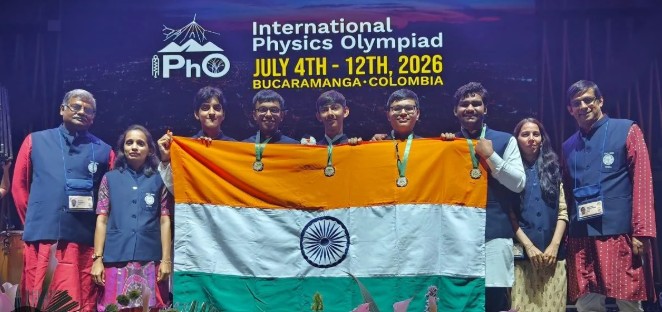
India has achieved one of its finest performances on the global science stage by winning five gold medals at the 56th International Physics Olympiad (IPhO) 2026, held in Bucaramanga, Colombia. With every member of the Indian contingent securing a gold medal, the country finished joint first alongside scientific powerhouses including China, Russia, Kazakhstan, South Korea, and Taiwan.
The remarkable accomplishment underscores India’s growing strength in physics education, scientific research, and talent development. It also reflects the effectiveness of the country’s rigorous Olympiad training ecosystem, which continues to produce world-class young scientists.
A Historic Achievement for India
The Indian team delivered a perfect medal tally, with all five participants earning gold medals in one of the world’s toughest school-level science competitions.
India’s Gold Medal Winners
- Kanishk Jain – Pune, Maharashtra
- Riddhesh Anant Bendale – Indore, Madhya Pradesh
- Rishit Garg – Delhi
- Shresth Suraiya – Mumbai, Maharashtra
- Svait Joshi – Ahmedabad, Gujarat
Competing against 381 students from 87 countries, the Indian delegation demonstrated exceptional excellence in both theoretical and experimental physics.
India Shares the Global Top Position
With five gold medals, India shared the first position with:
- China
- Russia
- Kazakhstan
- South Korea
- Taiwan
Joining this elite group highlights India’s emergence as one of the world’s leading performers in international science Olympiads and showcases the country’s growing competitiveness in STEM education.
What is the International Physics Olympiad (IPhO)?
The International Physics Olympiad (IPhO) is among the world’s most prestigious competitions for high school students passionate about physics.
About IPhO
- Conducted annually since 1967.
- Brings together the world’s brightest school students in physics.
- Each country may send up to five student participants.
- Competitors undertake challenging theoretical and experimental examinations designed to assess conceptual understanding, analytical thinking, and laboratory skills.
The Road to International Success
Representing India at the IPhO requires students to clear a highly competitive national selection process coordinated by the Homi Bhabha Centre for Science Education (HBCSE), Tata Institute of Fundamental Research (TIFR).
The selected students undergo months of intensive preparation that includes:
- Advanced physics lectures
- Laboratory training
- Problem-solving workshops
- Mock examinations
- Mentoring by leading physicists
This rigorous training equips students to compete with the world’s best young scientists.
Mentors Behind India’s Success
The Indian team received guidance from distinguished mentors and scientific observers who played a crucial role in preparing the students.
Team Leadership
- Professor Anwesh Mazumdar (HBCSE-TIFR)
- Dr. Leena Joshi
- Professor Ananda Dasgupta (IISER Kolkata)
- Ms. Nisha Kelkar
Their expertise in advanced physics and Olympiad training helped the students excel on the international stage.
Why This Achievement Matters
India’s clean sweep carries significance beyond medal counts.
Key Impacts
- Reinforces India’s reputation in global STEM education.
- Encourages more students to pursue physics and scientific research.
- Highlights the effectiveness of India’s science talent identification programmes.
- Inspires schools to promote inquiry-based learning and scientific thinking.
- Strengthens India’s long-term vision of becoming a global leader in innovation and research.
The achievement also reflects the increasing quality of science education and mentorship available to talented students across the country.
India’s Growing Legacy in International Science Olympiads
India has consistently improved its performance in international Olympiads over the past decade across physics, mathematics, chemistry, astronomy, and informatics.
Strong institutional support from organisations such as HBCSE-TIFR, dedicated teachers, and specialised training camps has enabled Indian students to compete successfully with the world’s leading scientific nations.
The 2026 IPhO performance adds another milestone to this growing legacy and demonstrates India’s expanding pool of young scientific talent.