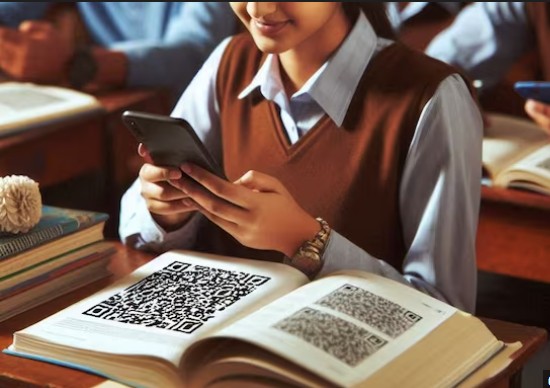
India’s education system is undergoing rapid digitisation, with QR-linked textbooks emerging as a key innovation. Initiated under national digital education initiatives and supported by the Central Board of Secondary Education and government platforms like DIKSHA, these “energised textbooks” aim to integrate physical learning with digital content.
By embedding QR codes in textbooks, students can instantly access videos, interactive modules, and supplementary material—bridging the gap between traditional and digital education. However, while access has significantly improved, student engagement remains inconsistent and limited.
1. What Are QR-Linked Textbooks?
Concept Overview
QR-linked textbooks are printed books embedded with Quick Response (QR) codes that connect learners to:
- Video explanations
- Practice exercises
- Interactive simulations
- Teacher training modules
These codes are part of a broader digital infrastructure designed to provide on-demand learning resources.
Policy Context
- Introduced under digital initiatives aligned with NEP 2020
- Supported by platforms like DIKSHA
- Aim to create a blended learning ecosystem
Key Takeaway
QR textbooks represent a shift from static content to dynamic, multi-format learning experiences.
2. Benefits: Expanding Access to Quality Education
Improved Accessibility
- Students across regions can access high-quality digital content instantly
- Reduces dependency on physical coaching or additional materials
Bridging Learning Gaps
- Helps students revisit complex topics through visual and audio explanations
- Supports self-paced learning
Teacher Enablement
- Provides ready-to-use digital teaching resources
- Enhances classroom delivery with multimedia support
Scalability
- Millions of textbooks embedded with QR codes have been distributed, enabling nationwide reach
Key Insight
QR-linked textbooks successfully address access inequality, especially in resource-constrained settings.
3. The Engagement Problem: Where the Model Falls Short
Despite their potential, QR-enabled textbooks face a critical limitation—low sustained engagement.
Key Challenges
1. Passive Consumption of Content
- Most QR-linked resources are video-based, leading to passive learning
- Limited interactivity reduces long-term retention
2. Lack of Awareness and Usage
- Many students and teachers do not regularly scan QR codes
- Insufficient training leads to underutilization
3. Digital Divide Issues
- Unequal access to smartphones and stable internet
- Rural areas face connectivity constraints
4. Content Quality & Relevance
- Some digital resources are generic and not context-specific
- Lack of personalization reduces interest
Analytical Perspective
The system has prioritized content availability over user engagement design, resulting in a gap between access and actual learning outcomes.
4. Case Reflection: Technology Without Engagement Strategy
Recent discussions around QR code usage—even beyond textbooks—highlight the complexity of integrating technology in education. For instance, QR codes in exam papers are primarily used for authentication and security purposes, not learning enhancement, emphasizing that technology alone does not guarantee educational value.
This reflects a broader issue:
Digital tools must be pedagogically integrated, not just technically implemented.
5. What Needs to Change: Making QR Learning Truly Effective
1. Interactive Content Design
- Shift from videos to quizzes, simulations, and gamified learning
- Encourage active participation
2. Teacher Training & Integration
- Train educators to embed QR usage in daily teaching
- Move from optional use to structured classroom integration
3. Personalized Learning Pathways
- Adaptive content based on student performance and level
4. Offline Accessibility
- Enable downloadable content for low-connectivity regions
5. Awareness Campaigns
- Promote consistent usage among students and parents
Key Insight
The future of QR textbooks depends on engagement-first design, not just digital expansion.
6. Broader Implications for India’s Education System
Positive Impact
- Accelerates digital transformation in education
- Supports inclusive and scalable learning models
Concerns
- Risk of technology becoming underutilized infrastructure
- May widen gaps if engagement issues persist
Strategic Outlook
For QR textbooks to succeed, India must transition from:
- Access-driven model → Engagement-driven ecosystem