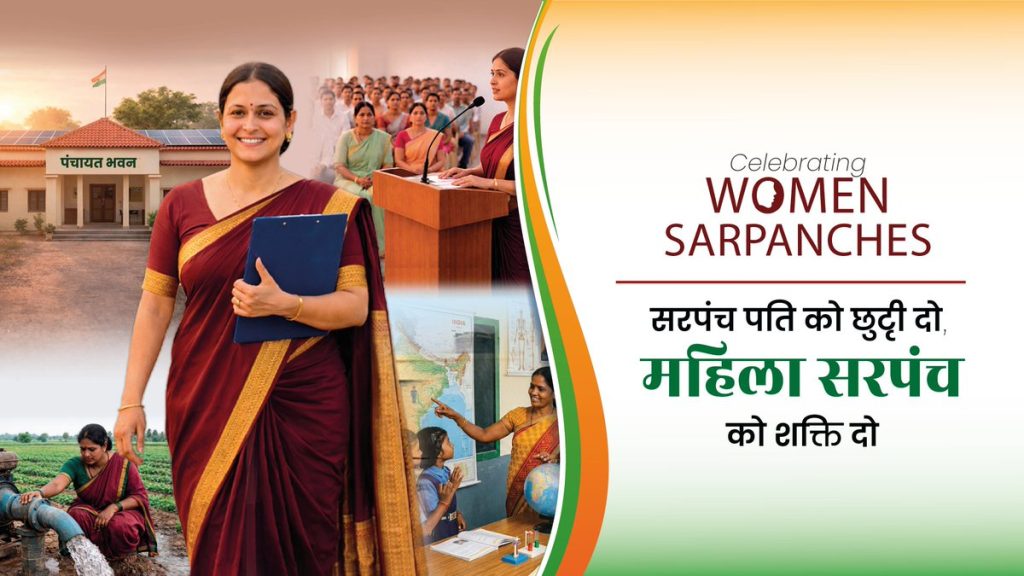
The Government of India has launched the “Say No to Proxy Sarpanch” campaign, a nationwide initiative designed to curb the practice where male relatives exercise authority in place of elected women village leaders. The campaign has been introduced by the Ministry of Panchayati Raj to strengthen women’s leadership in grassroots governance and ensure that elected women representatives can exercise their constitutional powers independently.
The initiative was launched around International Women’s Day and will run as a public awareness campaign until March 18, encouraging citizens to recognize and support genuine women leadership in local government institutions.
Understanding the “Proxy Sarpanch” or “Sarpanch Pati” Practice
In many villages across India, women are elected as Sarpanch (village head) due to reservation policies for women in Panchayati Raj institutions. However, in some cases, their husbands or male relatives informally run the administration, a practice commonly referred to as “Sarpanch Pati,” “Pradhan Pati,” or proxy leadership.
This practice undermines the constitutional intent of women’s political representation and leadership at the grassroots level.
Key Issues Associated with Proxy Sarpanch Culture
- Women representatives often lack decision-making authority
- Male relatives dominate administrative and financial decisions
- The system weakens grassroots democracy and gender equality
- It discourages women’s political participation and leadership development
Objectives of the ‘Say No to Proxy Sarpanch’ Campaign
The campaign has been designed to address these challenges and promote genuine women-led governance in rural India.
Major Goals of the Initiative
- Promote independent leadership of elected women sarpanches
- Raise public awareness against proxy representation
- Encourage communities to respect the democratic mandate of women leaders
- Support gender equality in local governance
The government is urging citizens to participate in the campaign by sharing experiences, celebrating real women leaders, and raising awareness on social media.
Role of Panchayati Raj Institutions in Local Governance
Panchayati Raj institutions are the foundation of grassroots democracy in India, allowing local communities to participate directly in governance.
A Sarpanch is the elected head of a Gram Panchayat, responsible for implementing government schemes, managing village development projects, and representing the village administration.
To promote gender equality, India has introduced reservations for women in local government bodies, which in many states now reach 50% representation.
However, proxy leadership practices have limited the effectiveness of this policy.
Measures Suggested to Address Proxy Leadership
Experts and advisory committees have recommended several steps to eliminate proxy governance and empower women leaders.
Recommended Solutions
- Introducing strict penalties for proven cases of proxy leadership
- Creating complaint and reporting mechanisms
- Establishing women watchdog committees
- Offering training, mentoring, and leadership programmes for women representatives
- Promoting public awareness campaigns like “Say No to Proxy Sarpanch.”
These measures aim to create an environment where women leaders can exercise authority confidently and independently.
Importance of Women Leadership in Rural Governance
Empowering women in local governance has several long-term benefits.
Positive Outcomes
- Improved community welfare and social development
- Greater focus on health, education, and social issues
- Stronger participation of women in political decision-making
- Promotion of gender equality and inclusive governance
Research has shown that women-led panchayats often prioritize development programmes that directly benefit families and communities.
Growing Efforts to Promote Women Sarpanches
Across India, several initiatives are emerging to encourage authentic women leadership in panchayats.
Some districts and local administrations have begun recognizing and rewarding independent women sarpanches who actively lead development initiatives in their villages.
These efforts aim to challenge patriarchal norms and inspire more women to take leadership roles in local governance.