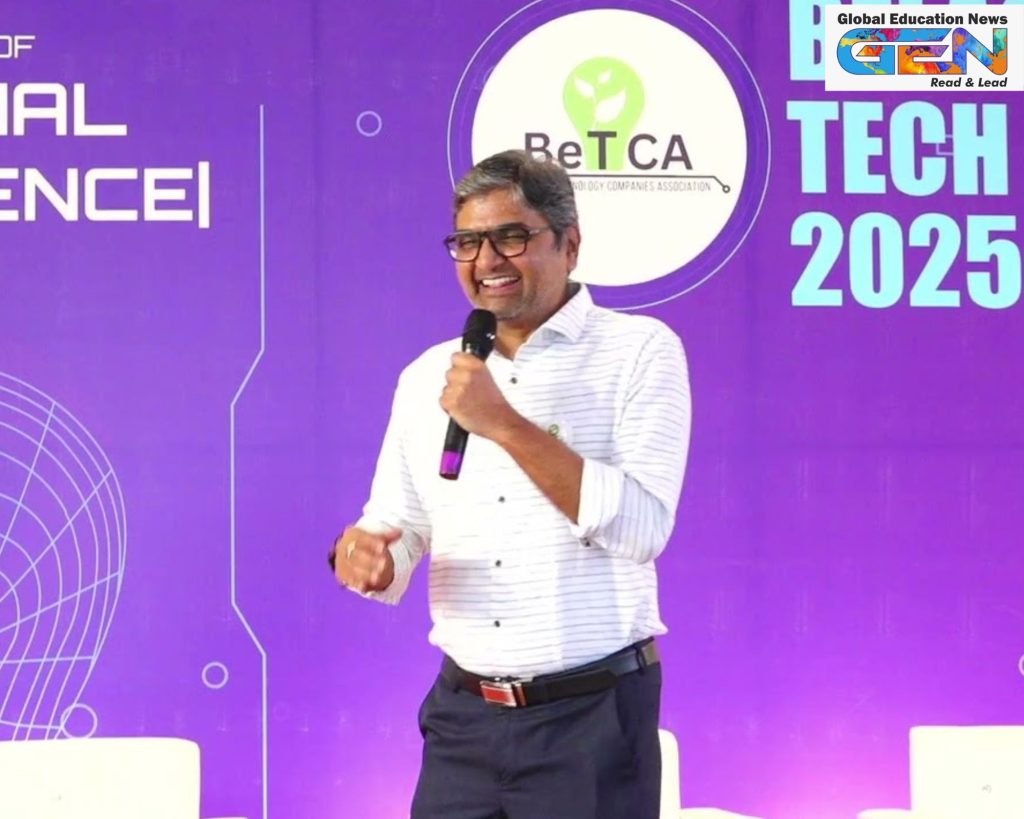
The Belagavi Tech Meet 2025, hosted by the Belagavi Technology Companies Association (BeTCA) on August 30, 2025, at the Presidency Club, highlighted Belagavi’s growing stature as a tier-2 tech hub under the theme “Tech for Human Impact.” Organized by BeTCA, a Section 8 non-profit collective of IT and ITeS firms, the event showcased the region’s innovation through engaging panel discussions and product launches. The DeepTech for the Future panel, moderated by Aadil Bandukwala (VP, HackerRank), featured Kawal Arora (DesiLLM) and Akash Kulgod (Dognosis), whose presentations underscored Belagavi’s contributions to cutting-edge technology with significant local and global potential.
Panel Overview
The DeepTech for the Future panel focused on how DeepTech—technologies rooted in advanced scientific and engineering breakthroughs—can drive transformative solutions. Moderated by Aadil Bandukwala, a seasoned tech leader from HackerRank, the panel featured two Belagavi-based innovators addressing global challenges through locally developed solutions. Their discussions aligned with BeTCA’s mission to position Belagavi as a key player in Karnataka’s Beyond Bengaluru initiative, emphasizing technologies that address societal needs while competing on a global stage.
Kawal Arora: DesiLLM and Culturally Contextualized AI
- Background: Kawal Arora, co-founder of DesiLLM, previously worked at Tesla, bringing global expertise to Belagavi. His experience in AI and machine learning informs DesiLLM’s mission to develop India-specific large language models (LLMs).
- Key Points:
- Bias in Global LLMs: Arora highlighted the limitations of global AI models like ChatGPT, which are often trained on Western-centric datasets and struggle with Indian languages, cultural nuances, and contexts. He described early AI tools as a “genie we didn’t know what to do with,” emphasizing their initial lack of direction and cultural relevance.
- DesiLLM’s Vision: DesiLLM aims to create bias-free LLMs tailored for India’s diverse linguistic and cultural landscape, supporting applications in education, healthcare, and governance. For example, these models could enhance vernacular education tools, aligning with NEP 2020’s focus on regional languages, as seen in the Anganwadi co-location initiative for 8 crore children.
- Global Ambitions: By addressing the $200 billion global AI market (projected by 2030, per NASSCOM), DesiLLM seeks to compete with global giants while serving India’s 1 billion+ population. This mirrors national efforts like the AI Cooperation Center proposed at the SCO Plus Summit 2025.
- Human Impact: DesiLLM’s culturally relevant AI could democratize technology access, empowering rural and marginalized communities with tools for education and governance, similar to the CBSE-NCB drug-free schools initiative’s focus on student welfare.
- Local Innovation: Based in Belagavi, DesiLLM leverages the region’s growing tech talent pool, supported by BeTCA’s jobs portal and institutions like Visvesvaraya Technological University, which produces 20,000 professional graduates annually.
Akash Kulgod: Dognosis and Canine-Assisted Diagnostics
- Background: Akash Kulgod, a UC Berkeley Cognitive Science graduate, founded Dognosis during the Covid-19 pandemic, inspired by dogs’ superior scent-detection capabilities. His return to Belagavi reflects the city’s appeal for returning innovators.
- Key Points:
- Inspiration from Covid: Kulgod noted that dogs, particularly Beagles, outperformed humans in detecting Covid-19, leading to Dognosis’s mission to use canine scent detection for diagnosing diseases like cancer and others. He praised Beagles for their “independence and temperament,” making them ideal for this work.
- Innovative Approach: Dognosis combines DeepTech (AI and data analytics) with canine capabilities to offer non-invasive, low-cost diagnostics, addressing healthcare gaps in rural areas where advanced equipment is scarce.
- Global Potential: Targeting the $50 billion global diagnostics market, Dognosis could revolutionize healthcare delivery, particularly in India, where 70% of healthcare access is rural (per NITI Aayog). This aligns with global health initiatives, such as China’s SCO commitment to 10,000 cancer screenings.
- Human Impact: Dognosis’s affordable diagnostics could improve health outcomes for underserved communities, complementing initiatives like PRATUSH’s space-based societal benefits and the Telangana domicile rules for strengthening local healthcare.
- Local Innovation: Developed in Belagavi, Dognosis showcases the city’s ability to produce globally relevant solutions, supported by BeTCA’s advocacy for infrastructure like the proposed IT Park.
Alignment with Belagavi Tech Meet’s Theme
The DeepTech for the Future panel embodied the theme “Tech for Human Impact” by showcasing solutions with tangible societal benefits:
- DesiLLM addresses digital inclusion, ensuring AI serves India’s diverse population, much like the Dr Ambedkar National Merit Awards empower marginalized students.
- Dognosis tackles healthcare accessibility, aligning with national priorities like the CBSE-NCB MoU for student welfare and Anganwadi co-location for child health.
- Both startups demonstrate Belagavi’s capacity for local innovation with global ambitions, contributing to Karnataka’s Beyond Bengaluru initiative and India’s broader tech goals, as seen in Semicon India 2025’s focus on $18 billion in semiconductor projects.
Challenges and Opportunities
- Challenges (from X feedback and document comments):
- Scalability: A comment on the article noted that innovations like Hoopoe Electric (launched at the event) are “me too” solutions, lacking unique differentiators in competitive markets like EVs. DesiLLM and Dognosis face similar hurdles, needing financial muscle and market differentiation to compete with global players like Google (AI) or Roche (diagnostics).
- Infrastructure: Belagavi’s tech ecosystem requires robust facilities, as emphasized by BeTCA’s push for an IT Park and plug-and-play spaces, supported by KEONICS and DST Secretary Abhay Karandikar.
- Opportunities:
- Policy Support: BeTCA’s engagement with DST and KEONICS aligns with the India Semiconductor Mission and K-Tech Innovation Hubs, providing funding and infrastructure for DeepTech startups.
- Talent Pool: Belagavi’s 20,000 annual graduates and BeTCA’s jobs portal create a strong foundation for scaling innovations like DesiLLM and Dognosis.
- Global Reach: Both startups target multi-billion-dollar markets, leveraging Belagavi’s strategic location (equidistant from Mumbai, Bengaluru, and Hyderabad) and connectivity (e.g., FlixBus routes and international airport links).
Broader Context: Belagavi’s Role in India’s Tech Landscape
The DeepTech for the Future panel reflects Belagavi’s alignment with national and global tech trends:
- Beyond Bengaluru: BeTCA’s efforts mirror Karnataka’s initiative to develop tier-2 hubs like Hubballi-Dharwad and Mysuru, as seen in the Bengaluru Tech Summit 2025 (November 18–20), expecting 1 lakh attendees.
- National Initiatives: DesiLLM’s AI focus complements the AI Cooperation Center and SWAYAM’s AI courses, while Dognosis aligns with healthcare innovations like Vigilomics Biosciences (also Belagavi-based).
- Educational Synergy: The panel’s emphasis on innovation ties to educational reforms like IIT JAM 2026 (3,000 MSc/PhD seats) and Anganwadi co-location, fostering a skilled workforce for DeepTech.
- Sustainability and Social Impact: The event’s product launches (e.g., KabadiMan for recycling) and Dognosis’s healthcare focus echo urban sustainability efforts like Belagavi’s VIISWAS Project under CITIIS 2.0.
Recommendations for Stakeholders
- Entrepreneurs (DesiLLM, Dognosis):
- Strengthen unique value propositions to address X feedback on scalability, potentially through partnerships with global firms (e.g., NVIDIA for AI, Siemens for diagnostics).
- Leverage NIDHI (DST’s startup support) and K-Tech Innovation Hubs for funding and prototyping.
- BeTCA:
- Expand the jobs portal to include DeepTech roles, aligning with SEMI University’s 800+ semiconductor courses.
- Advocate for the IT Park to provide incubation for startups like DesiLLM and Dognosis, as discussed with KEONICS.
- Policymakers:
- Accelerate the IT Park and plug-and-play facilities to support Belagavi’s 350 crore IT revenue and 1,200+ tech employees.
- Integrate DeepTech training into local curricula, building on NEP 2020 and institutions like VTU.
- Students and Professionals:
- Explore opportunities via BeTCA’s jobs portal and events like Bengaluru Tech Summit 2025 to connect with innovators like Arora and Kulgod.
- Pursue DeepTech education through platforms like SWAYAM or IIT JAM 2026 to contribute to Belagavi’s ecosystem.
Conclusion
The DeepTech for the Future panel at Belagavi Tech Meet 2025 showcased Belagavi’s potential as a tier-2 innovation hub through DesiLLM’s culturally relevant AI and Dognosis’s canine-assisted diagnostics. These initiatives align with the theme “Tech for Human Impact,” addressing societal needs like digital inclusion and healthcare access while targeting global markets. Supported by BeTCA’s advocacy for infrastructure and talent, Belagavi is carving a niche in Karnataka’s Beyond Bengaluru initiative, contributing to India’s Viksit Bharat vision.