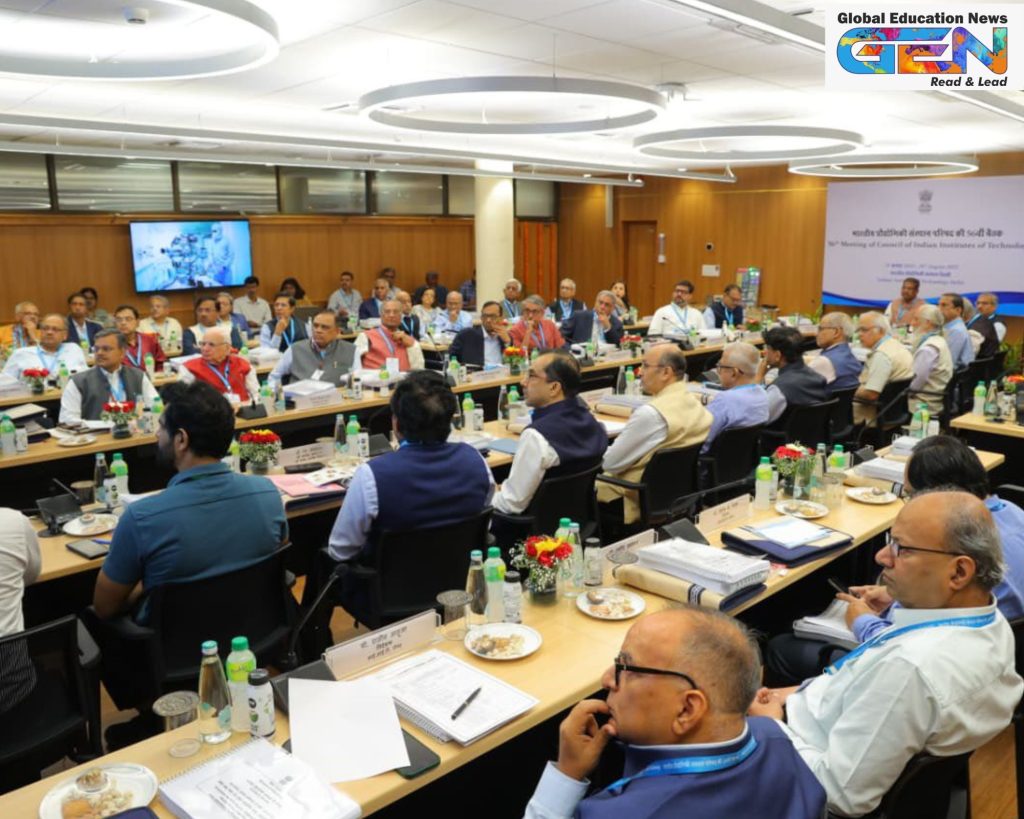
On August 25, 2025, Union Education Minister Dharmendra Pradhan chaired the 56th IIT Council Meeting at IIT Delhi, unveiling an ambitious 25-year roadmap to position the Indian Institutes of Technology (IITs) as global leaders in innovation, research, and inclusive education. Aligned with Prime Minister Narendra Modi’s vision of Atmanirbhar Bharat (self-reliant India) and Viksit Bharat 2047 (developed India by 2047), the plan emphasizes transformative changes to make IITs engines of economic growth, societal progress, and global leadership. With a focus on job creation, cutting-edge research, and inclusivity, IITs are set to redefine India’s higher education landscape.
Key Points:
- 25-year roadmap to align IITs with Atmanirbhar Bharat and Viksit Bharat 2047.
- Emphasis on inclusivity, research-driven education, and job creation.
- IITs hailed as “crowning jewels” of India’s higher education system.
A Quantum Leap for IITs: The 2047 Roadmap
Pradhan stressed that IITs must move beyond incremental progress and aim for a quantum jump in innovation and impact. The roadmap envisions IITs as hubs for translational research, producing not just graduates but job creators who solve real-world problems. Key initiatives include integrating Artificial Intelligence (AI) into curricula, reforming PhD programs, and enhancing global rankings to attract top talent.
Key Roadmap Highlights:
- Inclusivity: Introduce regional languages alongside English as mediums of instruction to widen access for underrepresented groups.
- Research Focus: Strengthen translational research in critical technologies like AI, renewable energy, and healthcare.
- Global Leadership: Elevate IITs’ global rankings through international collaborations and talent attraction.
- Entrepreneurship: Build on IITs’ legacy of nurturing over 6,000 startups, 56 unicorns, and 5,000 patents.
- Mental Well-Being: Promote student mental health through compassionate faculty engagement and healthy campus practices.
Key Points:
- Shift from incremental to transformative change in education and research.
- Focus on regional languages to make education more inclusive.
- IITs to lead in AI, critical technologies, and startup ecosystems.
IITs’ Role in Atmanirbhar Bharat: Innovation and Job Creation
Pradhan underscored IITs’ pivotal role in achieving self-reliance by fostering innovation and entrepreneurship. With initiatives like the PM Research Fellowship and AI Centres of Excellence, IITs are already driving economic growth. The minister highlighted their success in creating over 6,000 startups and 56 unicorns, contributing significantly to India’s economy. The roadmap aims to amplify this impact by producing job creators who address national challenges through research and innovation.
Key Contributions:
- Over 6,000 startups and 56 unicorns nurtured by IITs.
- Nearly 5,000 patents filed, showcasing innovation prowess.
- Focus on translational research to develop solutions for critical national technologies.
- Support for initiatives like research parks to boost industry-academia collaboration.
Key Points:
- IITs to drive economic growth through startups and innovation.
- Emphasis on creating job creators, not just job seekers.
- Research parks and AI Centres of Excellence to fuel self-reliance.
Inclusivity and Global Outreach: A New Era for IITs
The roadmap prioritizes inclusive education by expanding access for students from diverse socio-economic backgrounds and introducing regional languages as mediums of instruction. Additionally, IITs are set to enhance their global presence through international campuses and collaborations, positioning India as a hub for advanced research and innovation. The IIT R&D Fair will be elevated into a global innovation platform to showcase cutting-edge technologies.
Key Initiatives:
- Regional Languages: Courses in Indian languages to promote inclusivity.
- International Campuses: Expand IITs’ global footprint to attract international students and faculty.
- Alumni Networks: Leverage alumni for mentorship, funding, and industry ties.
- Global Innovation Platform: Transform the IIT R&D Fair into a world-class showcase.
Key Points:
- Regional languages to make IITs accessible to diverse students.
- Global campuses and collaborations to enhance IITs’ international reputation.
- Alumni engagement to strengthen industry-academia linkages.
Mental Well-Being and Student Support: A Compassionate Approach
The council addressed the critical issue of student mental health, especially after reports of at least five student deaths at IITs in 2025, including four at IIT Kharagpur. Pradhan urged faculty to adopt a compassionate approach, engaging with students through informal interactions like sharing meals or WhatsApp conversations to address issues early. The roadmap includes promoting healthy living habits and mandatory annual health check-ups to ensure student well-being.
Key Measures:
- Faculty to engage closely with students to prevent mental health issues.
- Promote healthy campus lifestyles and annual health check-ups.
- Develop policies to support student mental well-being and inclusivity.
Key Points:
- Compassionate faculty engagement to address student mental health.
- Healthy living initiatives to create supportive campus environments.
- Response to recent student deaths highlights urgency of mental health focus.
Industry and Policy Collaboration: A Multi-Stakeholder Approach
The 56th IIT Council Meeting saw participation from industry leaders like Sridhar Vembu (Zoho) and Kris Gopalakrishnan (Infosys), former ISRO Chairman Dr. K Radhakrishnan, and academic leaders like Prof. M Jagadesh Kumar (former UGC Chairman). Discussions focused on strengthening industry-academia-policy linkages to commercialize research and align IITs with national priorities. A Task Force will be formed to create a detailed action plan for higher and school education within a month.
Key Collaborations:
- Industry leaders to guide research commercialization and innovation.
- Task Force to develop action plan for education reforms by September 2025.
- Stronger alumni and industry ties to fund and mentor startups.
Key Points:
- Multi-stakeholder approach involving industry, policymakers, and academics.
- Task Force to streamline education reforms for self-reliance.
- Industry-academia linkages to boost research and startup ecosystems.