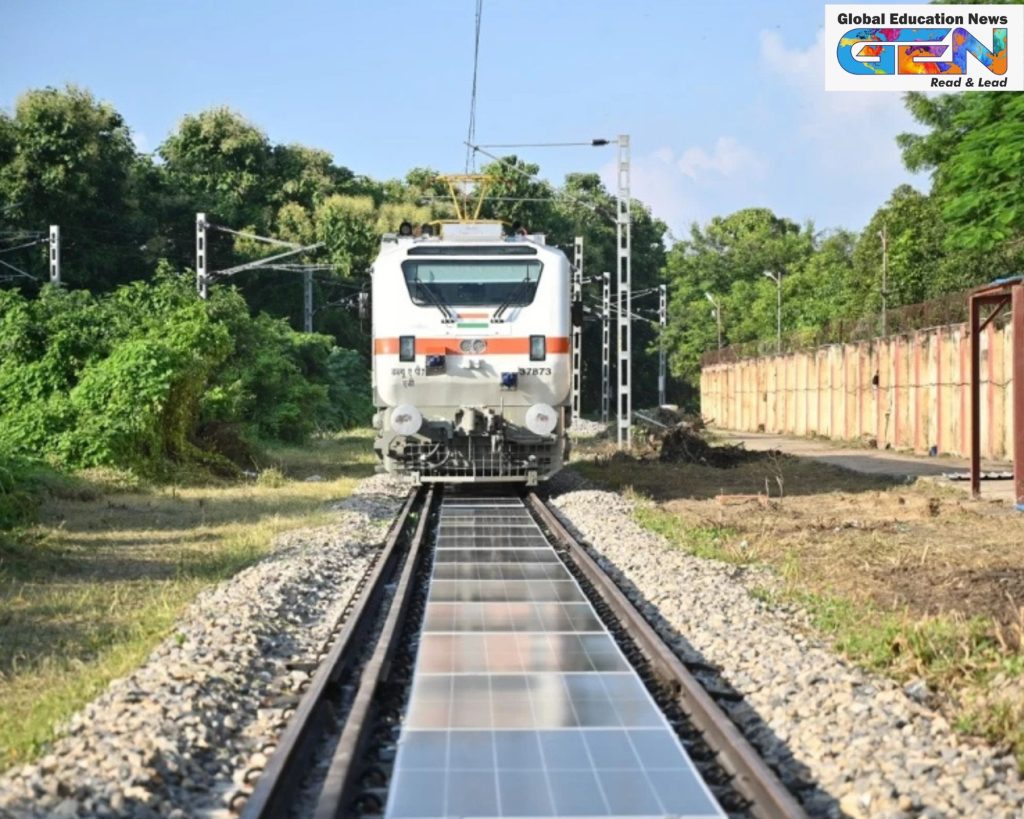
On August 15, 2025, Indian Railways achieved a historic milestone by commissioning the nation’s first detachable solar panel system between operational railway tracks at Banaras Locomotive Works (BLW) in Varanasi. Launched by General Manager Naresh Pal Singh, this innovative pilot project marks a significant step toward sustainable rail transport and aligns with India’s ambitious goal of achieving net-zero carbon emissions by 2030. By harnessing solar energy from a 70-meter track stretch, this initiative showcases India’s engineering prowess and commitment to green energy. Here’s an in-depth exploration of the project, its technical brilliance, and its transformative potential for Indian Railways’ renewable energy mission.
A Pioneering Project: Solar Panels Between Tracks
The detachable solar panel system, installed on Line No. 19 of the BLW workshop in Varanasi, introduces a novel approach to renewable energy by utilizing the space between railway tracks. This 70-meter pilot project features 28 solar panels generating a combined 15 kWp of clean energy, designed to power railway offices, signaling systems, and other auxiliary needs without disrupting train operations.
Key Points:
- Launch Date: August 15, 2025, inaugurated by BLW General Manager Naresh Pal Singh.
- Location: Line No. 19, BLW workshop, Varanasi, Uttar Pradesh.
- Purpose: Supports Indian Railways’ mission to reduce carbon emissions and promote sustainable energy use.
- Recognition: Railways Minister Ashwini Vaishnaw hailed it as a “historic first” for green rail transport.
Innovative Design: Overcoming Technical Challenges
The project’s success lies in its indigenous engineering, addressing the unique challenges of installing solar panels in an active railway environment. The panels are mounted on concrete sleepers using epoxy adhesive and rubber mounting pads to withstand train vibrations, heat, and weather conditions. Their detachable design ensures easy removal for track maintenance, making the system both practical and scalable.
Key Points:
- Installation Method: Panels are secured with epoxy adhesive and vibration-resistant rubber pads, removable via four bolts for maintenance.
- Panel Specifications: Each panel measures 2,278 mm x 1,133 mm, weighs 31.83 kg, and uses 144 half-cut mono-crystalline PERC bifacial cells with 21.31% efficiency.
- Maintenance Ease: Panels can be cleaned and removed without disrupting rail traffic, ensuring operational continuity.
- Engineering Lead: Chief Electrical Service Engineer Bhardwaj Chaudhary and his team were commended for their innovative approach.
Key Project Details
The pilot project demonstrates impressive technical and energy metrics, setting a benchmark for future scalability across Indian Railways’ 1.2 lakh-kilometer network.
Key Points:
- Track Length: 70 meters
- Number of Panels: 28
- Capacity: 15 kWp (kilowatt peak)
- Power Density: 240 kWp per kilometer
- Energy Density: 960 units per kilometer per day, with an annual capacity of 3.21 lakh units per kilometer
- Daily Output: Approximately 67 units (kWh) per day, sufficient for local railway infrastructure needs.
Supporting Indian Railways’ Net-Zero Mission
The BLW solar project is a cornerstone of Indian Railways’ 2030 net-zero carbon emissions target, complementing existing efforts like 209 MW of rooftop solar installations across 2,000+ locations and 7.7 GW of renewable power procurement. By leveraging underutilized track space, the initiative eliminates the need for costly land acquisition, making it a cost-effective solution for large-scale adoption.
Key Points:
- Net-Zero Goal: Supports Indian Railways’ commitment to carbon neutrality by 2030, reducing reliance on fossil fuels.
- Complementary Efforts: Enhances BLW’s existing 4.5 MW rooftop solar plants, meeting 20% of its power needs.
- Environmental Impact: If scaled across yard lines, it could generate hundreds of megawatts, offsetting emissions equivalent to thousands of cars annually.
- Broader Sustainability: BLW is a “zero-discharge unit” with water recycling, rainwater harvesting, and 1.5 lakh trees planted, with 5,000 more planned in 2025.
Future Potential: Scaling Across the Network
The detachable solar panel system holds immense potential for transforming Indian Railways into the world’s largest green railway network. By utilizing the space between tracks in its vast 1.2 lakh-kilometer network, the system could generate 3.21 lakh units per kilometer annually, significantly boosting clean energy production without additional infrastructure costs.
Key Points:
- Scalability: Ideal for yard lines and non-operational tracks, requiring no land acquisition.
- Economic Benefits: Reduces operational costs by replacing fossil fuel-based power with solar energy.
- Global Model: Positions Indian Railways as a leader in sustainable transport, inspiring global rail networks.
- Next Steps: Further trials planned to assess performance across diverse terrains and weather conditions, with potential rollout by 2027.
Alignment with Broader Railway Innovations
The solar panel project coincides with other advancements at BLW, including the production of 2,500 electric locomotives and the upcoming Amrit Bharat locomotives (24 units in 2025, 48 in 2026). BLW’s shift from diesel to electric locomotives, with 174 exported and 641 supplied to non-railway clients, reflects its pivot toward sustainable manufacturing.
Key Points:
- Electrification Push: Supports Indian Railways’ 100% electrification policy, reducing diesel dependency.
- Export Growth: BLW’s focus on electric locomotives for export markets enhances India’s global presence.
- Allied Services: Expansion into diesel loco servicing and wheel maintenance strengthens profitability.
- Infrastructure Modernization: Complements initiatives like the 2×25 kV electric traction system at Nagda-Khachrod.