You’ve probably heard the tale of the engineer who charged $10,000 for a single tap—or in this case, a chalk mark. It’s not just a legend—it’s the true story of Charles Proteus Steinmetz, a brilliant electrical engineer who saved Ford’s factory with one genius move. In 2025, as AI dominates headlines, this century-old story, shared by Gyanendra Pandey on Medium and buzzing on X, proves why human expertise remains unbeatable. From Bengaluru’s tech hubs to global industries, let’s unravel Steinmetz’s $10,000 lesson and why your skills are still the ultimate edge in the knowledge economy!
The $10,000 Chalk Mark: Steinmetz’s Legendary Fix
- The Crisis: Henry Ford’s River Rouge plant generator fails, stumping all engineers.
- The Genius: Charles Proteus Steinmetz (1865–1923) arrives with a notebook, pencil, and cot.
- The Solution: After two days of study, he marks an “X” and instructs: “Remove panel, unwind 16 coil turns.”
- The Bill: $10,000—$1 for the chalk mark, $9,999 for knowing where to mark.
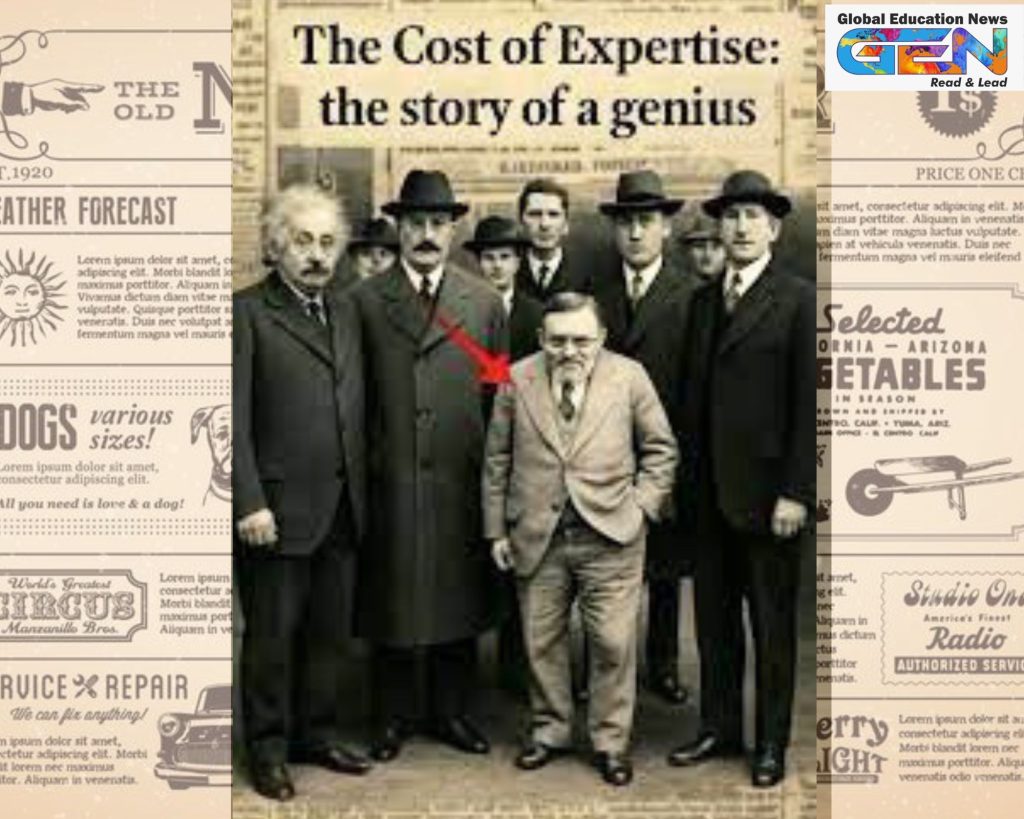
Picture this: Henry Ford’s massive River Rouge plant in the early 1900s, crippled by a broken generator. Ford’s top engineers are clueless, and production grinds to a halt. Enter Charles Proteus Steinmetz, a legendary electrical engineering pioneer. Armed with just a notebook, pencil, and cot, he spends two days and nights listening to the machine, scribbling calculations. Then, with a ladder, tape measure, and chalk, he climbs up, measures, and marks an “X.” His instructions? “Remove this panel, unwind the coil here, take out 16 turns of wire.” The team follows, and the generator roars back to life. Days later, Ford gets the bill: $10,000. Shocked, he asks for a breakdown. Steinmetz’s reply: “Marking the spot with chalk: $1. Knowing where to mark: $9,999.” Ford paid without hesitation, as documented by Jack B. Scott in Life magazine (1965). As @Medium tweeted, “Steinmetz’s chalk mark is a masterclass in expertise!”
Why Human Expertise Trumps AI in 2025
- Intuition Over Code: Steinmetz’s ear for the machine’s hum outsmarted any algorithm.
- Context Mastery: Humans blend experience with nuanced problem-solving AI can’t replicate.
- Creative Solutions: His precise fix shows human ingenuity in unpredictable scenarios.
- Real-World Impact: Expertise saves time and money where AI might miss subtle cues.
AI in 2025—like Grok 3 or advanced diagnostics—crunches data at lightning speed, but it lacks Steinmetz’s magic: intuition honed by years of experience. His ability to “hear” the generator’s fault and pinpoint the exact coil turn showcases human skills no machine can fully match. X user @TechBit sums it up: “AI can analyze, but humans understand.” In industries like engineering, healthcare, or cybersecurity, humans excel at reading context—cultural, emotional, or mechanical—where AI falters. For instance, AI might flag a generator’s error code, but only a seasoned engineer like Steinmetz could sense the subtle vibration causing it.
The Future: Humans and AI as Powerhouse Partners
- AI’s Role: Excels at data processing, predictive analytics, and repetitive tasks.
- Human Edge: Intuition, creativity, and ethical judgment keep humans irreplaceable.
- Collaborative Wins: Experts use AI tools—like predictive maintenance software—while leading with insight.
- Future-Proof Skills: AI ethics, green tech, and personalized medicine demand human expertise.
By 2030, the World Economic Forum predicts 85% of jobs will hinge on advanced problem-solving—humans’ forte. Karnataka’s 2025 push for govt-academia-industry partnerships (Economic Times, July 2025) blends AI tools with human skills, like apprenticeships teaching students to use AI diagnostics while sharpening intuition. Think of a cybersecurity pro using AI to detect threats but relying on gut instinct to counter novel hacks. @IndiaTodayEdu on X nails it: “Human creativity + AI = the future!” Steinmetz’s story proves humans add the spark AI can’t replicate, even in 2030 and beyond.
Real-World Examples: Humans Outshine AI
- Engineering Feats: Steinmetz’s fix mirrors today’s engineers solving unique mechanical issues.
- Medical Intuition: Doctors use AI scans but rely on patient history for accurate diagnoses.
- Creative Fields: Writers and marketers craft nuanced campaigns AI struggles to match.
- Ethical Calls: Humans navigate AI ethics or policy dilemmas where algorithms lack judgment.
In 2025, human expertise shines bright. A Bengaluru coder debugs AI-generated code with intuition machines miss. In healthcare, AI flags MRI anomalies, but doctors weave patient stories for holistic care. Steinmetz’s $10,000 chalk mark echoes this—decades of experience led to one perfect fix. As Pandey’s Medium post notes, “It’s the mind behind the tool that matters.” @ndtveducation on X agrees: “Steinmetz’s genius shows why humans are still the MVPs!”
Challenges: Valuing Expertise in an AI World
- Pricing Debates: X users like @EduBit ask, “Is $10,000 fair for one mark?” Transparency is key.
- AI Over-Reliance: Firms leaning on AI risk undervaluing human intuition.
- Skill Gaps: Not all professionals are trained to integrate AI effectively.
- Access Issues: Smaller firms may struggle to afford top-tier expertise.
The $10,000 bill sparked debate, with some X users arguing it feels exploitative without a clear breakdown. Over-dependence on AI also risks sidelining human skills, especially in resource-constrained sectors. Karnataka’s focus on apprenticeship-based degrees (Economic Times, July 2025) aims to bridge this by training students to wield AI as a tool, not a replacement. Ethical pricing and upskilling are crucial to balance expertise’s value with fairness.
Tips to Be the Steinmetz of 2025
- Master Your Craft: Dive deep into AI ethics, cybersecurity, or green tech via platforms like Coursera.
- Blend AI and Intuition: Use AI tools (e.g., diagnostics) but trust your gut for nuanced fixes.
- Justify Your Worth: Like Steinmetz, explain your expertise’s impact to clients.
- Upskill Relentlessly: Stay ahead with certifications in emerging fields like quantum computing.
- Network Smart: Connect with pros in Bengaluru’s tech hub or X communities for insights.
The $10,000 chalk mark isn’t just a story—it’s a rallying cry for students and professionals to hone their expertise. In 2025 and beyond, as AI reshapes industries, your intuition, creativity, and problem-solving will set you apart. As @TimesEducation tweeted, “Steinmetz’s $10,000 mark proves: knowing where is everything!” Ready to be the next Steinmetz? Build your skills, wield AI wisely, and make your mark in the knowledge economy!