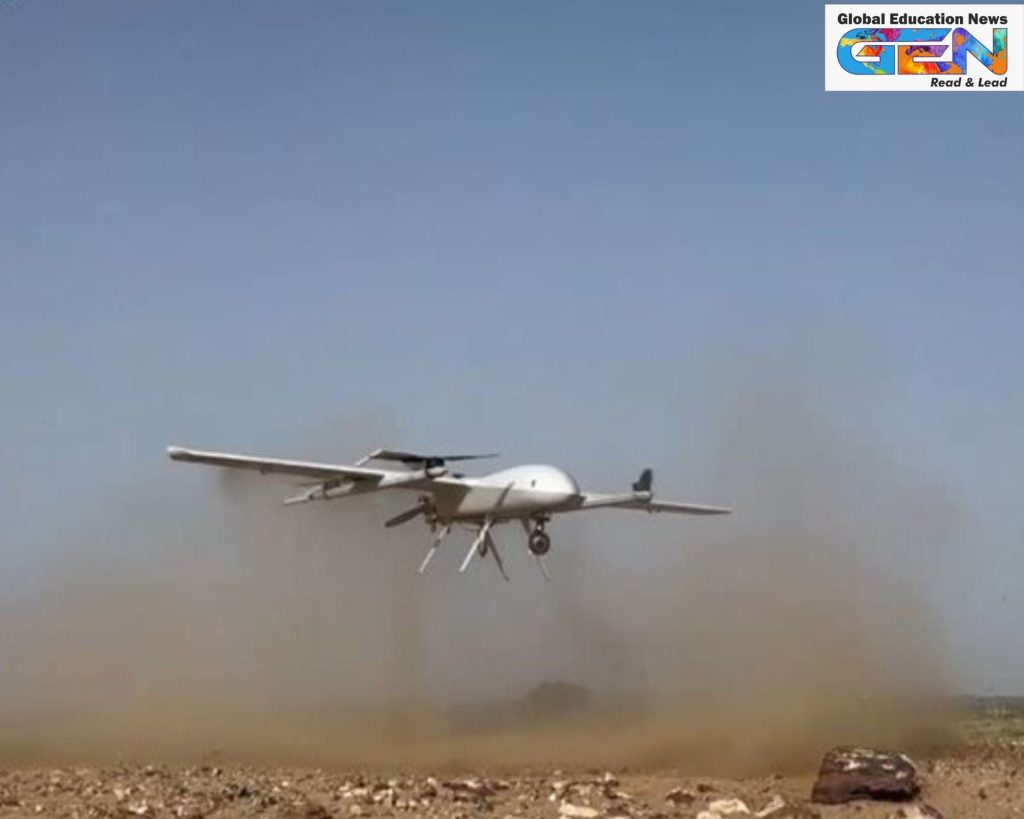
On June 11, 2025, the Indian Army successfully tested the Rudrastra, an indigenous hybrid Vertical Take-Off and Landing (VTOL) Unmanned Aerial Vehicle (UAV), at Rajasthan’s Pokhran Firing Range. Developed by Solar Defence and Aerospace Limited (SDAL), this cutting-edge drone showcased a jaw-dropping 170-km range, precision strikes, and unmatched versatility. Named after a mythical weapon of destruction, Rudrastra is a bold step toward Atmanirbhar Bharat, proving India’s prowess in homegrown defence tech. Ready to explore this game-changing UAV? Let’s soar into the details!
Key Points:
- Rudrastra tested on June 11, 2025, at Pokhran, meeting all Army specifications.
- Developed by SDAL, emphasizing India’s self-reliance in defence manufacturing.
- Showcased VTOL, 1.5-hour endurance, and precision-guided warhead deployment.
What is Rudrastra? India’s Precision Strike Marvel
Imagine a drone that lifts off like a helicopter, cruises like a jet, and strikes with pinpoint accuracy—all without risking a single soldier. That’s Rudrastra! This 45-kg hybrid VTOL UAV combines six lift rotors, a pusher propeller, and high-aspect wings, delivering a 170-km mission range with a 1.5-hour endurance. Equipped with an 8-kg precision-guided anti-personnel warhead, advanced cameras, and a dual-channel EO/IR gimbal, Rudrastra is designed for surveillance, reconnaissance, and lethal strikes deep inside enemy territory.
Key Points:
- Design: Carbon fibre body with VTOL and fixed-wing capabilities for versatility.
- Payload: 8-kg airburst warhead for anti-personnel/light-armour targets.
- Tech: Real-time video link over 50 km, laser designator, and autonomous return.
- Range: 170 km, including loitering, with 1.5-hour flight time.
Pokhran Trials: Rudrastra’s Flawless Performance
The Pokhran trial on June 11, 2025, was a masterclass in precision and reliability. Rudrastra aced the Indian Army’s stringent parameters, including vertical take-off, long-range surveillance, and a devastating airburst strike. Dropped from medium altitude, the warhead exploded just above the ground, wiping out targets across a wide radius. The UAV maintained a stable real-time video link over a 50-km mission radius and returned to its launch point autonomously, proving its battlefield readiness.
Key Points:
- Trial conducted at Pokhran Firing Range, Rajasthan, on June 11, 2025.
- Demonstrated VTOL, precision targeting, and autonomous return.
- Airburst warhead achieved lethal effect over a wide area.
- Stable video feed and 170-km range met Army benchmarks.
Why Rudrastra Matters: A Strategic Game-Changer
Born from the lessons of Operation Sindoor, where drone attacks highlighted India’s need for advanced UAVs, Rudrastra is a direct response to evolving border threats. It offers the Army a platoon-portable, stand-off weapon capable of surveilling infiltration routes, targeting terrorist hideouts, and neutralizing enemy artillery up to 100 km inside hostile territory. With tensions along the Line of Control and Chinese drone swarms in Tibet, Rudrastra signals India’s readiness to dominate modern warfare.
Key Points:
- Addresses drone threats exposed during Operation Sindoor in 2024.
- Enables deep strikes without risking manned assets.
- Counters regional rivals like Pakistan and China with indigenous tech.
- Army plans to procure Rudrastra in large numbers for border security.
Atmanirbhar Bharat in Action: SDAL’s Triumph
Developed by Nagpur-based Solar Defence and Aerospace Limited (SDAL), Rudrastra emerged victorious from a 40-bidder competition, narrowing to four prototypes for live firing. SDAL’s innovation, backed by India’s Atmanirbhar Bharat vision, showcases the private sector’s growing role in defence. The drone complements DRDO’s Rustom program and follows SDAL’s recent success with Bhargavastra, a low-cost counter-drone system tested in May 2025.
Key Points:
- SDAL beat 40 competitors to secure Rudrastra’s development.
- Aligns with Atmanirbhar Bharat and DRDO’s indigenous efforts.
- SDAL’s Bhargavastra counter-drone system tested successfully in May.
- Private sector innovation drives India’s defence tech surge.
Rudrastra vs. Global Rivals: A Standout Performer
How does Rudrastra stack up? Unlike older Israeli VTOL imports or India’s Rustom-I, Rudrastra combines heavier payloads, autonomous flight, and high-altitude versatility. Compared to Türkiye’s Kargu or Iran’s Farpad, which sacrifice payload for endurance, Rudrastra delivers an 8-kg warhead with a 170-km range, making it ideal for India’s rugged borders. Its encrypted video link and AI-driven autonomy give it an edge in contested environments.
Key Points:
- Outperforms Israeli VTOLs with heavier payload and autonomy.
- Surpasses Türkiye’s Kargu and Iran’s Farpad in strike capacity.
- Suited for high-altitude, dispersed operations along LoC.
- Encrypted video and AI autonomy ensure secure missions.
Tips for Defence Aspirants and Tech Enthusiasts
Inspired by Rudrastra’s success? Whether you’re eyeing a career in defence or fascinated by UAV tech, here’s how to get involved:
Key Points:
- Study UAV Tech: Pursue aerospace or electronics engineering at IITs or NITs.
- Follow Innovations: Track DRDO and private firms like SDAL on X for updates.
- Join Competitions: Participate in drone design events like DRDO’s Dare to Dream.
- Stay Informed: Visit upsc.gov.in for defence-related exam updates like CDS or AFCAT.
Rudrastra’s Impact: India’s Drone Warfare Future
The Rudrastra VTOL UAV is more than a drone—it’s a symbol of India’s self-reliance and strategic ambition. Tested flawlessly on June 11, 2025, at Pokhran, it’s poised to transform how the Indian Army tackles border threats, from terrorist hideouts to enemy artillery. With a 170-km range, precision strikes, and autonomous capabilities, Rudrastra is a force multiplier in modern warfare. As the Army plans to induct these drones in large numbers, India’s message to rivals is clear: we’re ready, and we’re homegrown! Follow upsc.gov.in for defence career opportunities or X for Rudrastra updates. Jai Hind!
Key Points:
- Rudrastra enhances surveillance, reconnaissance, and strike capabilities.
- Signals India’s shift to agile, indigenous drone warfare.
- Army’s mass procurement plan strengthens border defence.
- A proud milestone for Atmanirbhar Bharat’s defence vision.