Date: November 26, 2026
Place: New Delhi, India
Education News: Artificial Intelligence, Indian Technology and Document Processing
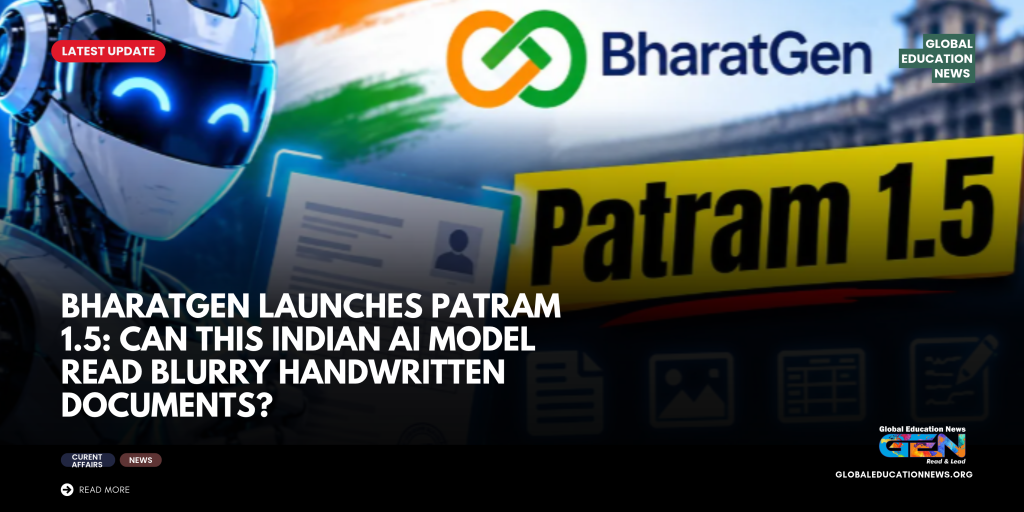
New Delhi, Education News: India’s artificial intelligence sector has taken another step forward with the launch of Patram 1.5, a document-focused AI model developed by BharatGen. Designed to understand complex documents, the model can interpret handwritten entries, tables, signatures, stamps, charts and scanned pages that conventional text-reading systems may struggle to process.
The new model is designed for organisations that handle large volumes of paperwork, including banks, hospitals, insurance companies and government departments. It can also be useful for researchers, developers and students exploring document intelligence and artificial intelligence applications.
Unlike traditional systems that primarily convert images into text, Patram 1.5 analyses a document as an image and uses its visual structure to understand the information.
What Is BharatGen’s Patram 1.5 AI Model?
Patram 1.5 is a vision-language model (VLM) developed by BharatGen. It combines visual understanding with language-based reasoning to interpret information contained in documents.
The model belongs to the Patram family of document AI systems. Its predecessor, Patram 1, was launched in June 2025.
The latest version is an approximately seven-billion-parameter open-weight model. BharatGen’s technical comparison lists its model at around 7.8 billion parameters.
Its purpose is to help users understand not only the words on a page but also how information is organised. For example, it can examine a table, identify which figures belong to particular rows and columns, and respond to questions about the document.
What Can Patram 1.5 Do? Key Features Explained
Patram 1.5 introduces several capabilities aimed at improving document processing.
| Feature | What it means |
|---|---|
| Handwriting recognition | Helps interpret handwritten entries in documents |
| Table understanding | Recognises the relationship between rows, columns and figures |
| Signature and stamp interpretation | Examines visual elements beyond printed text |
| Multilingual document support | Supports English and English mixed with Indian languages |
| Natural-language extraction | Allows users to ask for specific information |
| Structured output | Can return information in formats such as JSON, HTML and Markdown |
| Uncertainty detection | Flags missing, unclear or ambiguous information |
| Multiple-image processing | Can process multiple images in a single request |
1. Can It Read Handwritten and Blurry Documents?
One of the main objectives of Patram 1.5 is to handle documents that are difficult to process through conventional text extraction.
Many organisations still depend on scanned forms, handwritten applications, stamped records and older paper documents. These may contain faded text, unclear figures or complicated layouts.
Patram 1.5 is designed to interpret these elements while considering their position and relationship with other information on the page.
2. How Is It Different From Traditional OCR?
Optical Character Recognition (OCR) technology converts text in images into machine-readable words. However, extracting the words does not always preserve the complete meaning of a document.
For example, when a financial statement contains several rows of figures, a conventional text extraction system may struggle to retain which number belongs to which entry.
Patram 1.5 takes a different approach by analysing the document visually.
BharatGen describes one of its major additions as OCR 3.0. Users can ask the model to extract particular information instead of requesting the entire document’s text.
For example, a user processing an account statement could request only the relevant dates, customer identification details or branch information in a predefined JSON format.
3. Can Patram 1.5 Identify Missing Information?
Another important feature is its ability to flag information that it cannot confidently interpret.
If a field is blank, a figure is unreadable or a question has more than one possible answer, the model is designed to communicate the uncertainty rather than automatically provide a confident response.
This capability is known as abstention.
It is particularly relevant in areas such as healthcare and banking, where an incorrect figure or misinterpreted record could lead to serious administrative or operational problems.
However, this feature does not guarantee that the model will never make mistakes. Human verification remains important, especially when documents are used for important decisions.
How Did BharatGen Test Patram 1.5?
BharatGen evaluated the model through 49 tests, including 34 public benchmarks and 15 tasks from its own PatramBench dataset.
The company’s benchmark dataset contains 11,828 test items drawn from 8,773 pages of Indian documents.
According to the company’s published evaluation, Patram 1.5 achieved an overall score of 83. It was compared with 20 other vision-language models, including substantially larger models, as well as specialist OCR systems.
| Evaluation detail | Reported figure |
|---|---|
| Overall evaluation tests | 49 |
| Public benchmarks | 34 |
| PatramBench tasks | 15 |
| PatramBench test items | 11,828 |
| Document pages in PatramBench | 8,773 |
| Overall score reported by BharatGen | 83 |
These results are based on BharatGen’s own evaluation. They provide an indication of the model’s reported capabilities, but independent testing and performance on real-world documents will be important for assessing its practical reliability.
Where Can Patram 1.5 Be Used?
The model is designed for document-heavy industries and organisations.
- Banking and financial services: Processing account statements, customer forms and KYC-related paperwork.
- Healthcare: Understanding scanned reports and other administrative documents, subject to appropriate human checks.
- Government departments: Supporting the processing and classification of applications and official records.
- Insurance: Extracting information from policy documents, claims and supporting paperwork.
- Legal services: Helping organise and interpret document-based information.
Its open-weight availability also creates opportunities for developers and research teams to explore document AI applications.
Is BharatGen’s Patram 1.5 Available to Users?
Yes. BharatGen has made Patram 1.5 available as open weights under the Apache 2.0 licence. Users can explore the model through its public model release and the BharatGen Playground.
The Playground allows users to upload documents or images, ask questions and extract information using natural-language instructions.
It also offers ready-to-use document solutions, including:
- Document parsing
- Information extraction
- Document classification
- Document splitting
- Section identification
The company has also outlined additional capabilities, including digitisation, translation and editing, for future development.
What Does Patram 1.5 Mean for India’s AI Development?
The launch reflects India’s growing interest in developing AI models and tools that address local technological requirements.
A significant challenge for organisations in India is the variety of documents they handle. Records may combine printed and handwritten information, multiple languages, stamps, signatures and different formats.
A document AI system designed to understand these features could help reduce repetitive administrative work and make information easier to organise.
For students and researchers, the release also offers an opportunity to explore how vision-language models, OCR, natural-language processing and document automation work together.
However, its real-world impact will depend on accuracy, implementation costs, data security and how effectively organisations combine automated processing with human review.
Patram 1.5: Important Details at a Glance
| Particular | Details |
|---|---|
| Model name | Patram 1.5 |
| Developer | BharatGen |
| Model category | Vision-language model |
| Model size | Approximately 7 billion parameters |
| Main purpose | Document understanding and information extraction |
| Key technology | OCR 3.0 and visual document reasoning |
| Language support | English and English mixed with Indian languages |
| Context window | Up to 32,000 tokens |
| Availability | Open weights and BharatGen Playground |
| Licence | Apache 2.0 |
Frequently Asked Questions (FAQs)
1. What is Patram 1.5?
Patram 1.5 is an AI model developed by BharatGen to read, understand and extract information from complex documents, including scanned pages, handwritten entries, tables and forms.
2. Who developed Patram 1.5?
BharatGen developed Patram 1.5 as part of its document intelligence model family.
3. What is OCR 3.0 in Patram 1.5?
OCR 3.0 is BharatGen’s term for a more flexible document extraction approach. Users can request specific information in natural language and define how the extracted information should be presented.
4. Can Patram 1.5 understand Indian-language documents?
The model supports English and English mixed with Indian languages. This should not be interpreted as a guarantee of equal performance across every Indian language or document type.
5. Is Patram 1.5 free to use?
BharatGen has released its model weights under the Apache 2.0 licence and provides access through its Playground. Infrastructure, deployment and implementation costs may still apply depending on how an organisation uses the model.
6. Where can users try Patram 1.5?
Users can explore the model through the BharatGen Playground and its public model release.
7. Does Patram 1.5 guarantee error-free document reading?
No. Although it is designed to flag unclear or missing information, AI models can still make mistakes. Important information should be checked by a human reviewer.
Conclusion
BharatGen’s Patram 1.5 brings together document reading, visual understanding and information extraction in an open-weight AI model developed in India. Its ability to interpret complex layouts and flag uncertain information could make it useful for organisations dealing with large volumes of paperwork.
The next important test will be how well it performs on real documents across different sectors. For India’s AI ecosystem, the launch adds another development worth watching as homegrown models expand beyond general-purpose chatbots into specialised applications.
Stay updated with Global Education News for the latest developments in artificial intelligence, education technology, research and India’s digital innovation landscape.