Date: November 26, 2026
Place: New Delhi
Education News: Internationalisation of Indian Education, CBSE Schools Abroad, Foreign Universities in India
New Delhi, Education News: India’s education system is expanding its international presence, with 268 CBSE-affiliated schools now operating across 26 countries and around 21 foreign higher education institutions functioning in India. The latest figures shared by the Union Education Ministry highlight a growing international connection between Indian schools, universities and global academic institutions.
The development reflects India’s wider ambition to strengthen its position as an international education destination while also taking Indian higher education institutions and academic programmes beyond national borders.
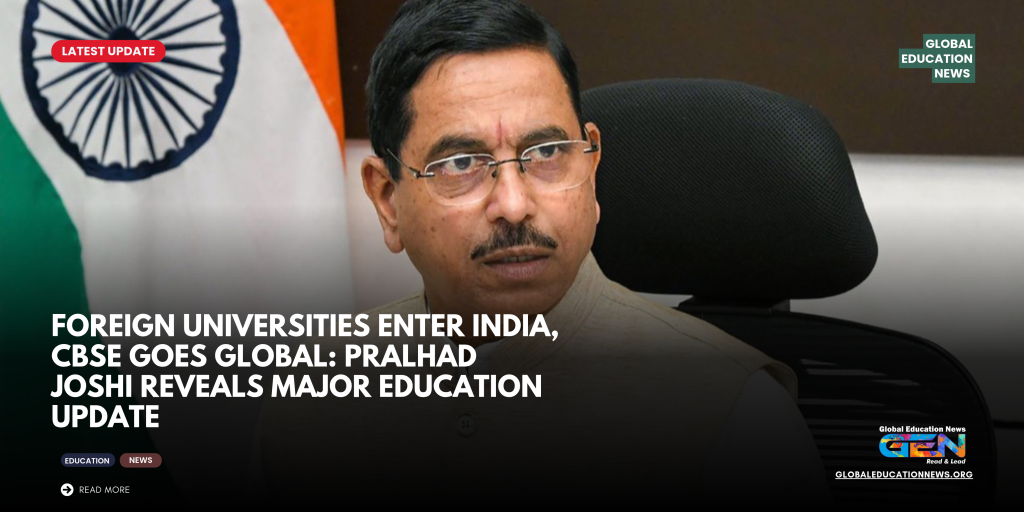
Union Education Minister Pralhad Joshi shared these details during the first meeting of the Parliamentary Consultative Committee for the Ministry of Education in 2026. The discussion focused on the internationalisation of Indian education, including foreign university campuses, international research partnerships and opportunities for students.
How Many CBSE Schools Are Operating Outside India?
According to the Education Ministry, 268 CBSE-affiliated schools are currently functional across 26 countries.
The growing international presence of CBSE schools reflects demand for Indian education programmes among Indian communities living overseas and families seeking an Indian school curriculum outside the country.
An overseas regional office has also been established in Dubai to support the international network.
The Ministry stated that a standardised assessment framework has been implemented across affiliated schools globally to maintain uniformity in academic assessment.
Key figures: India’s international education network
| Education indicator | Latest reported figure |
|---|---|
| CBSE schools outside India | 268 |
| Countries with CBSE schools | 26 |
| Foreign higher education institutions operating in India | Around 21 |
| Foreign universities issued Letters of Intent | 17 |
| Overseas CBSE regional office | Dubai |
These figures demonstrate that internationalisation is taking place at both school and university levels.
21 Foreign Higher Education Institutions Are Operating in India
One of the most important developments is the presence of around 21 foreign higher education institutions in India.
These institutions are operating alongside international academic and research collaborations. Their presence is expected to contribute to greater academic interaction, research opportunities and exposure to different education systems.
The government is also facilitating the establishment of foreign university campuses in India under the applicable regulatory framework.
However, the number of operational institutions should not be confused with the number of universities that have received permission to establish future campuses.
17 Foreign Universities Receive Letters of Intent Under UGC Regulations
The Ministry also informed the parliamentary committee that 17 Letters of Intent (LoIs) had been issued to foreign universities under the University Grants Commission’s regulations.
The universities include institutions from countries such as:
- United Kingdom
- United States
- Australia
- Italy
A Letter of Intent is an important step in the regulatory process. It should not automatically be interpreted as confirmation that a university campus has already started admitting students.
The development indicates growing international interest in establishing a presence in India’s higher education sector.
Why Is India Encouraging Foreign Universities to Open Campuses?
The internationalisation of higher education is an important part of India’s National Education Policy (NEP) 2020 and its wider Viksit Bharat 2047 vision.
The government is working towards a system in which Indian students can access more international academic opportunities without necessarily having to travel abroad.
Foreign university campuses in India could create additional choices for students, introduce international academic practices and encourage research partnerships.
The strategy also aims to attract international students to Indian institutions and strengthen India’s position in global education.
Four major strategies for internationalising Indian higher education
| Strategy | What it means |
|---|---|
| Academic and research collaborations | Partnerships between Indian and international universities |
| Attracting international students | Encouraging students from other countries to study in India |
| Foreign university campuses in India | Allowing eligible international institutions to establish campuses |
| Indian university campuses abroad | Supporting Indian higher education institutions in expanding internationally |
Together, these strategies aim to connect India’s education system more closely with global academic networks.
What Does Internationalisation Mean for Indian Students?
The expansion of foreign universities and international academic partnerships could create new opportunities for students.
Some potential benefits include:
1. More international study choices: Students may gain access to programmes offered by foreign universities through their Indian campuses.
2. Greater academic exposure: International teaching methods, research activities and academic collaborations could broaden students’ learning experiences.
3. Research opportunities: Partnerships between Indian and overseas institutions may support joint research projects and academic exchange.
4. Reduced need to travel abroad for certain programmes: Students may have access to selected international university programmes within India, depending on campus offerings and eligibility.
5. Stronger global academic connections: International collaborations could help students and researchers connect with institutions and academic communities in other countries.
However, the actual benefits will depend on the universities involved, the courses offered, admission requirements, tuition fees and regulatory approvals.
What Is the Role of NEP 2020 in India’s Global Education Expansion?
The National Education Policy 2020 provides an important foundation for the internationalisation of Indian education.
The policy encourages multidisciplinary learning, research, international collaboration and greater flexibility in higher education.
The Ministry highlighted several initiatives supporting these objectives, including:
- Bharat Innovates: An initiative supporting innovation and international engagement.
- SPARC: The Scheme for Promotion of Academic and Research Collaboration, which encourages research partnerships.
- GIAN: The Global Initiative of Academic Networks, which supports international academic engagement.
- DASA: Direct Admission of Students Abroad, a route for eligible international and specified Indian-origin applicants to access participating Indian institutions.
- Study in India: A programme designed to attract international students to Indian higher education institutions.
The revamped Study in India portal was also discussed as part of the government’s efforts to strengthen India’s international education presence.
How Will India’s Education System Benefit From Global Collaboration?
Internationalisation is not limited to opening university campuses. It also involves improving academic standards, strengthening research and encouraging knowledge exchange.
The Ministry highlighted several areas supporting this transformation, including globally aligned curricula, multilingual education, student and teacher exchange programmes, and the work of PARAKH National Assessment Centre.
These initiatives aim to improve academic quality, assessment standards and educational equivalence.
The expansion of Indian education abroad could also increase the international visibility of Indian academic programmes and encourage institutions to develop stronger global partnerships.
Frequently Asked Questions (FAQs)
1. How many CBSE schools are operating outside India?
According to the Education Ministry, 268 CBSE-affiliated schools are operating across 26 countries.
2. How many foreign universities are currently operating in India?
Around 21 foreign higher education institutions are currently operational in India, according to the latest figures shared by the Ministry.
3. How many foreign universities have received Letters of Intent in India?
The Ministry reported that 17 foreign universities have received Letters of Intent under UGC regulations to establish campuses in India.
4. Which countries are represented among the foreign universities?
The universities issued Letters of Intent include institutions from the United Kingdom, United States, Australia and Italy.
5. Why is India allowing foreign universities to establish campuses?
The initiative aims to expand higher education choices, encourage international research collaborations, attract international students and strengthen India’s position as a global education destination.
6. What is the role of NEP 2020 in internationalising education?
NEP 2020 encourages international academic collaboration, multidisciplinary education, research partnerships, student exchange and the global development of Indian higher education institutions.
7. What is the Study in India initiative?
Study in India is a government initiative designed to attract international students to Indian universities and higher education institutions.
Conclusion: India’s Education System Is Building a Global Presence
The expansion of CBSE schools across 26 countries and the growing presence of foreign higher education institutions in India indicate a significant shift in the country’s education strategy.
With 268 international CBSE schools, around 21 foreign higher education institutions operating in India and 17 foreign universities receiving Letters of Intent, internationalisation is becoming an increasingly important part of India’s education agenda.
The next major challenge will be to translate these developments into accessible, affordable and high-quality academic opportunities for students.
Global Education News will continue to track developments in foreign university campuses, international education partnerships and opportunities emerging for Indian students.