Date: November 23, 2026
Place: Lucknow, Uttar Pradesh
Education News: Skill Development and Vocational Education
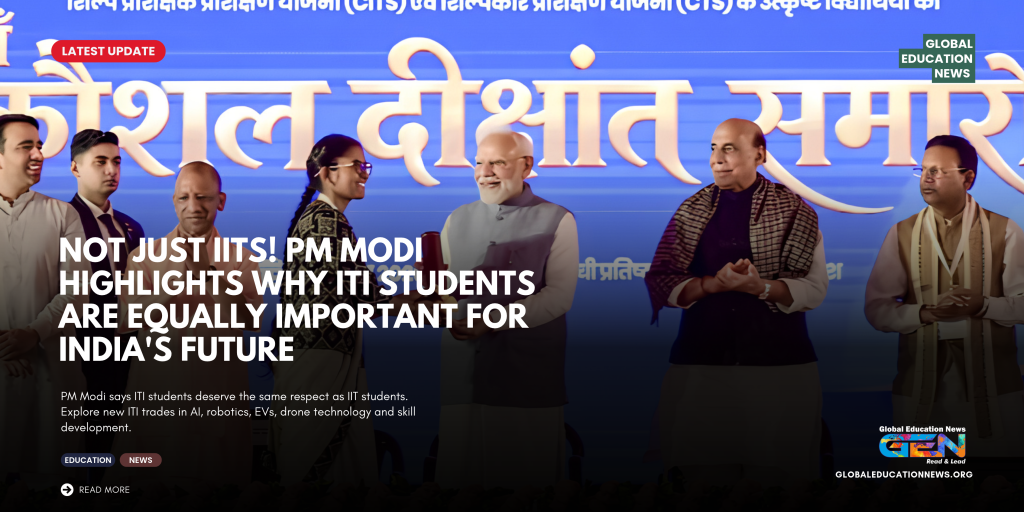
Lucknow, Education News: Prime Minister Narendra Modi has called for a major change in how Indian society views vocational education, saying that students trained at Industrial Training Institutes (ITIs) deserve the same respect as those studying at Indian Institutes of Technology (IITs). His message has brought renewed attention to skill-based education, technical training and career opportunities beyond traditional university degrees.
Speaking at the 5th Kaushal Deekshant Samaroh in Lucknow on November 21, PM Modi urged families to stop treating ITI education as a less prestigious option. He highlighted the importance of skilled technicians in industries and said that practical training plays a major role in keeping companies and manufacturing operations running.
The Prime Minister also pointed to the growing importance of modern vocational skills as India expands its manufacturing and technology sectors.
Why Did PM Modi Say ITI Students Deserve the Same Respect as IIT Students?
PM Modi said that society often gives greater recognition to conventional university degrees while overlooking students who choose practical and technical training.
He observed that some families hesitate to tell others that their children are studying at an ITI because vocational education is sometimes viewed as less prestigious than traditional college education.
The Prime Minister called for this attitude to change. According to him, ITI-trained professionals are essential to industries because they bring practical knowledge and technical abilities that help businesses function every day.
His message was clear: a student’s value should not be judged only by the name of the institution or the type of qualification they pursue. Technical skills, craftsmanship and practical knowledge also deserve recognition.
Why Are ITI-Trained Workers Important for India’s Industries?
Industrial Training Institutes prepare students for technical occupations that require practical knowledge, equipment handling and specialised training.
Companies need skilled workers to install, operate, maintain and repair machinery, electrical systems, vehicles and industrial equipment.
While engineers and managers may handle planning and design, trained technicians often perform essential operational work. This makes vocational education an important part of India’s industrial workforce.
Some sectors where ITI-trained professionals can find career opportunities include:
- Manufacturing and industrial production
- Automobile and electric vehicle services
- Electrical and electronics maintenance
- Construction and infrastructure
- Robotics and industrial automation
- Information technology support
- Aviation-related technical services
- Renewable energy and green technology
The Prime Minister’s remarks underline why vocational training should be viewed as a valuable career pathway rather than a second choice.
ITI Education in India: What Changes Did PM Modi Highlight?
During his address, PM Modi highlighted the expansion of India’s ITI network and the introduction of training programmes designed around changing industry requirements.
He stated that nearly 5,000 new ITIs had been established over the preceding decade. He also said that the number of students enrolled in ITIs had increased by more than five lakh, while the number of girls studying in these institutions had grown to more than two-and-a-half times its earlier level.
The government has also focused on improving training infrastructure, faculty quality and the relevance of vocational courses.
| Key development | Details highlighted by PM Modi |
|---|---|
| New ITIs | Nearly 5,000 established over a decade |
| Student enrolment | Increased by more than 5 lakh |
| Girls’ participation | Increased to more than 2.5 times |
| New-age trades | More than 30 introduced |
| Training focus | Modern technology and industry requirements |
These figures were highlighted in the Prime Minister’s address and reflect the government’s stated emphasis on expanding skill-based education.
AI, Robotics and Drone Technology: New Skills Enter ITI Training
One of the important aspects of the address was the introduction of newer technical trades in ITIs.
As industries adopt automation, artificial intelligence and advanced manufacturing technologies, vocational institutions are expected to prepare students for changing workplace requirements.
PM Modi highlighted several new-age trades introduced in ITI training, including:
| New-age trade | Potential area of application |
|---|---|
| Artificial Intelligence Assistant | AI-supported technical operations |
| Cyber Security Assistant | Digital security and technical support |
| Drone Technician | Drone maintenance and technical services |
| Industrial Robotics | Automated manufacturing systems |
| Electric Vehicle Technician | EV servicing and maintenance |
| Green Hydrogen Technician | Emerging clean-energy technologies |
| Semiconductor Technician | Electronics and chip manufacturing |
| Aeronautical Structure | Aircraft structure-related technical work |
| Animation and Special Effects | Digital media and creative technology |
These courses indicate how vocational education is gradually expanding beyond traditional trades to include technology-oriented skills.
For students, the development highlights the importance of exploring technical courses that match their interests and the changing needs of industries.
Can ITI Courses Offer Career Opportunities in the Age of AI?
Artificial intelligence is changing the nature of work across several industries. However, many occupations continue to require practical abilities, technical maintenance, equipment handling and on-site problem-solving.
During the event, PM Modi emphasised that skilled workers remain important even as AI adoption increases. He referred to the contribution of technical workers during the COVID-19 pandemic, when essential services and operations depended on people with practical skills.
ITI training can prepare students for roles involving machinery, electrical systems, manufacturing, vehicle technology and industrial automation.
However, career opportunities depend on the quality of training, relevant certifications, practical experience and the requirements of individual employers. Students should consider both the course curriculum and industry demand before choosing a trade.
Why Does Vocational Education Need Greater Social Recognition?
India has traditionally placed considerable importance on academic degrees as a measure of educational achievement. This has sometimes resulted in vocational courses receiving less attention from families and students.
The Prime Minister’s remarks highlight the need to recognise different forms of education and career preparation.
Vocational education can help students develop job-specific abilities, gain practical experience and enter technical occupations. It can also support entrepreneurship and local businesses by creating a trained workforce.
Greater social recognition could encourage more young people to consider ITIs based on their interests and career goals rather than choosing courses only because of social expectations.
What Is the Government’s Skill Development Message for Young People?
At the Kaushal Deekshant Samaroh, PM Modi encouraged young people to dream big, improve their skills and contribute to the country’s development.
He also highlighted the importance of the National Education Policy in giving greater attention to skill development and practical learning.
The broader message is that India’s future workforce will need a combination of academic knowledge, technical expertise, creativity and adaptability.
As manufacturing, digital technology and emerging industries expand, vocational training could become an important route for preparing young people for employment and entrepreneurship.
Frequently Asked Questions (FAQs)
1. What did PM Modi say about ITI students and IIT students?
PM Modi said ITI students deserve the same level of respect as IIT students. He urged society to recognise the importance of practical skills and vocational education.
2. Where did PM Modi make the statement about ITI students?
He made the remarks at the 5th Kaushal Deekshant Samaroh held in Lucknow, Uttar Pradesh, on November 21, 2026.
3. What is the main purpose of ITI education?
Industrial Training Institutes provide practical and technical training to prepare students for skilled occupations in sectors such as manufacturing, electrical work, automobiles, construction and technology.
4. Which new-age courses are being introduced in ITIs?
The trades highlighted by the Prime Minister include AI Assistant, Cyber Security Assistant, Drone Technician, Industrial Robotics, Electric Vehicle Technician, Green Hydrogen Technician and Semiconductor Technician.
5. How many new ITIs have been established in the last decade?
PM Modi stated that nearly 5,000 new ITIs had been established over the preceding decade.
6. Has girls’ participation in ITI education increased?
Yes. During his address, the Prime Minister said the number of girls studying in ITIs had increased to more than two-and-a-half times its earlier level.
7. Can students build a career through vocational education?
Yes. ITI qualifications can prepare students for technical occupations in manufacturing, electrical services, automobiles, electronics, construction and other industries. Career opportunities depend on the trade, training and employer requirements.
Conclusion: Skills Must Become a Source of Pride
PM Modi’s message at the Kaushal Deekshant Samaroh has renewed the discussion around the importance of vocational education in India. His appeal to give ITI students the same respect as IIT students highlights a wider need to recognise technical knowledge and practical abilities.
As India invests in manufacturing, automation, artificial intelligence and emerging technologies, skilled professionals will remain an important part of the workforce. The challenge now is to ensure that vocational qualifications receive stronger social recognition and that students have access to relevant, quality training.
For students and parents, the message is worth considering: a successful career can begin through different educational pathways, and practical skills deserve recognition alongside academic achievements.
Stay connected with Global Education News for the latest updates on skill development, vocational education, ITI admissions, career opportunities and education policy.