Date: November 17, 2026
Place: New Delhi, India
Education News: UPSC | Government Exams | AI in Education | Recruitment Reforms
New Delhi, Education news: Preparing for a government examination could soon involve more technology-driven identity checks and digital verification. The Union Public Service Commission (UPSC) is encouraging State Public Service Commissions (State PSCs) to strengthen examination security through artificial intelligence (AI), digital records and improved recruitment procedures. At a national workshop held on November 16, 2026, UPSC Chairman Ajay Kumar highlighted measures such as AI-enabled facial authentication, Universal Registration Numbers and computerised random allocation of interview boards. The discussions also focused on sharing best practices among state recruitment bodies to improve fairness, transparency and examination security. Press Information Bureau+1
Why Is UPSC Pushing State PSCs Towards AI and Digital Reforms?
Government recruitment examinations involve large numbers of candidates, examination centres and administrative processes. Maintaining the identity of applicants, checking eligibility and ensuring fair selection can be challenging when recruitment takes place on a large scale.
UPSC’s November 16 workshop brought together secretaries and senior officials from State Public Service Commissions to discuss these challenges.
The main objective was to encourage commissions to share successful practices and improve recruitment administration across states.
UPSC Chairman Ajay Kumar stressed that technology must be used to protect the integrity of examinations and prevent people from misusing technology to bypass safeguards. Press Information Bureau
5 Major UPSC Digital Reforms Government Job Aspirants Should Know About
1. AI-Based Facial Authentication at Examination Centres
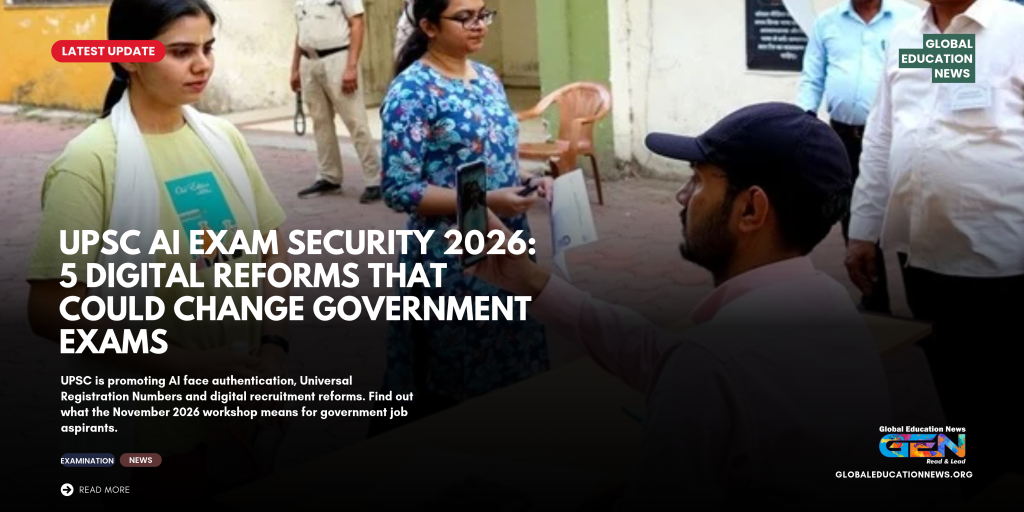
One of the important measures highlighted by UPSC is AI-enabled facial authentication.
The system helps verify whether the person appearing at an examination centre matches the candidate’s registered identity.
This technology is intended to strengthen identity verification and reduce the risk of impersonation.
What it means for candidates: Accurate photographs and registration details become especially important during the application process.
2. Universal Registration Number for Applicants
UPSC has introduced a Universal Registration Number (URN) for applicants.
The purpose is to give candidates a consistent registration identity and make application-related processes more systematic.
It can also help reduce repeated paperwork and improve the management of applicant information.
What it means for candidates: A more organised registration process and easier management of application records.
3. Computerised Random Allocation of Interview Boards
UPSC has introduced computerised randomisation of interview boards.
This means technology is used to allocate interview boards through a computerised process rather than relying entirely on manual allocation.
The objective is to strengthen transparency and reduce the scope for manual interference in the allocation process.
What it means for candidates: A more systematic approach to interview-board allocation.
4. Digitisation of Departmental Promotion Committee Proposals
UPSC is also moving Departmental Promotion Committee (DPC) proposals towards digital processing.
These proposals are connected with promotion-related administrative decisions in government departments.
Digitisation can help make records easier to manage and administrative procedures more efficient.
What it means: The reforms are not limited to entrance examinations; they also cover internal government recruitment and promotion processes.
5. Sharing Digital Best Practices Among State PSCs
The workshop encouraged State Public Service Commissions to share their successful methods in areas such as:
- Digital application processing.
- Conducting examinations in regional languages.
- Candidate grievance redressal.
- Recruitment administration.
- Secure examination management.
The idea is to create a shared collection of useful practices that commissions can learn from and adapt to their own requirements. Press Information Bureau+1
What Happened at the UPSC Workshop on November 16, 2026?
The one-day workshop took place at Dholpur House in New Delhi and brought together secretaries, joint secretaries and senior officials from State Public Service Commissions.
The discussions were organised around four major areas:
| Discussion area | Main focus |
|---|---|
| Examinations | Secure and reliable examination procedures |
| Recruitment | Transparent selection processes |
| Recruitment rules | Updating rules to match modern job requirements |
| Disciplinary and appeal cases | Fair administrative decisions and procedures |
UPSC also encouraged state commissions to contribute their successful practices to a shared repository. The workshop followed a decision taken at the 25th National Conference of Chairpersons of State Public Service Commissions in Bengaluru in January 2025. Press Information Bureau
Will All State PSC Exams Now Use AI?
Not immediately.
The workshop was designed to encourage coordination and exchange of ideas. It does not mean that every State Public Service Commission has already adopted UPSC’s technology or that all state examinations will follow identical procedures.
Each commission will need to consider its own examination requirements, technology infrastructure and administrative rules before implementing changes.
For candidates, the important point is to follow the official instructions issued by the particular commission conducting their examination.
How Could AI and Digital Checks Change Government Exams?
The proposed direction could influence several parts of the recruitment process.
| Recruitment stage | Possible role of technology |
|---|---|
| Application | Better digital management of candidate records |
| Identity verification | AI-enabled facial authentication |
| Eligibility checks | More systematic verification of applicant information |
| Interview allocation | Computerised randomisation of interview boards |
| Administration | Digital processing of official records |
| Candidate support | Improved digital grievance-management practices |
These measures are intended to strengthen examination administration. However, technology alone cannot guarantee fairness. Accuracy, transparency, data protection and proper human oversight will also matter.
What Should UPSC and State PSC Aspirants Know?
The digital reforms are relevant to candidates preparing for civil services and other government recruitment examinations.
Students and job aspirants should keep these points in mind:
- Enter accurate personal and educational details in application forms.
- Ensure that registration photographs and identity information are correct.
- Follow the examination authority’s identity-verification instructions.
- Check official notifications for changes in application procedures.
- Keep registration and application records organised.
- Use official channels to resolve examination-related queries.
Important: These reforms do not announce a new UPSC examination, change the syllabus or alter the eligibility criteria for government jobs. Candidates should continue preparing according to the existing official notifications unless a specific change is announced.
Can AI Make Government Recruitment More Transparent?
AI can help automate certain verification tasks and make administrative processes more systematic. Computerised allocation can also reduce dependence on manual procedures in selected areas.
But there are important questions that recruitment authorities will need to address:
- How will candidate information and facial data be protected?
- What happens if an identity-verification system makes an error?
- Will candidates have a clear process to report technical problems?
- How will commissions ensure that technology is accessible to candidates across different regions?
- What human review will be available when automated checks produce incorrect results?
The success of digital recruitment reforms will depend not only on adopting new technology but also on building trust in how it is used.
Frequently Asked Questions (FAQs)
1. What new technology is UPSC promoting for government examinations?
UPSC has highlighted AI-enabled facial authentication, Universal Registration Numbers, digitised administrative records and computerised randomisation of interview boards.
2. When did UPSC hold its workshop with State PSCs?
The one-day workshop was held on November 16, 2026, at Dholpur House in New Delhi.
3. What is AI-based facial authentication in government exams?
It is a technology-assisted identity-verification process that helps check whether the candidate appearing at an examination centre matches their registered identity.
4. What is the Universal Registration Number (URN)?
URN is a registration identity introduced by UPSC to make applicant registration and record management more systematic.
5. Will State PSCs immediately introduce AI-based verification?
No. The workshop encouraged State PSCs to share and adopt useful practices. It did not announce compulsory or immediate implementation by every state commission.
6. Will these reforms change UPSC eligibility criteria or examination patterns?
The workshop announcement did not introduce changes to examination eligibility, syllabus or selection criteria.
7. Why is UPSC encouraging digital recruitment reforms?
The objective is to strengthen examination security, improve transparency, modernise administrative procedures and protect the integrity of government recruitment.
Conclusion: Is AI Becoming the Next Big Part of Government Recruitment?
UPSC’s latest initiative signals a growing role for technology in India’s government recruitment system. From AI-enabled identity verification to computerised interview-board allocation, digital tools are being used to strengthen different stages of the selection process.
The next important step will be how State Public Service Commissions adapt these practices while maintaining transparency, candidate privacy and equal access.
For government job aspirants, one message is clear: examination preparation remains important, but understanding official digital application and verification procedures is becoming increasingly relevant.
Global Education News will continue tracking UPSC reforms, State PSC updates, government recruitment changes and the growing role of AI in public examinations.