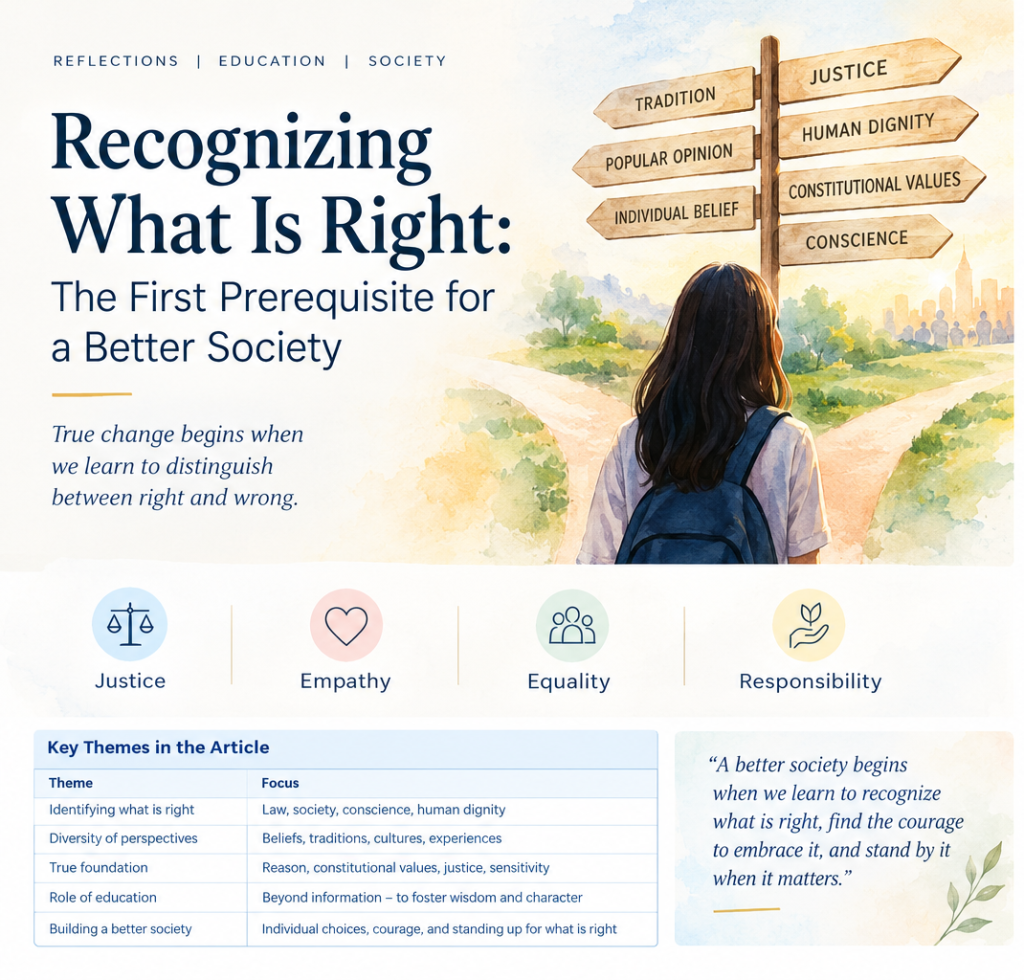
We often say that one should stand up for what is right. But have we ever paused to consider how one identifies what is right? Is “right” simply what I deem to be so? What society considers right? What the law validates? Or is it that which stands the test of human dignity, justice, and conscience?
For me, this question is not a matter of a definitive answer, but rather a subject of continuous reflection. If we envision a society where values such as justice, empathy, equality, and responsibility transcend the pages of books to become an integral part of life, that journey must begin with the ability to distinguish between right and wrong.
This task is not as simple as it appears. Society itself is not monolithic; it is composed of diverse ideas, beliefs, traditions, and cultures. Each group constructs its own definitions of right and wrong based on its experiences and convictions. In this context, the question naturally arises: what should be the basis for determining what is right?
I believe that what is right cannot be determined solely by social acceptance or individual belief. History bears witness to the fact that many beliefs once deemed correct by society were eventually proven to be unjust. Therefore, the yardstick for determining what is right should not merely be tradition, but rather reason, constitutional values, the law, justice, sensitivity, and human dignity.
As a teacher and a student of sociology, I believe that if we wish to cultivate the ability to make sound decisions in the coming generation, mere preaching will not suffice. A sense of right and wrong does not stem from a single chapter, a speech, or an examination; rather, it evolves through our actions, our decisions, and our daily conduct.
The true purpose of education is not merely to impart information but to foster wisdom. Children learn from what they observe around them. If they see their teachers, parents, and society upholding integrity, honesty, justice, and responsibility, these values will naturally become an integral part of their own character. Therefore, conduct is the most powerful medium of education.
Today, the need is not merely to groom good students, but to cultivate citizens who—even under the pressure of circumstances—can distinguish right from wrong, make decisions based on their conscience, and possess the courage to stand up for what is right. For a society that forgets how to recognize what is right gradually becomes desensitized to injustice.
Perhaps, instead of seeking immediate answers to every question, we should cultivate the habit of asking ourselves a few questions: Is this just? Does this compromise anyone’s dignity? Do I consider this right because everyone else does, or because my own conscience affirms it?
A better society does not begin with grand movements. It begins when an individual learns to recognize what is right, finds the courage to embrace it, and decides to stand by it when the moment arises. This is, perhaps, the fundamental prerequisite upon which the foundation of any healthy, compassionate, and just society rests.
Author’s Profile:

Dr. Sima Iqbal