Date: October 14, 2026
Place: Banda, Uttar Pradesh
Education News: School Education, Science and Student Opportunities
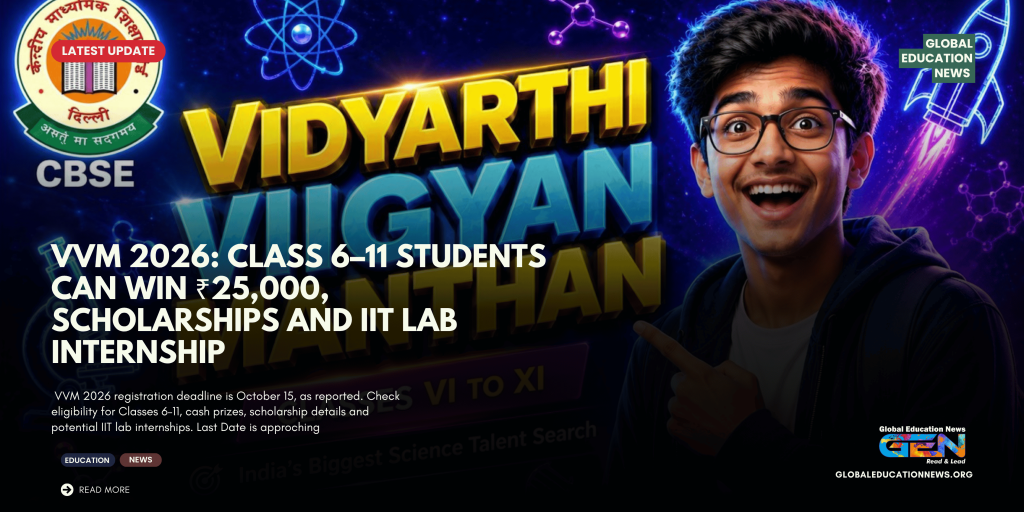
Students from Classes 6 to 11 have an opportunity to showcase their scientific knowledge and compete for cash awards, scholarships and research exposure through the Vidyarthi Vigyan Manthan (VVM) 2026 examination. The national-level science talent search programme aims to develop scientific curiosity, logical thinking and research interests among school students.
According to reports, the registration deadline is October 15, 2026. Students who perform well in the competition may qualify for awards and opportunities to gain practical exposure in laboratories at leading scientific institutions, including the Indian Institutes of Technology (IITs) and CSIR laboratories.
The programme is particularly relevant for students interested in science, technology, artificial intelligence, robotics, space research and future scientific careers. However, cash prizes, scholarships and internships are linked to performance and selection; participation does not guarantee these benefits.
What Is Vidyarthi Vigyan Manthan 2026?
Vidyarthi Vigyan Manthan is a national-level science talent search initiative designed to encourage school students to explore science beyond routine classroom learning.
The programme introduces students to scientific concepts, the contributions of Indian scientists and the importance of research and innovation. It also provides a competitive platform for students to demonstrate their understanding of science and related subjects.
The initiative is organised by Vijnana Bharati (VIBHA), in association with the National Council of Educational Research and Training (NCERT) and the National Council of Science Museums (NCSM), according to the published report.
Unlike an ordinary school examination, VVM aims to identify students with an interest in scientific learning and encourage them to consider future opportunities in research and technology.
Who Can Apply for VVM 2026?
Students studying in Classes 6 to 11 can apply, subject to the programme’s official eligibility conditions.
The opportunity is relevant to students from different school boards, including state boards and national boards. Students in Banda and other parts of India can check the registration portal for the applicable rules.
| Eligibility detail | Information |
|---|---|
| Programme | Vidyarthi Vigyan Manthan 2026 |
| Eligible classes | Classes 6 to 11 |
| Target participants | School students interested in science |
| Registration mode | Online, subject to official instructions |
| Reported last date | October 15, 2026 |
| Official website | https://vvm.org.in/ |
Students and parents should confirm the registration fee, eligibility requirements and application instructions on the official website before submitting a form.
What Are the Rewards? ₹25,000 Cash Prize, Scholarship and Research Exposure
The opportunity to gain research exposure is one of the main attractions of VVM 2026. Students who achieve top positions may receive cash awards, scholarships and opportunities to work on projects in scientific laboratories.
National-level cash prizes
According to the published report, the national-level awards are:
| National rank | Reported cash award |
|---|---|
| First | ₹25,000 |
| Second | ₹15,000 |
| Third | ₹10,000 |
National-level winners may also receive a scholarship of ₹2,000 per month for one year, subject to the programme’s rules.
State and zonal-level awards
Students who achieve top positions at state and zonal levels may also receive cash prizes.
| Position | Reported cash award |
|---|---|
| First | ₹5,000 |
| Second | ₹3,000 |
| Third | ₹2,000 |
The applicable award categories and conditions should be confirmed through the official programme guidelines.
Can VVM Winners Get an Internship in IIT Laboratories?
Yes, selected high-performing students may receive opportunities for research exposure in laboratories at leading scientific institutions.
The reported programme benefits include the possibility of spending two to three weeks working on projects in IIT or CSIR laboratories under the guidance of scientists. The precise institution, duration and activities will depend on the programme’s selection and placement arrangements.
For school students, such exposure can help bridge the gap between textbook science and practical research. It may also help them understand how scientific experiments are designed, how evidence is examined and how researchers approach problems.
However, students should understand that laboratory internships are opportunities for selected winners, not a benefit automatically provided to every applicant.
When Will the VVM 2026 Examination Be Held?
The examination schedule reported for the 2026–27 cycle includes multiple stages.
| Examination stage | Reported schedule |
|---|---|
| District-level online examination | November 16–21, 2026 |
| State-level examination | December 27, 2026–January 17, 2027 |
| National-level examination | February 28, 2027 |
Candidates should verify the dates, examination format and progression rules through the official VVM portal, as the programme may publish additional instructions or updates.
How Can Students Register for VVM 2026?
Students should visit the official website and follow the registration instructions for the relevant academic class.
- Visit https://vvm.org.in/.
- Find the registration section for the 2026–27 examination.
- Read the eligibility criteria and application instructions.
- Enter the required student and school details.
- Complete any applicable fee payment through the authorised process.
- Review the information and save the registration confirmation.
Students should seek help from a parent, guardian or school teacher if they need assistance with registration. They should also avoid sharing passwords, payment details or unnecessary personal information with unofficial websites or individuals.
Important deadline: The reported registration deadline is October 15, 2026. Candidates should check the official portal promptly to confirm the final date and time.
Why Is VVM Important for Students Interested in Science and Technology?
Science education is increasingly connected with emerging fields such as artificial intelligence, robotics, biotechnology, space science and advanced computing. These areas require more than memorising facts: students also need curiosity, logical reasoning, problem-solving skills and the ability to investigate questions systematically.
VVM can encourage students to explore these skills while learning about India’s scientific contributions.
The programme may help participants:
- Develop a stronger interest in science and scientific reasoning.
- Learn about Indian scientists and their contributions.
- Explore possible future pathways in research and technology.
- Gain recognition for their performance in a national-level competition.
- Understand how laboratory research differs from classroom learning.
Participation in a talent search examination does not determine a student’s future career. It can, however, provide an additional learning experience for those who enjoy scientific exploration.
VVM 2026: Key Details at a Glance
| Particular | Details |
|---|---|
| Programme name | Vidyarthi Vigyan Manthan |
| Academic cycle | 2026–27 |
| Eligible classes | 6 to 11 |
| Registration deadline | October 15, 2026, as reported |
| National first prize | ₹25,000, as reported |
| National second prize | ₹15,000, as reported |
| National third prize | ₹10,000, as reported |
| Reported scholarship | ₹2,000 per month for one year for eligible national winners |
| Research opportunity | Potential internship exposure at IIT or CSIR laboratories for selected winners |
| Official website | https://vvm.org.in/ |
Frequently Asked Questions (FAQs)
1. What is VVM 2026?
Vidyarthi Vigyan Manthan 2026 is a national-level science talent search programme intended to encourage scientific knowledge, reasoning and research interest among school students.
2. Which students can apply for Vidyarthi Vigyan Manthan?
Students studying in Classes 6 to 11 can apply, subject to the eligibility conditions published by the programme.
3. What is the last date to register for VVM 2026?
The reported registration deadline is October 15, 2026. Students should confirm the final deadline on the official VVM website.
4. Can students win ₹25,000 through VVM?
The published report lists ₹25,000 as the national-level first prize. The award is for eligible top performers and is not guaranteed to every participant.
5. Does VVM offer scholarships?
The report states that eligible national-level winners may receive a scholarship of ₹2,000 per month for one year, subject to the programme’s rules.
6. Can VVM winners visit or intern at IIT laboratories?
Selected winners may receive opportunities for research exposure in IIT or CSIR laboratories. The actual placement and duration depend on the programme’s arrangements and selection criteria.
7. Where can students register for VVM 2026?
Students can visit the official website at https://vvm.org.in/ to check the application process, eligibility rules and latest announcements.
8. Why should school students consider taking part?
The programme can help students explore scientific reasoning, learn about Indian scientists and develop an interest in research and technology. It may be particularly useful for students who enjoy science beyond their regular school syllabus.
Conclusion: A Science Opportunity for School Students
Vidyarthi Vigyan Manthan 2026 offers students in Classes 6–11 a platform to test their scientific knowledge and potentially earn national recognition, cash awards, scholarships and research exposure.
With the reported registration deadline falling on October 15, students interested in participating should verify the official instructions and complete the application process within the permitted period. They should also understand that prizes and laboratory opportunities depend on performance and selection.
For young learners, the larger value of such initiatives lies in encouraging curiosity, evidence-based thinking and an interest in discovering how the world works.
Global Education News will continue to cover student competitions, science programmes, scholarships and opportunities that help young people explore future academic and research pathways.